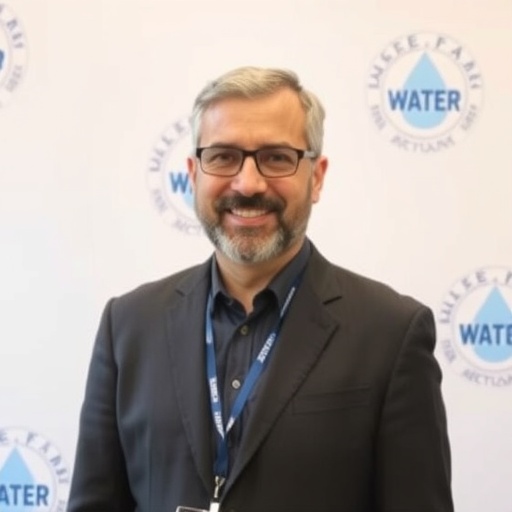
UNESCO Headquarters, Paris – March 18, 2026 – Professor Kaveh Madani, Director of the United Nations University Institute for Water, Environment and Health (UNU-INWEH), has been honored as the 2026 Stockholm Water Prize Laureate, an accolade often hailed as the “Nobel Prize of Water.” The award announcement was made at UNESCO Headquarters during the World Water Day ceremony, with the formal presentation scheduled to be conducted by His Majesty King Carl XVI Gustaf of Sweden during World Water Week in Stockholm this August. This momentous recognition underscores Professor Madani’s extraordinary contributions to sustainable water resource management and global water governance under exceptionally complex and challenging circumstances.
The Stockholm Water Prize is renowned globally as the most prestigious recognition in the water sector, celebrating visionary leadership and scientific breakthroughs that significantly advance the sustainable use and protection of the world’s dwindling water resources. What makes Professor Madani’s receipt of this prize particularly historic is that, at age 44, he is the youngest laureate in the Prize’s history. Moreover, he is distinguished as the first UN official and the first former politician to receive this honor, showcasing the unique breadth and impact of his work in bridging science, policy, and diplomacy in water management.
Professor Madani’s work is revolutionary in water resources management, primarily through his integration of game theory and decision analysis into conventional water modeling approaches. His pioneering research challenges the prevailing assumption of perfect cooperation among stakeholders sharing water resources. By incorporating realistic representations of competing interests, institutional constraints, and incentives, his models uncover why technically optimal solutions often falter in real-world human-water systems. This nuanced understanding has opened new avenues for resolving water conflicts, enhancing governance frameworks, and encouraging cooperation in regions plagued by political fragmentation and a dearth of trust.
A seminal concept introduced by Madani is that of “water bankruptcy,” a term he coined to reflect chronic, systemic, and often irreversible water insecurity that exceeds what the common phrase “water crisis” can capture. His landmark 2026 Global Water Bankruptcy report elucidates how numerous river basins and aquifer systems are no longer experiencing temporary or episodic shocks but are instead locked in a state of long-term degradation. This paradigm shift calls for a new discourse that moves beyond crisis management toward strategies addressing water “insolvency,” adaptation frameworks, sustainable resource allocation, and social justice considerations to mitigate irreversible hydrological decline.
Professor Madani has often reflected on the broader sociopolitical contexts framing his scientific endeavors. In a personal statement, he emphasized how water remains a universal denominator that transcends political divisions and national interests. Addressing the intertwined nature of water sustainability, human rights, and international law, he underscored the urgent need for shared vulnerability to build collective action. His reflections poignantly resonate amid ongoing conflicts and geopolitical instability in regions where water security is most precarious, highlighting water’s potential role as a medium of peace and unity.
Under Professor Madani’s stewardship, UNU-INWEH has flourished as the UN’s Think Tank on Water, deepening its engagement with global water policy, sustainability, and climate adaptation initiatives. Headquartered in Richmond Hill, Ontario, Canada, UNU-INWEH plays a pivotal role in generating research, training, and knowledge dissemination to assist UN Member States in tackling complex water, environmental, and health challenges worldwide. Madani’s leadership has greatly expanded the institute’s influence, forging innovative partnerships that bridge academia with UN and international stakeholders to accelerate actionable solutions.
The United Nations University Rector and UN Under-Secretary-General Tshilidzi Marwala commended Professor Madani’s outstanding achievements and strategic vision, emphasizing how his scholarly work has transformed global understanding of water scarcity. Praising his exceptional leadership within the UNU system, Marwala highlighted Madani’s success in revitalizing UNU-INWEH’s global footprint, which has strengthened interdisciplinary collaborations key to navigating water-related challenges amid climate change and population growth.
Professor Madani’s distinguished career encompasses roles across academia, public service, and international diplomacy. Before his appointment at UNU, he held prominent academic positions at Imperial College London, Yale University, and the University of Central Florida. In his native Iran, he served as Deputy Vice President and Deputy Head of the Department of Environment, where he led the International Affairs and Conventions Center and acted as Vice President of the UN Environment Assembly Bureau. His diplomatic leadership included chairing Iran’s National Committee on International Climate Change Negotiations and leading delegations at critical global forums, such as COP23.
Beyond UNU-INWEH, Madani maintains academic ties as a Research Professor at the City University of New York’s Remote Sensing Earth Systems Institute (CUNY CREST) at City College of New York. He also chairs the UNU Sustainability Nexus Analytics, Informatics, and Data (AID) Programme, underscoring his commitment to leveraging advanced data analytical tools for sustainability. This multidisciplinary engagement reflects his dedication to closing gaps between rigorous scientific inquiry and practical policymaking.
Vincent Boudreau, President of City College of New York, remarked on Professor Madani’s rare ability to bridge the worlds of research, policy, and public discourse. Boudreau noted that Madani’s pioneering research on water governance and the concept of water bankruptcy, coupled with his public and policy engagement, has elevated water issues to the forefront of global sustainability debates. This prestigious award not only testsifies to Madani’s scholarly excellence but also symbolizes the critical role science plays in shaping secure futures amid environmental uncertainties.
Established in 1991 by the Stockholm Water Foundation in cooperation with the Royal Swedish Academy of Sciences, the Stockholm Water Prize honors groundbreaking achievements in water resource science, management, and outreach each year. The laureate’s identity is typically disclosed around World Water Day in March, followed by a formal royal ceremony and participation in World Water Week activities in Stockholm. This tradition fosters visibility and momentum for water sustainability initiatives worldwide, amplifying the contributions of laureates like Professor Madani.
Anette Scheibe Lorentzi, Chair of the Stockholm Water Foundation, lauded Madani’s invaluable contributions to understanding multifaceted water issues against the backdrop of climate change. She emphasized the growing necessity of such knowledge as global climatic patterns evolve and intensify water-related risks. Her congratulations echoed the global water community’s recognition of Madani as an iconic figure whose innovative research and diplomacy inspire urgent climate adaptation and water security action.
Professor Madani’s unique synthesis of scientific innovation, diplomatic acumen, and social consciousness exemplifies the vital interplay between complex system understanding and pragmatic governance in the Anthropocene. By reframing water scarcity as a systemic insolvency problem rather than transient crises, his work challenges scientists, policymakers, and society to envision transformative solutions that account for ecological limits, human behaviors, and geopolitical realities. As the world grapples with intensifying hydrological uncertainties, Madani’s leadership and scholarship emerge as beacons guiding the path toward resilient and just water futures.
Subject of Research: Sustainable water resource management, water governance, water conflict resolution, application of game theory and decision analysis in hydrology, concept of water bankruptcy, global water security under climate change.
News Publication Date: March 18, 2026
Web References:
Keywords: Kaveh Madani, Stockholm Water Prize 2026, water bankruptcy, water governance, water resources management, UNU-INWEH, climate change adaptation, game theory, decision analysis, water scarcity, global water security, sustainable development