


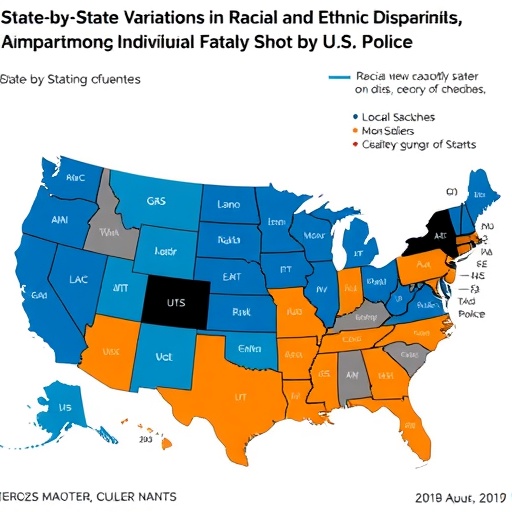
A groundbreaking new study published in the open-access journal PLOS One on March 11, 2026, sheds unprecedented light on the troubling and complex issue of racial and ethnic disparities in fatal police shootings across the United States. Conducted by Roland Neil and his team at the RAND Corporation, this comprehensive observational research provides a detailed state-by-state analysis of how these disparities vary and explores the role of firearm ownership rates in shaping these deadly outcomes.
Each year in the United States, roughly one thousand individuals lose their lives to police shootings, a figure that casts a long shadow over public trust and racial equity. The study highlights a stark racial divide: Black Americans face a risk of fatal police shootings twice that of Hispanic Americans and an alarming three times higher than White Americans nationwide. While national statistics underscore a grim reality, fewer investigations have probed the variance in these disparities across individual states or sought to understand the underlying factors contributing to these geographic differences—an essential step toward targeted policy interventions.
Neil and colleagues’ rigorous analysis hinges on data meticulously compiled by The Washington Post, encompassing fatal police shootings from 2015 to 2020. This time frame provides a robust dataset reflecting evolving trends while maintaining a contemporary lens on the issue. The team applied advanced statistical modeling techniques to estimate state-level fatal shooting rates for White, Black, and Hispanic populations, correcting for population size and other demographic factors to reveal nuanced patterns otherwise masked by national aggregates.
One of the most striking revelations from the study is the substantial variation in Black-White disparities among U.S. states. Although Black residents are more frequently fatally shot than Whites in every state, the degree of disparity swings dramatically. For instance, Mississippi reports a comparatively modest difference of 0.5 fatal shootings per 100,000 residents between Black and White populations. Contrastingly, Utah experiences a profound disparity nearly fourteen times greater, with 6.72 per 100,000. The states exhibiting the most pronounced disparities, ranked from highest to lowest, include Utah, Oklahoma, West Virginia, Colorado, and Missouri, signaling a diverse geographic distribution that defies simplistic regional explanations.
Interestingly, the pattern for Hispanic-White disparities departs from national trends in many states. While Hispanic Americans nationally suffer higher rates of fatal police shootings than White Americans, this discrepancy largely emanates from states in the Southwestern U.S. In states like New Mexico, Colorado, Arizona, and California, significant Hispanic-White disparities coexist with elevated overall police shooting rates and sizable Hispanic populations. Yet, for most states across the country, Hispanic individuals experience fatal police shooting rates lower than their White counterparts—a fact that complicates prevailing narratives and calls for more granular investigations into localized social and law enforcement dynamics.
Beyond racial and ethnic group comparisons, the study probed the potential impact of firearm ownership—a factor hypothesized to influence police officers’ threat perceptions and subsequent use of deadly force. The researchers integrated state-level estimates of gun ownership, a proxy for firearm availability, into their analyses. They found a consistent positive correlation: states with higher firearm ownership rates generally exhibited increased fatal shooting rates by police among all racial and ethnic groups. This relationship underscores the complex interplay between gun prevalence, law enforcement behavior, and community safety yet does not straightforwardly explain racial disparities.
Crucially, the investigators determined that variation in firearm ownership did not account for differences in racial and ethnic disparities between states. States with similar firearm ownership profiles could exhibit dramatically different disparity magnitudes, suggesting that other contextual factors—perhaps including state-specific policing policies, community relations, systemic biases, and socio-economic influences—play pivotal roles in shaping the observed disparities. This finding challenges simplistic causal attributions and signals the necessity of multifaceted approaches to reform.
The methodological rigor of the study deserves emphasis. Employing observational data from a high-profile, credible source, the authors used statistical models that accounted for demographic variations, ensuring reliability in their estimates of fatal police shooting rates. By mapping disparities visually across the country, the research spotlights states where interventions could yield the highest impact, empowering policymakers with actionable intelligence grounded in robust quantitative evidence.
These findings arrive at a critical juncture in American society, where calls for police reform resonate nationwide amid ongoing protests and policy debates. The stark interstate variability indicates that “one size fits all” solutions may be inadequate and that tailored, evidence-driven strategies focusing on local realities are essential. In particular, addressing underlying factors beyond firearm prevalence—such as entrenched racial biases, training deficiencies, and accountability mechanisms—will be key to mitigating disproportionate harm.
Neil and colleagues’ study opens vital pathways for future inquiry. It invites interdisciplinary efforts to dissect the sociopolitical and institutional determinants of fatal police violence disparities and encourages longitudinal tracking to assess progress over time. Moreover, it highlights the need for transparency and data availability, urging departments and states to maintain and share detailed information to fuel continued research and reform.
As the nation grapples with how to reconcile law enforcement practices with principles of justice and equity, this research provides a crucial evidentiary foundation. It calls on public health experts, criminologists, policymakers, and communities alike to engage in informed dialogue, grounded in empirical insight rather than anecdotal impressions or politicized rhetoric. Only through such collective dedication can the alarming racial and ethnic disparities in fatal police shootings begin to be fully understood and, ultimately, addressed.
The study was funded by the Robert Wood Johnson Foundation, ensuring independent scientific inquiry free from conflicts of interest. The authors have declared no competing interests, reinforcing the credibility and impartiality of their findings. The rigorous peer review published by PLOS One, combined with the open-access availability of the article, ensures that this groundbreaking work is accessible to researchers, activists, and the public at large.
In sum, this study by Neil et al. is a seminal contribution to the urgent discourse on police violence and racial justice in America. It not only quantifies disparities with precise granularity but also underscores that firearm ownership alone cannot explain the persistent inequities in fatal police shootings. The research propels the conversation toward more comprehensive, data-driven efforts to devise reforms that can save lives and foster trust across all communities.
—
Subject of Research: People
Article Title: Racial and ethnic disparities in fatal police shootings: Variation across U.S. states and the role of firearm ownership
News Publication Date: 11-Mar-2026
Web References: http://dx.doi.org/10.1371/journal.pone.0333424
References: Neil R, Bushway S, Schell TL, Morral AR, Smart R (2026) Racial and ethnic disparities in fatal police shootings: Variation across U.S. states and the role of firearm ownership. PLoS One 21(3): e0333424.
Image Credits: Neil et al., 2026, PLOS One, CC-BY 4.0
Keywords: police shootings, racial disparities, ethnic disparities, firearm ownership, police violence, U.S. states, public health, law enforcement, racial justice, policing reform
Cite Scienmag News
Courtney Benton. (March 11, 2026). State-by-State Variations in Racial and Ethnic Disparities Among Individuals Fatally Shot by U.S. Police. Scienmag. https://scienmag.com/state-by-state-variations-in-racial-and-ethnic-disparities-among-individuals-fatally-shot-by-u-s-police/
Courtney Benton. "State-by-State Variations in Racial and Ethnic Disparities Among Individuals Fatally Shot by U.S. Police." Scienmag, 11 March 2026, https://scienmag.com/state-by-state-variations-in-racial-and-ethnic-disparities-among-individuals-fatally-shot-by-u-s-police/. Accessed 3 September 2026.
Courtney Benton. "State-by-State Variations in Racial and Ethnic Disparities Among Individuals Fatally Shot by U.S. Police." Scienmag. March 11, 2026. https://scienmag.com/state-by-state-variations-in-racial-and-ethnic-disparities-among-individuals-fatally-shot-by-u-s-police/


