


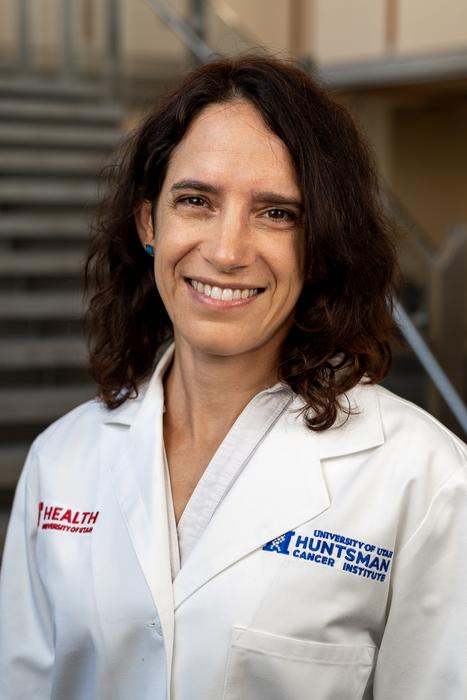
Michelle Mendoza, PhD, researcher at Huntsman Cancer Institute and associate professor of oncological sciences at the University of Utah (the U) and Jeffrey Weiss, PhD, professor of biomedical engineering and faculty member in the Scientific Computing and Imaging Institute at the U, are the recipients of a $2.6 million grant from the National Institutes of Health (NIH) to research how tension in lung tissue affects the growth and distribution of tumors. This innovative approach could uncover new mechanisms for understanding how lung cancer develops.

Credit: Huntsman Cancer Institute
Michelle Mendoza, PhD, researcher at Huntsman Cancer Institute and associate professor of oncological sciences at the University of Utah (the U) and Jeffrey Weiss, PhD, professor of biomedical engineering and faculty member in the Scientific Computing and Imaging Institute at the U, are the recipients of a $2.6 million grant from the National Institutes of Health (NIH) to research how tension in lung tissue affects the growth and distribution of tumors. This innovative approach could uncover new mechanisms for understanding how lung cancer develops.
“There are a lot of people looking at the stiffness of breast tissue or other material properties and other types of cancers, but not so much in the lung. And it’s interesting, because the lung is always undergoing stretch as we breathe in and out. There’s not a lot of tissues that have that characteristic,” says Mendoza.
The study examines the role of mechanobiology—an emerging field that explores how cells respond to mechanical signals—in the progression of early benign lesions to lung adenocarcinoma. According to the American Cancer Society, adenocarcinoma is the most common subtype of non-small cell lung cancer.
The researchers simulated how the presence of a solid tumor fills and affects alveolar sacs, where lungs and blood exchange oxygen for carbon dioxide, using computational models developed in Weiss’s lab.
They observed that the connective tissues making up the walls of the sacs are sensitive to strain—which may produce a cellular response that allows the tumor to grow.
“It’s a new hypothesis about something that’s contributing to the early tumor cells progressing to malignancy, which other people haven’t looked at,” says Mendoza. “And it would be a really interesting discovery if it’s contributing to tumor development—because strain could be affected by things in our environment that cause lung damage or scarring.”
The NIH grant allows Mendoza and Weiss to conduct their research experimentally by testing the effects directly in tissue and also develop more advanced computer models.
Weiss has worked in biomechanics for decades, particularly in musculoskeletal science and cardiovascular mechanics.
“It’s gratifying for me that at this point in my career, I can still do different and new things that are interesting to me,” says Weiss. “I’m pleased to see that the tools that I’ve developed over my career are useful in this context, as well.”
The $2.6 million grant will be distributed over the next five years. Mendoza and Weiss hope the study will lead to further explorations of mechanobiology, as well as the development of neoadjuvant therapies to reduce lung cancer mortality.
|
About Huntsman Cancer Institute at the University of Utah |
|
Huntsman Cancer Institute at the University of Utah (the U) is the National Cancer Institute-designated Comprehensive Cancer Center for Utah, Idaho, Montana, Nevada, and Wyoming. With a legacy of innovative cancer research, groundbreaking discoveries, and world-class patient care, we are transforming the way cancer is understood, prevented, diagnosed, treated, and survived. Huntsman Cancer Institute focuses on delivering a cancer-free frontier to all communities in the area we serve. We have more than 300 open clinical trials and 250 research teams studying cancer at any given time. More genes for inherited cancers have been discovered at Huntsman Cancer Institute than at any other cancer center. Our scientists are world-renowned for understanding how cancer begins and using that knowledge to develop innovative approaches to treat each patient’s unique disease. Huntsman Cancer Institute was founded by Jon M. and Karen Huntsman. |
Cite Scienmag News
Nathaniel Bowman. (July 15, 2024). Mendoza, Weiss receive $2.6 million grant to study biomechanics of lung tumors. Scienmag. https://scienmag.com/mendoza-weiss-receive-2-6-million-grant-to-study-biomechanics-of-lung-tumors/
Nathaniel Bowman. "Mendoza, Weiss receive $2.6 million grant to study biomechanics of lung tumors." Scienmag, 15 July 2024, https://scienmag.com/mendoza-weiss-receive-2-6-million-grant-to-study-biomechanics-of-lung-tumors/. Accessed 3 September 2026.
Nathaniel Bowman. "Mendoza, Weiss receive $2.6 million grant to study biomechanics of lung tumors." Scienmag. July 15, 2024. https://scienmag.com/mendoza-weiss-receive-2-6-million-grant-to-study-biomechanics-of-lung-tumors/

