


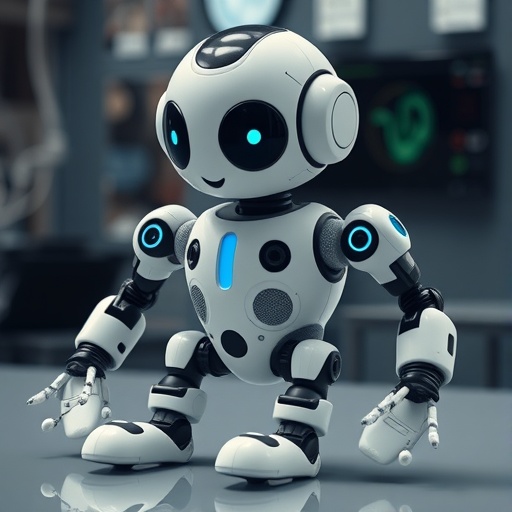
In the rapidly evolving field of robotics, the frontier is continuously expanding beyond rigid mechanical frames toward a future shaped by soft, adaptable, and intelligent materials. Among these innovations, programmable somatosensory soft robots represent a transformative leap, integrating tactile sensing and flexible actuation to perform complex tasks with a level of finesse and adaptability previously reserved for biological organisms. The groundbreaking work detailed by Georgopoulou, Aguiriano Calvo, Lucherini, and colleagues, to be published in npj Flexible Electronics, unveils a new paradigm in robotics that combines advanced materials science, sophisticated neural-inspired computation, and cutting-edge manufacturing techniques.
Soft robots have captivated researchers due to their compliance, safety, and ability to adapt to unpredictable environments. Unlike traditional robots constructed from rigid components, soft robots utilize materials such as elastomers, hydrogels, and flexible polymers that allow bending, stretching, and twisting. However, the integration of somatosensory capabilities—that is, the ability to sense touch, pressure, position, and deformation—has been a significant challenge. Conventional electronic sensors are typically rigid and brittle, creating interfaces that limit the robot’s softness and range of motion. This new class of programmable somatosensory soft robots addresses this challenge through innovative design principles that seamlessly combine sensing and actuation within a monolithic, stretchable architecture.
At the heart of this technological breakthrough lies the development of multimodal tactile sensors embedded within a soft matrix. These sensors employ piezoresistive and piezoelectric nanomaterials dispersed in elastomeric substrates, allowing the robots to detect a spectrum of mechanical stimuli with high sensitivity and spatial resolution. The materials are engineered to be highly deformable without compromising electrical performance, enabling continuous sensory feedback even under large strains. Moreover, the integration of these sensors directly with the robot’s musculature—soft actuators made from dielectric elastomers and fluidic networks—allows real-time sensing of the robot’s posture and environmental interactions, facilitating closed-loop control.
One of the most remarkable aspects of the research is the use of programmable neural network models embedded within flexible electronics that serve as the robot’s “brain.” Inspired by neuromorphic computing principles, these embedded processors interpret complex sensory data streams and generate context-specific motor commands. By exploiting the inherent compatibility between the soft sensor network and neural computation, the robotic system dynamically adapts its behavior in response to tactile inputs. This results in unprecedented dexterity, from delicate manipulation of fragile objects to locomotion on varied terrains with real-time adjustment to obstacles and perturbations.
Advanced fabrication techniques underpin these sophisticated capabilities. The team employed multimaterial 3D printing combined with soft lithography to construct the robots with intricate internal architectures. These methods allow precise spatial arrangement of sensing elements, actuator channels, and conductive pathways, achieving integration at microscale dimensions. The process also supports scalability and customization, potentially enabling rapid prototyping of robots tailored for specific applications—ranging from biomedical devices for minimally invasive surgery to autonomous exploration units in hazardous environments.
Beyond the materials and fabrication innovations, the computational framework introduced is a significant step forward. The researchers developed algorithms capable of mapping high-dimensional sensory inputs to control signals in a way that mimics biological sensorimotor coordination. This biomimetic approach harnesses machine learning techniques to continuously refine the robot’s responses based on its interaction history and environmental context, effectively enabling the robot to “learn” its terrain and improve performance autonomously.
In practical terms, these programmable somatosensory soft robots demonstrate striking versatility. The research showcases prototypes capable of manipulating delicate objects such as soft fruits without causing damage, navigating complex mazes autonomously, and performing intricate movements that replicate human-like gestures. Importantly, the combination of softness and sensibility reduces mechanical impedance and risk of injury, paving the way for safer human-robot collaboration in settings like healthcare, eldercare, and manufacturing.
Moreover, these robots exhibit remarkable energy efficiency, a critical factor for autonomous operation, by harnessing the synergy between sensing and actuation. The elastomer-based actuators operate at low voltages, while the embedded neuromorphic processors consume minimal power, enabling extended deployment times in the field. Furthermore, the robustness of the soft materials confers resilience to impacts and mechanical fatigue, addressing longevity and maintenance concerns that often hamper traditional robots.
The implications of this research extend into numerous domains. In medical robotics, for instance, soft robots with programmable somatosensory capabilities could revolutionize surgical tools, enabling minimally invasive procedures with tactile feedback that enhances precision. Similarly, in prosthetics, the integration of tactile awareness could greatly improve the dexterity and natural feel, delivering significant benefits to users. In environmental monitoring and search-and-rescue operations, these adaptable robots can traverse debris and confined spaces, providing situational awareness while protecting themselves from damage.
The roadmap ahead involves further refinement of sensor resolution, actuator force output, and computational complexity, as well as the development of standardized modular building blocks to accelerate adoption. The interdisciplinary nature of this work, bridging materials science, robotics, electronics, and artificial intelligence, exemplifies the collaborative advance necessary for creating robots that are not only functional but also intuitive and interactive partners in human environments.
Public fascination with robots capable of gentle touch and nuanced sensation is poised to grow, fueled by demonstrations that blur the line between biological organisms and engineered machines. As these programmable somatosensory soft robots progress towards commercialization, ethical considerations surrounding autonomy, safety, and human-robot interaction protocols will assume increasing importance.
In summary, the work by Georgopoulou and colleagues marks a watershed moment in robotics, presenting programmable somatosensory soft robots that harmonize flexible materials, embedded neural computation, and advanced manufacturing to achieve unprecedented adaptability and intelligence. This innovative platform opens new vistas for robotics across medicine, industry, and exploration, heralding an era when robots can sense, learn, and respond with biological subtlety.
The coming years will likely witness these soft robotic systems evolving from laboratory prototypes to ubiquitous tools that enhance human capabilities and enrich our interaction with machines. As the boundaries of engineering blur with biology, programmable somatosensory soft robots represent a critical step towards a future where responsive, intelligent, and safe robots become a natural extension of human effort.
Cite Scienmag News
Denise Maddox. (March 7, 2026). Programmable Soft Robots with Advanced Somatosensory Skills. Scienmag. https://scienmag.com/programmable-soft-robots-with-advanced-somatosensory-skills/
Denise Maddox. "Programmable Soft Robots with Advanced Somatosensory Skills." Scienmag, 7 March 2026, https://scienmag.com/programmable-soft-robots-with-advanced-somatosensory-skills/. Accessed 4 September 2026.
Denise Maddox. "Programmable Soft Robots with Advanced Somatosensory Skills." Scienmag. March 7, 2026. https://scienmag.com/programmable-soft-robots-with-advanced-somatosensory-skills/


