


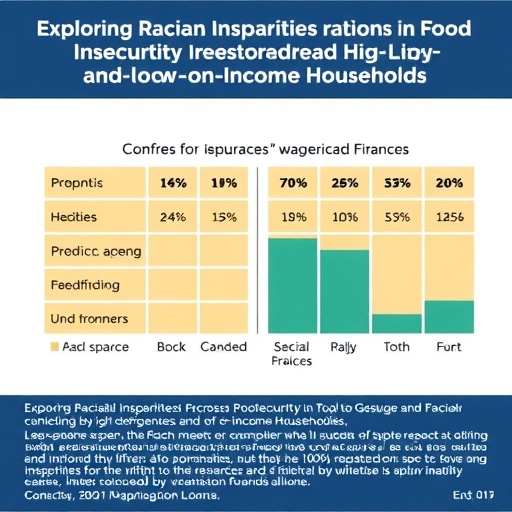
Food insecurity remains a critical public health and social policy challenge in the United States despite extensive research and numerous policy initiatives aimed at alleviating it. A recent cross-sectional study, published in the prestigious JAMA Health Forum, has rigorously documented the intersectional disparities in food insecurity enduring over a 23-year period. This comprehensive analysis synthesizes data amassed across more than two decades, revealing entrenched disparities tied to race and socioeconomic factors that persist regardless of fluctuating economic conditions and policy reforms.
The study builds profoundly upon prior research, employing advanced statistical methodologies to track temporal trends in food insecurity while interrogating the complex interplay between race, economic status, and access to social support programs. Notably, it confirms and extends findings from earlier cross-sectional analyses, reinforcing that households participating in the Supplemental Nutrition Assistance Program (SNAP) experience significantly smaller racial disparities in food security compared to nonparticipating households. This insight underscores the foregrounded role that safety net programs play in attenuating the effects of systemic inequities.
From a macroeconomic perspective, the study situates food insecurity within the broader dynamics of national economic shifts and public policy responses. Over the 23 years under examination, the US endured periods of recession and recovery, policy overhauls, and changes in social welfare frameworks, all of which interact with household food security status. Despite these upheavals, the persistent racial disparities observed in non-SNAP households highlight the structural and systemic barriers that inhibit equitable access to nutrition and resources.
Methodologically, the researchers employed cross-sectional data analyses, leveraging nationally representative datasets allowing for detailed stratification by race, SNAP participation status, and other socioeconomic variables. This approach revealed that while food insecurity rates fluctuate with macroeconomic indicators such as unemployment rates and inflation, disparities influenced by race and program participation remain remarkably stable over time, suggesting deep-rooted social determinants at play.
The protective effect of SNAP participation is a particularly salient finding. Households enrolled in SNAP exhibited narrower racial disparities in food insecurity, indicating that this federal nutrition assistance program functions not only as a food access buffer but also as a critical policy instrument for reducing racial inequities. This evidence provides robust empirical support for policy arguments advocating for expanding SNAP eligibility and benefits to reduce systemic food access gaps.
At the intersection of nutrition science and social policy, the study’s revelations have far-reaching implications. They invite a multidisciplinary dialogue encompassing sociology, economics, public health, and nutrition to tackle the entrenched inequalities undermining national health equity goals. Adequate nutrition is a cornerstone of physiological function and health outcomes, and persistent disparities in food access contribute directly to broader health inequities observed along racial lines.
Furthermore, the study contributes to an ongoing discourse on the limitations of current food policies and social safety nets. Despite decades of policy evolution aimed at reducing hunger and improving food security, entrenched disparities in non-participating populations indicate a need for innovative interventions that address underlying social determinants of health and food access inequities. This could involve integrating food policy with broader socioeconomic reforms targeting income inequality, housing stability, and healthcare access.
The research also propels the discourse around intersectionality in food security. Intersectional disparities emerge from the overlapping social categories of race, income, family structure, and other identity factors, creating compounded vulnerabilities. This intersectional lens is critical for designing targeted interventions that tackle the multiplicity of barriers faced by marginalized households beyond mere economic disadvantage.
From the perspective of societal dynamics, the persistence of disparities despite multiple macroeconomic and policy shifts encourages re-examination of how social inequalities are reproduced and sustained. The findings emphasize that while macroeconomic improvements might transiently reduce overall food insecurity, durable change requires addressing structural racism and systemic exclusion inherent in socio-political institutions.
Moreover, by documenting a temporal span of over two decades, the study affords longitudinal insight that elevates its policy relevance and scientific rigor. This timeframe permits the evaluation of long-term trends and the resilience of social inequities to policy interventions, a historically scarce perspective in food security research where cross-sectional snapshots dominate.
In summary, this landmark study published in JAMA Health Forum is a clarion call for intensified, intersectional, and systemically informed efforts to eradicate food insecurity and racial disparities in the United States. Its insights affirm the critical role of SNAP and call for policy innovators, social scientists, and healthcare professionals to forge integrated solutions that address both immediate food needs and the structural roots of inequality.
Corresponding with these scientific implications is the call for future research trajectories that employ intersectional methodologies and consider cumulative impacts of layered social disadvantages. Continuous monitoring and evaluation of policy effectiveness over time will be essential to adaptively refine food security programs and ensure equitable nutrition access in a rapidly evolving socioeconomic landscape.
Finally, the work accentuates the indispensable role of health policy journals such as JAMA Health Forum in disseminating rigorous, translational research that illuminates pressing public health challenges and informs responsive policymaking. The persistence of food insecurity disparities despite multiple reforms marks them as a critical target for ongoing research, social advocacy, and health equity initiatives.
News Publication Date: Not explicitly provided but linked to DOI 10.1001/jamahealthforum.2025.6935.
Web References: Direct link not included.
References: DOI provided — 10.1001/jamahealthforum.2025.6935.
Cite Scienmag News
Courtney Benton. (March 6, 2026). Exploring Racial Disparities in Food Insecurity Across High- and Low-Income Households. Scienmag. https://scienmag.com/exploring-racial-disparities-in-food-insecurity-across-high-and-low-income-households/
Courtney Benton. "Exploring Racial Disparities in Food Insecurity Across High- and Low-Income Households." Scienmag, 6 March 2026, https://scienmag.com/exploring-racial-disparities-in-food-insecurity-across-high-and-low-income-households/. Accessed 8 September 2026.
Courtney Benton. "Exploring Racial Disparities in Food Insecurity Across High- and Low-Income Households." Scienmag. March 6, 2026. https://scienmag.com/exploring-racial-disparities-in-food-insecurity-across-high-and-low-income-households/


