


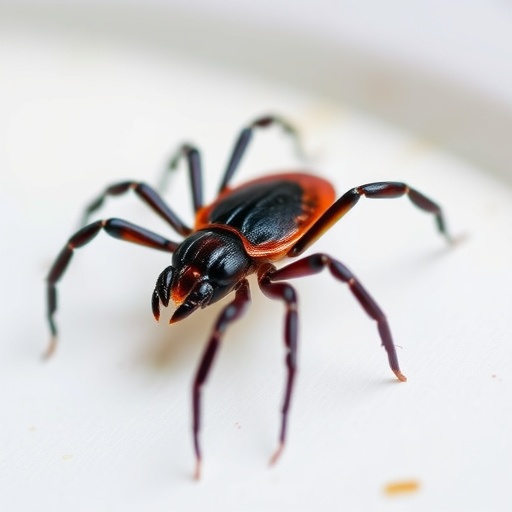
In a groundbreaking advancement for parasitology and vector-borne disease research, scientists at the University of Melbourne have pioneered the world’s first entirely laboratory-based tick feeding system specifically designed for the Asian longhorned tick (Haemaphysalis longicornis). This innovative platform heralds a transformative shift away from traditional reliance on live animal hosts, enabling more ethical and reproducible tick studies while maintaining rigorous scientific fidelity. The novel system allows researchers to observe tick feeding behavior, reproduction, pathogen acquisition, and transmission without inflicting undue harm or stress on vertebrate animals, marking a major ethical and methodological milestone in entomological and veterinary research.
Ticks pose an immense global health threat due to their role as vectors for a diverse array of pathogens including viruses, bacteria, and protozoa, which they transmit to both animals and humans. These hematophagous arachnids have garnered increasing scientific attention due to their expanding geographical ranges influenced by climate change, alterations in land use, and intensification of global trade networks. Such changes not only facilitate spread into novel ecosystems but also potentially amplify the incidence of tick-borne diseases, underlining the urgent need for advanced research tools that can dissect tick biology and vector competence under controlled, animal-free laboratory conditions.
The development, spearheaded by Dr. Abdul Ghafar and Professor Abdul Jabbar from the University of Melbourne’s Melbourne Veterinary School along with Professor Ard Nijhof from Freie Universität Berlin, Germany, was recently published in The Veterinary Journal. Their methodology centers on replicating the intricate physiological environment required for tick feeding using a synthetic silicone membrane mimicking host skin, complemented by defibrinated cattle blood to simulate natural feeding substrates. This artificial feeding platform is tailored to accommodate the anatomical peculiarities of H. longicornis, which previously hindered successful in vitro feeding attempts due to their short mouthparts and limited mobility.
By engineering membrane thickness and optimizing feeding parameters, the researchers were able to overcome the inherent difficulties associated with facilitating reliable attachment and blood uptake in these ticks. The successful sustenance and full reproductive cycle completion on this platform signify a critical breakthrough, enabling sustained propagation and experimental manipulation of this species without animal participation. This breakthrough presents a scalable, high-throughput alternative for conducting physiological assays and pathogenesis studies with enhanced consistency and experimental repeatability.
Of particular significance is the Asian longhorned tick’s role as a vital vector of Theileria orientalis, a pathogenic protozoan responsible for substantial economic losses in cattle industries, especially across Australia where this tick is endemic. Theileriosis induced by this parasite causes anemia, decreased productivity, and mortality in affected herds. The new tick feeding system offers an indispensable tool for investigating pathogen-vector dynamics, facilitating detailed exploration of pathogen acquisition and transmission mechanisms at the molecular and cellular levels under carefully controlled conditions.
Furthermore, emergent research implicates the bites of H. longicornis in triggering alpha-gal syndrome, an allergic reaction to mammalian red meat caused by immune sensitization to the carbohydrate galactose-α-1,3-galactose present in tick saliva. Understanding the salivary components and feeding interactions mediated by this tick species through such in vitro systems could unlock crucial insights into the pathophysiology of this syndrome, potentially guiding the development of novel diagnostics and interventions to mitigate allergic responses in affected populations.
Traditionally, experimental tick research depends heavily on live animal hosts, which entails challenges ranging from ethical dilemmas to biological variability introduced by host immune responses, grooming behavior, and individual differences in tick attachment success. Variability in host factors contributes significant noise to data sets, complicating interpretation and reducing reproducibility. The lab-based feeding system effectively decouples tick biology from these confounding variables, facilitating cleaner experimental designs and enabling rigorous mechanistic studies.
The platform’s capability extends beyond physiological and pathological inquiries; it also provides a robust framework for evaluating new classes of acaricides and vaccines targeting ticks under standardized, animal-free lab conditions. This feature holds immense promise for accelerating the discovery pipeline in anti-tick biotechnologies, potentially reducing the burden of infestations and tick-borne diseases on livestock and human health worldwide. The controlled environment allows precise dosing, repeatable testing parameters, and efficient screening of candidate compounds, thereby increasing the speed and reliability of efficacy assessments.
Dr. Ghafar emphasizes that the platform can serve as a critical research hub to address growing challenges posed by climate change, land development, and international trade, all of which continue to reshape the landscape of tick ecology and disease epidemiology. As ticks extend their range into new areas and encounter novel hosts, robust experimental models will become indispensable for forecasting disease risks and guiding informed public health and agricultural interventions.
The integration of this host-free feeding system into global tick research networks could revolutionize our understanding of tick-host-pathogen interactions, streamlining and ethicalizing experimental approaches while enhancing reproducibility. The methodological innovations encapsulated in this platform exemplify how engineering and biology can synergize to overcome entrenched scientific challenges, opening avenues for breakthroughs in vector-borne disease control and prevention.
This scientific advance underscores the critical importance of interdisciplinary collaboration, bringing together parasitologists, veterinarians, entomologists, and bioengineers to craft a solution addressing complex biological constraints. The host-free feeding system represents an elegant bioengineering solution to a long-standing problem, promising to catalyze new insights that could benefit both animal and human health by mitigating the impacts of these medically significant arthropods.
As the threat of tick-borne diseases escalates globally, tools such as this innovative feeding system equip researchers with unprecedented capabilities to decipher tick biology and disease transmission pathways. This could ultimately lead to the development of novel intervention strategies, reducing disease transmission risks and improving control measures amid an era of rapid environmental and ecological transformations.
News Publication Date: Not specified (pending publication year 2026)
Web References:
https://www.sciencedirect.com/science/article/pii/S1090023326000171
http://dx.doi.org/10.1016/j.tvjl.2026.106561
Keywords
Tick feeding system, Haemaphysalis longicornis, artificial tick feeding, vector-borne diseases, Theileria orientalis, alpha-gal syndrome, tick saliva, tick physiology, acaricide screening, anti-tick vaccines, in vitro feeding, host-free tick research, veterinary parasitology, climate change and ticks
Cite Scienmag News
Florence R. (March 6, 2026). Innovative Artificial Feeding Platform Revolutionizes Research on Ticks and Tick-Borne Diseases. Scienmag. https://scienmag.com/innovative-artificial-feeding-platform-revolutionizes-research-on-ticks-and-tick-borne-diseases/
Florence R. "Innovative Artificial Feeding Platform Revolutionizes Research on Ticks and Tick-Borne Diseases." Scienmag, 6 March 2026, https://scienmag.com/innovative-artificial-feeding-platform-revolutionizes-research-on-ticks-and-tick-borne-diseases/. Accessed 28 August 2026.
Florence R. "Innovative Artificial Feeding Platform Revolutionizes Research on Ticks and Tick-Borne Diseases." Scienmag. March 6, 2026. https://scienmag.com/innovative-artificial-feeding-platform-revolutionizes-research-on-ticks-and-tick-borne-diseases/


