


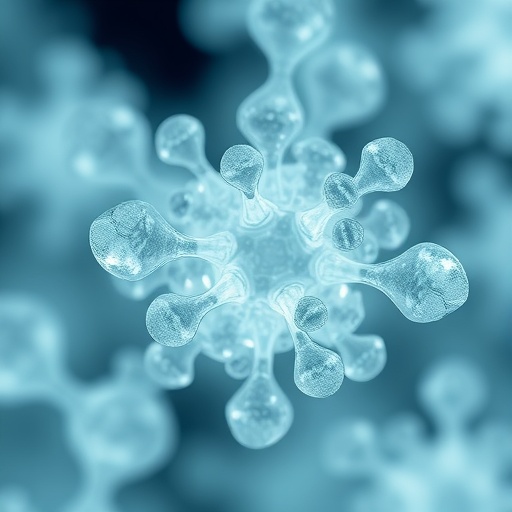
In a groundbreaking study recently published in the Journal of the American Chemical Society, a team of scientists from the Dalian Institute of Chemical Physics, led by Professors JIANG Ling and LI Gang, has unveiled critical insights into the microscopic mechanisms governing alkali dissolution in aqueous environments. Their research focuses on neutral barium hydroxide-water clusters, BaOH(H₂O)n, where n ranges from 1 to 5. Astonishingly, they discovered that only three water molecules are necessary to effectively separate barium ions (Ba) from hydroxide ions (OH) within these clusters. This discovery offers a profound leap forward in understanding how water molecules initiate and facilitate the dissolution of alkali species at the molecular level.
The dissolution of alkali metals in water is a fundamental chemical process with wide-reaching implications, including catalysis, energy storage, and pharmaceutical applications. Despite its importance, the precise molecular details of how water molecules interact with alkali species to initiate their ionization and solvation have remained elusive. This is largely due to the complex interplay of hydrogen bonding networks, proton transfers, and electrostatic forces in liquid environments, which are notoriously difficult to probe at the atomic scale. Neutral hydrated alkali clusters, such as those formed by BaOH and a finite number of water molecules, provide an ideal systems-level model to investigate these early stages of solvation and dissociation without the interference of bulk solvent effects.
The researchers pioneered a novel experimental platform combining infrared excitation with vacuum ultraviolet threshold photoionization, termed IR-VUV spectroscopy. This approach allows for the high-sensitivity detection of the infrared spectra of mass-selected, neutral molecular clusters under ultrahigh vacuum conditions. The technique not only resolves subtle vibrational modes associated with hydrogen bonding and solvation but also offers unprecedented access to the structures and reactivity of neutral clusters, which are otherwise challenging to examine due to their transient nature and low abundance.
Using this sophisticated IR-VUV system, the team meticulously measured the infrared spectral signatures of BaOH(H₂O)n clusters with hydration numbers from one to five. These experimental spectra were then directly compared against state-of-the-art computational simulations employing high-level quantum chemical harmonic frequency calculations complemented by anharmonic molecular dynamics simulations. Such rigorous theoretical analyses were crucial for validating the structural interpretations and gaining molecular-level insights into the dynamics of water molecule interaction with BaOH.
Their findings reveal a critical hydration threshold: for n = 1 and 2, water molecules bind directly to the BaOH moiety via O–H⋯O hydrogen bonds without inducing dissociation between barium and hydroxide. This indicates the stability of the molecular complex at low hydration levels. However, when the cluster grows to n ≥ 3, the hydration environment fosters a striking transformation where Ba and OH ions dissociate, giving rise to solvent-shared ion pair structures. This transition signifies the onset of true ionization driven by the solvation network.
Electronic structure analyses further illuminated the underlying forces driving this dissociation. As the number of water molecules increases, enhanced charge transfer interactions between the ionic species and surrounding water molecules substantially reduce the electrostatic attraction binding Ba and OH together. Simultaneously, the emergence of a hydrogen-bonded network among water molecules acts cooperatively to stabilize the separated ions, promoting their spatial separation within the cluster. This synergistic interplay between electronic charge redistribution and hydrogen bonding is the molecular basis for the solvated ion pair formation.
This research offers a concrete atomistic model that elucidates the delicate balance of electrostatic and inductive interactions governing the interaction between ionic species and water molecules in early solvation stages. Importantly, the results extend our understanding beyond bulk solution chemistry by demonstrating how microscopic solvation structure dictates the ionization process with extreme size resolution. Such mechanistic insights are essential for unraveling complex chemical phenomena ranging from acid-base chemistry to charge transfer in biochemical systems.
Moreover, the technical approach pioneered here sets a new benchmark for probing neutral cluster chemistry. By integrating IR vibrational spectroscopy with VUV photoionization techniques, scientists can now access highly selective structural and electronic information about elusive transient species. This approach could be readily extended to study other hydrated ions and molecular solutes, thereby broadening our fundamental understanding of solvation chemistry across chemical and biological contexts.
The ability to map out the stepwise hydration process from molecular complexes to separated ion pairs provides fresh perspectives on crucial phenomena such as proton transfer, solvation shell formation, and ion mobility. By tracking how just a few water molecules can dramatically alter chemical bonding and charge distribution, this study offers a powerful narrative of the chemical evolution from isolated molecules to fully solvated ions in aqueous environments.
In summary, the work by Prof. JIANG Ling, Prof. LI Gang, and their colleagues represents a monumental advance in physical chemistry, providing definitive experimental and theoretical evidence of base dissociation mechanism induced by microsolvation in BaOH water clusters. Their findings pave the way for a new generation of targeted studies exploring how solvation influences reactivity, stability, and dynamics of chemical species at the nanoscale. This transformative insight holds vast potential applications in materials science, catalysis, environmental chemistry, and drug design, where hydration plays a key role in molecular function and behavior.
As researchers continue to unravel the complexities of solvation-induced electron and proton dynamics, the novel methodologies and fundamental principles described in this study will undoubtedly serve as a cornerstone for future scientific breakthroughs. The convergence of advanced spectroscopic tools with quantum mechanical modeling exemplifies the cutting edge of molecular science, offering a detailed microscopic window into processes that once remained hidden in the perplexing realm of liquid-phase chemistry.
Keywords
Water chemistry, alkali dissolution, neutral hydrated clusters, infrared spectroscopy, vacuum ultraviolet photoionization, BaOH clusters, solvation mechanism, hydrogen bonding networks, proton transfer, charge transfer, ion pair formation, molecular dynamics simulations
Cite Scienmag News
Bethany Barker. (March 6, 2026). Scientists Reveal Microscopic Process Behind Alkali Species Dissolution in Water Clusters. Scienmag. https://scienmag.com/scientists-reveal-microscopic-process-behind-alkali-species-dissolution-in-water-clusters/
Bethany Barker. "Scientists Reveal Microscopic Process Behind Alkali Species Dissolution in Water Clusters." Scienmag, 6 March 2026, https://scienmag.com/scientists-reveal-microscopic-process-behind-alkali-species-dissolution-in-water-clusters/. Accessed 8 September 2026.
Bethany Barker. "Scientists Reveal Microscopic Process Behind Alkali Species Dissolution in Water Clusters." Scienmag. March 6, 2026. https://scienmag.com/scientists-reveal-microscopic-process-behind-alkali-species-dissolution-in-water-clusters/


