


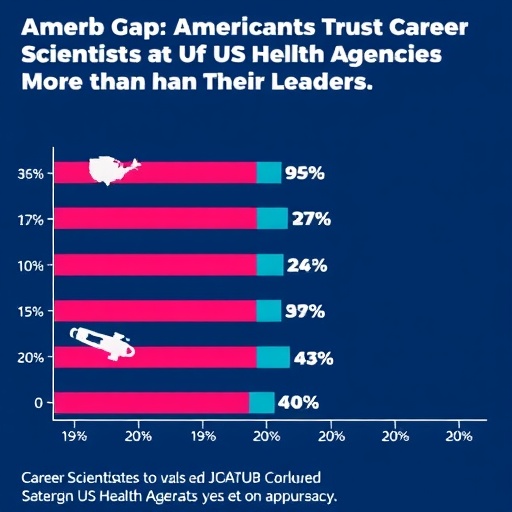
Public trust in U.S. federal health agencies has entered a pivotal and complex phase, as a recent survey by the Annenberg Public Policy Center (APPC) uncovers a pronounced divide between the confidence Americans place in career scientists versus agency leadership. The survey, representing a nationally representative sample of 1,650 adults across the United States and conducted in February 2026, reveals that while two-thirds of respondents maintain faith in the scientific rigor and integrity of career researchers within the Centers for Disease Control and Prevention (CDC), National Institutes of Health (NIH), and Food and Drug Administration (FDA), confidence in the agencies’ leaders notably lags, with less than half expressing trust in these figures. This distinction is underscored by the leadership changes under Health and Human Services (HHS) Secretary Robert F. Kennedy Jr., whose tenure has been marked by significant public health controversy.
Delving deeper into the perceptions surrounding agency leaders, the survey data suggests a marked erosion of trust when compared to past figures such as Dr. Anthony Fauci, who helmed the National Institute of Allergy and Infectious Diseases (NIAID) during earlier public health crises. Fauci commanded confidence from over half of Americans, whereas Kennedy and Centers for Medicare and Medicaid Services (CMS) Administrator Dr. Mehmet Oz, each receive confidence levels below half, signifying public skepticism potentially fueled by politicized health messaging and contentious policy shifts. The temporal analysis of confidence scores indicates that trust has notably declined in the first year of the Trump administration, suggesting that political transition periods may exacerbate public uncertainty regarding health communication.
The survey further contextualizes this skepticism within the broader ecosystem of health information dissemination by comparing federal agencies with major professional health associations. Organizations such as the American Heart Association, American Academy of Pediatrics, American Medical Association, and National Academy of Sciences enjoy substantially higher levels of public confidence, sometimes surpassing those attributed to federal entities by 15 to 20 percentage points. This phenomenon underscores the public’s preference for perceived nonpartisan, science-driven guidance over government-affiliated information sources, particularly amid increasingly polarized health policy landscapes. For instance, in vaccine-related advisories, the American Academy of Pediatrics’ recommendations on neonatal hepatitis B vaccination are favored overwhelmingly compared to the CDC’s recent stance, which advocates for shared clinical decision-making—an approach that seems to engender ambiguity and thus less public acceptance.
The intricacies of vaccine confidence are further illuminated when examining attitudes towards the American Medical Association and the CDC, who sometimes diverge in their guidance about vaccine safety. The survey points to a near doubling of public willingness to follow the AMA’s recommendations over the CDC’s in scenarios of disagreement, reflecting nuanced preferences for medical authority and credibility. Similar trends are observed in regard to alcohol consumption safety guidelines, where the American Medical Association ranks significantly higher in public trust compared to the National Institute on Alcohol Abuse and Alcoholism or the CDC. This elevated trust in professional associations may derive from their longstanding reputations, perceived insulation from political pressures, and specialized focus on clinical best practices.
Climate change science communication also sits at the nexus of public trust dynamics, as respondents are more inclined to trust the National Academy of Sciences over the Environmental Protection Agency by a 2-to-1 margin when conflicting information arises about climate change causation. The EPA has experienced a sharp 20-percentage-point drop in public confidence regarding its messaging on climate-related health impacts over a roughly two-year span, plunging from a majority to a position where nearly half of Americans express doubt. This precipitous decline, coupled with a substantial portion of the public expressing uncertainty, signals a growing void in authoritative environmental health communication that could have broad implications for public health policy and engagement.
Temporal analysis across the board reveals a troubling trend of declining confidence in the nation’s key health institutions from 2024 through 2026. While confidence metrics hovered in the mid-70% range during the Obama and Biden administrations, the transition into the Trump administration saw these rates fall sharply, with some institutions experiencing declines of over 10 percentage points within a single year. Specifically, the CDC, FDA, and NIH now command confidence levels hovering around 60-62%, with significant drops in the subset of individuals who report being “very confident” in these agencies. These downward trajectories correspond to notable moments of policy shifts or communication challenges, including changes in vaccine recommendations and the politicization of pandemic responses.
Perhaps most striking is the persistent and overwhelming trust Americans place in their own primary healthcare providers. An overwhelming 86% of survey respondents report confidence in their doctors, nurses, or primary care teams to provide trustworthy health information, reinforcing the central role of direct patient-provider relationships in fostering health literacy and public trust. This high level of trust starkly contrasts with the more variable confidence in institutional sources, highlighting the differentiated nature of trust depending on the proximity and personalization of information delivery. The intimate nature of clinical encounters likely offers a counterbalance to wider societal scepticism surrounding federal and large-scale health communications.
The nuanced findings of the APPC survey underscore an evolving public health communication landscape shaped by intersecting forces: administrative changes, leadership personalities, conflicting scientific advice, and political polarization. At a technical level, this alignment—or misalignment—of trust has critical implications for public health policy, compliance with health directives, and ultimately, disease prevention outcomes. Classic models of health communication emphasize the need for source credibility, message consistency, and audience engagement; the data presented here suggest these dimensions are currently challenged within federal health agencies, necessitating strategic communication interventions to rebuild public trust.
From a methodological standpoint, the ASAPH panel survey benefits from rigorous design features, including a large, probability-based national sample, a margin of error of ±3.5%, and repeated waves allowing for longitudinal analysis. Data collection employed mixed modes, enhancing representativeness and mitigating response biases that can plague purely web-based surveys. Importantly, the panelists were quarantined from other survey panel memberships, reducing contamination of responses and ensuring cleaner data reflective of authentic attitudes. These methodological strengths lend weight to the survey’s insights and their relevance for policymakers and health communicators navigating a fragmented information environment.
The implications extend to vaccination strategies, where ambiguity introduced by shifts from universal to risk-based recommendations can undermine public health goals. The hepatitis B vaccine scenario exemplifies the delicate balance between nuanced clinical guidance and public messaging clarity. Shifts that emphasize “shared clinical decision-making” over universal protocols may intend to respect individual patient contexts but potentially erode the unequivocal confidence needed to sustain high vaccination uptake. The preference for American Academy of Pediatrics guidance in this context signals both opportunity and challenge for federal entities striving to maintain authoritative voices in vaccine advocacy.
Moreover, the political context looms large in interpreting these trust dynamics. The decline in confidence in federal health agencies correlates temporally with the change from a Democratic to a Republican administration and raises critical questions about the politicization of public health agencies and the scientific leadership they embody. Such politicization may amplify divides and confusion around health guidance, thereby complicating public efforts to manage infectious diseases, chronic conditions, and environmental health risks. This underscores the necessity for health agencies to cultivate independence and robustness in their scientific communication to counterbalance political influences.
Climate change misinformation and declining trust in environmental health authorities reflect a broader struggle to leverage scientific consensus effectively amid a fragmented media and political landscape. The nearly one-third of respondents preferring the National Academy of Sciences over the EPA in climate disputes highlights increasing public desire for perceived scientific objectivity over regulatory agency messaging, which may be marred by perceived policy agendas. Addressing this gap is essential as climate change continues to manifest in diverse public health effects, demanding coherent and trusted communication strategies to mobilize effective responses.
Overall, the APPC’s 2026 survey reveals a public health communication environment in flux, distinguished by tensions between trust in science and skepticism of leadership, divergent preferences for organizational sources, and the destabilizing effects of politicized health governance. For practitioners, policymakers, and scientists, this demands renewed emphasis on transparent, consistent, and evidence-based communication tailored to an audience navigating complex, often contradictory information streams. Only through such approaches may the public’s confidence and adherence to beneficial health practices be restored and fortified in an era marked by profound challenges and opportunities for public health.
News Publication Date: Not provided
Web References:
- Annenberg Public Policy Center: https://www.annenbergpublicpolicycenter.org/
- Survey topline data: https://www.annenbergpublicpolicycenter.org/wp-content/uploads/aw28-do03-topline-confcomp-v7.pdf
- CDC hepatitis B immunization schedule: https://www.cdc.gov/vaccines/imz-schedules/child-easyread.html
- American Academy of Pediatrics Hepatitis B guidance: https://www.aap.org/en/patient-care/hepatitis-b/
References: Not provided
Cite Scienmag News
Courtney Benton. (March 5, 2026). Sharp Gap: Americans Trust Career Scientists at US Health Agencies More Than Their Leaders. Scienmag. https://scienmag.com/sharp-gap-americans-trust-career-scientists-at-us-health-agencies-more-than-their-leaders/
Courtney Benton. "Sharp Gap: Americans Trust Career Scientists at US Health Agencies More Than Their Leaders." Scienmag, 5 March 2026, https://scienmag.com/sharp-gap-americans-trust-career-scientists-at-us-health-agencies-more-than-their-leaders/. Accessed 31 August 2026.
Courtney Benton. "Sharp Gap: Americans Trust Career Scientists at US Health Agencies More Than Their Leaders." Scienmag. March 5, 2026. https://scienmag.com/sharp-gap-americans-trust-career-scientists-at-us-health-agencies-more-than-their-leaders/


