


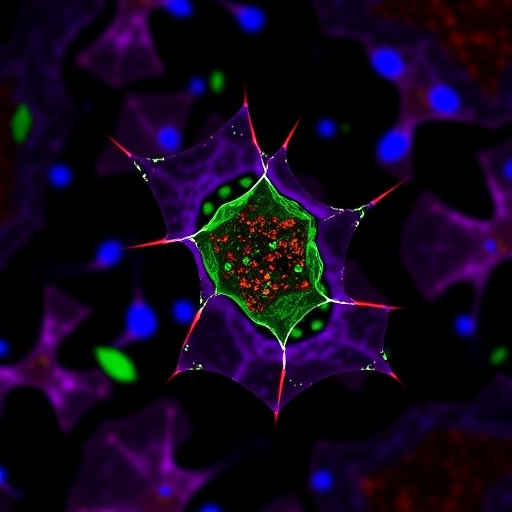
In the relentless quest to decode the mechanisms driving colorectal cancer (CRC), particularly those subtypes fueled by KRAS mutations, a groundbreaking discovery has emerged offering fresh hope for effective immunotherapy strategies. KRAS mutations are notorious for driving oncogenesis and resistance to existing treatments, presenting a formidable obstacle in clinical oncology. The newly unveiled study shines a spotlight on a previously unrecognized molecular pathway that enables KRAS-mutant CRC cells to evade immune destruction, shedding light on how tumor metabolism directly cripples T cell functionality.
Central to this discovery is the protein thyroid hormone receptor interactor 6 (TRIP6), whose phosphorylation state acts as a molecular switch dictating cancer cell metabolism and immune evasion. Researchers elucidated that in KRAS wild-type CRC cells — those without KRAS mutations — TRIP6 remains unphosphorylated, binding intimately to lysine-specific demethylase 1A (KDM1A). This partnership suppresses expression of the gene enolase 2 (ENO2), a glycolytic enzyme, by promoting the accumulation of repressive histone marks H3K9me1 and H3K9me2. The outcome is a restrained glycolytic flux, limiting lactate production and subsequent metabolic alterations in the tumor microenvironment.
Intriguingly, this regulatory axis is dismantled in KRAS-mutant CRC cells. Activation of ERK1 and ERK2 kinases, downstream effectors of the KRAS signaling cascade, phosphorylates TRIP6. This phosphorylation event disrupts the TRIP6-KDM1A interaction, lifting the brakes on ENO2 expression and triggering a metabolic overhaul. Enhanced ENO2 expression elevates glycolysis, flooding the tumor microenvironment with extracellular lactate and driving aggressive tumor phenotypes.
The metabolic reprogramming in KRAS-mutant tumors has profound immunological consequences. Elevated extracellular lactate concentrations mediate post-translational modification of CD44 on infiltrating CD8+ cytotoxic T cells—a process known as lactylation. This lactylation of CD44 compromises its ability to bind hyaluronan, an essential extracellular matrix component that modulates T cell adhesion and migration. Moreover, impaired hyaluronan binding attenuates AKT signaling within T cells, a key pathway governing their survival, proliferation, and effector functions. The cumulative effect is a debilitating suppression of anti-tumor immunity, allowing KRAS-mutant CRC tumors to thrive unchecked despite immune surveillance.
This revelation connects metabolic rewiring directly to immune escape, painting a vivid picture of how tumor cells manipulate their microenvironment to disable immune effectors. The fact that such a metabolic checkpoint hinges on TRIP6 phosphorylation opens the door for innovative therapeutic interventions. By targeting this modification, the study proposes a novel strategy to restore T cell function and sensitize tumors to immunotherapy.
Building on these mechanistic insights, the researchers developed a peptide inhibitor, mouse PT6, designed to block TRIP6 phosphorylation. Preclinical models demonstrated that administration of PT6 reinstated TRIP6-KDM1A binding, suppressed ENO2-driven glycolysis, and, crucially, restored the anti-tumor activity of CD8+ T cells. When combined with anti-PD-1 immune checkpoint blockade, PT6 markedly enhanced therapeutic efficacy, suggesting a promising avenue to overcome resistance mechanisms that plague KRAS-mutant CRC.
This study’s significance is underscored by its potential translational impact. KRAS mutations are some of the most common oncogenic drivers across malignancies, yet they have long represented a ‘undruggable’ target in cancer therapy. The identification of an epigenetic and metabolic vulnerability governed by TRIP6 phosphorylation offers a critical molecular target downstream of KRAS, one that is amenable to pharmacologic modulation.
Furthermore, the characterization of CD44 lactylation as a metabolic checkpoint on CD8+ T cells bridges two vibrant fields of cancer research: tumor metabolism and immune regulation. While lactate has been recognized as a suppressive metabolite within the tumor microenvironment, its direct modification of immune cell surface receptors opens new paradigms on the biochemical crosstalk between cancer cells and immune infiltrates.
By delineating this TRIP6-ENO2-CD44 lactylation axis, the study provides a comprehensive mechanistic framework linking oncogenic KRAS signaling to immune dysfunction via metabolic reprogramming. This nuanced understanding reshapes our perspective on how mutated cancer cells create inhospitable niches for immune cells and highlights metabolic intermediates as critical regulators of immune escape.
The implications for clinical oncology are immense. Current immunotherapies, including checkpoint inhibitors like anti-PD-1 antibodies, have shown limited efficacy in KRAS-mutant CRC due to intrinsic resistance mechanisms. Targeting the newly identified TRIP6 phosphorylation pathway could sensitize these tumors to immunotherapy, overcoming a critical bottleneck in treatment.
Moreover, the specificity of the TRIP6 phosphorylation effect on glycolysis and lactate production suggests that such interventions may selectively recalibrate tumor metabolism without broadly suppressing systemic metabolic pathways. This precision increases the likelihood of therapeutic window and safety in clinical applications.
Importantly, the therapeutic peptide PT6 offers a proof-of-principle tool to translate these findings from bench to bedside. Its ability to reverse immune suppression and synergize with checkpoint blockade advocates for rapid advancement into clinical development and evaluation.
This study also invites further exploration into the landscape of metabolic modifications impacting immune cell receptors—a largely uncharted territory that could reveal new biomarkers and combination therapy strategies. Understanding how lactylation influences other immune subsets could unravel additional layers of tumor immune escape.
The discovery serves as a clarion call for the oncology community to integrate metabolic, epigenetic, and immunologic research, reinforcing the concept that tumor evolution is a multifaceted process necessitating multifaceted interventions. It underscores the power of targeting post-translational modifications to disrupt oncogenic feedback loops and reinvigorate anti-tumor immunity.
As the fight against colorectal cancer intensifies, insights from this research illuminate novel vulnerabilities exploitable for precision medicine approaches, offering renewed optimism for patients bearing the burden of KRAS mutations. By decoding the molecular language tumors use to silence immune attacks, scientists edge closer to therapies that can outsmart even the most insidious cancer subtypes.
In sum, the unveiling of TRIP6 phosphorylation as a linchpin in KRAS-mutant CRC immune evasion embodies a milestone in cancer biology. It translates complicated biochemical pathways into tangible targets, marrying fundamental discovery with therapeutic innovation. This synergy paves the way for next-generation immunometabolic therapies that hold promise to redefine the clinical landscape of colorectal cancer treatment.
Cite Scienmag News
Nathaniel Bowman. (March 4, 2026). CD44 Lactylation Weakens CD8+ T Cells in KRAS Cancer. Scienmag. https://scienmag.com/cd44-lactylation-weakens-cd8-t-cells-in-kras-cancer/
Nathaniel Bowman. "CD44 Lactylation Weakens CD8+ T Cells in KRAS Cancer." Scienmag, 4 March 2026, https://scienmag.com/cd44-lactylation-weakens-cd8-t-cells-in-kras-cancer/. Accessed 3 September 2026.
Nathaniel Bowman. "CD44 Lactylation Weakens CD8+ T Cells in KRAS Cancer." Scienmag. March 4, 2026. https://scienmag.com/cd44-lactylation-weakens-cd8-t-cells-in-kras-cancer/


