


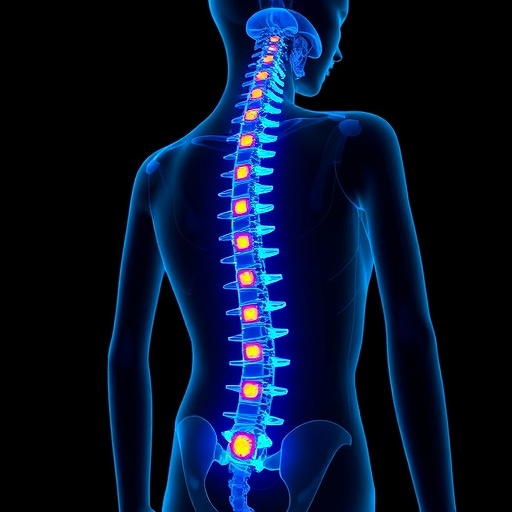
In the ever-evolving landscape of biomedical engineering, the integration of electronics with the human body continues to push the boundaries of what is possible in medical technology. In a groundbreaking development, researchers Hong, Pak, Cho, and colleagues have unveiled a revolutionary spinal bioelectronic device that boasts unprecedented ease of insertion and conformal attachment, heralding a new era in spinal healthcare. Their study, recently published in npj Flexible Electronics, presents a design underpinned by unidirectional dynamic stiffness modulation, a technological innovation that promises to overcome many of the longstanding challenges in the domain of implantable spinal devices.
Central to this pioneering work is the manipulation of the mechanical properties of the device, specifically its stiffness, which can be dynamically modulated in a directional manner. Traditional spinal implants often face difficulties balancing the mechanical rigidity necessary for stable positioning with the flexibility required to adapt to the complex, curved anatomy of the spinal cord and surrounding tissues. The novel approach taken by Hong and colleagues addresses this duality by enabling the device to switch its stiffness dynamically—in one direction—thereby allowing it to be both easily insertable during surgery and conformally attachable post-implantation.
The unidirectional dynamic stiffness modulation mechanism is realized through sophisticated material engineering, combining flexible substrates with responsive mechanical elements that can alter their Young’s modulus upon specific stimuli. This capability ensures that during insertion, the device maintains sufficient rigidity to navigate the dense tissue structures without deformation or damage, significantly simplifying the surgical procedure. After insertion, the device relaxes into a softer, flexible state, enhancing its ability to intimately interface with spinal tissues without exerting harmful pressure or causing discomfort, thus improving biocompatibility and patient outcomes.
One of the crucial technological advancements enabling this functionality involves the strategic layering and material selection within the bioelectronic device. The research team integrated shape-memory polymers and novel elastomers that respond to thermal or electromagnetic cues, allowing for the controlled stiffness transition. This intricate layering not only supports the mechanical transition but also maintains the electrical integrity necessary for the device to perform its bioelectronic functions, such as neural signal recording or electrical stimulation.
The application of such a device extends far beyond mere mechanical adaptability. By ensuring conformal attachment to the spinal cord, the device allows for more precise and reliable bioelectronic interfacing, which is vital for therapies targeting neurological disorders such as chronic pain, spinal cord injury, and neurodegenerative diseases. The improved signal fidelity achieved through enhanced contact quality can significantly improve diagnostic accuracy and therapeutic efficacy, providing a new tool in the arsenal of neuromodulation technologies.
Design challenges also included ensuring biocompatibility and minimizing immune responses, which are critical for long-term implantation success. The research addresses these concerns by employing ultrathin, flexible materials that match the mechanical properties of the surrounding biological tissues, thereby reducing irritation and fibrotic encapsulation. The conformal nature of the attachment further reduces micromotion between the device and spinal tissues, a common source of inflammation and device failure.
Moreover, the device’s fabrication process was tailored to be scalable and compatible with existing bioelectronic manufacturing techniques. The integration of advanced lithography and printing methods enables precise patterning of conductive traces and electrode arrays on flexible substrates, facilitating the device’s ability to maintain electrical performance alongside mechanical adaptability. This compatibility with mass production techniques suggests a promising pathway towards commercial viability and widespread clinical adoption.
During the in vivo testing phase, the researchers demonstrated the device’s remarkable self-adjusting stiffness properties through animal models. The device exhibited seamless insertion with minimal tissue disruption, followed by a spontaneous transition to a flexible, conformal state facilitating stable attachment to the spinal cord surface. Electrophysiological recordings confirmed the preservation of neural function post-implantation, indicating that the device’s dynamic mechanical properties did not compromise biological integrity.
This transformative technology also underscores the importance of multidisciplinary collaboration, bridging materials science, mechanical engineering, neurobiology, and clinical medicine. The team’s ability to integrate these domains resulted in a device that not only meets biomedical demands but also anticipates future therapeutic needs, potentially serving as a platform for next-generation spinal neural interfaces capable of more complex modulation and feedback functions.
Looking ahead, the implications of such a device are vast. Clinicians could offer more minimally invasive surgical procedures for spinal implants, reducing operating times and patient recovery periods. Patients suffering from debilitating spinal disorders might experience more effective treatments with fewer side effects due to the device’s capacity to maintain intimate contact without imposing mechanical stress. Furthermore, this technology opens new avenues for closed-loop bioelectronic systems where real-time monitoring and adaptive stimulation could revolutionize pain management and motor function restoration.
Another key aspect highlighted by the research is the potential for customization. The unidirectional stiffness modulation can be tuned to individual patient anatomy and pathology, allowing for personalized treatment regimens. By adjusting the material compositions and triggering mechanisms, devices can be engineered to precisely match the mechanical and functional requirements of diverse spinal conditions, paving the way for personalized spinal bioelectronics.
As the field advances, integration with wireless power delivery and data transmission systems is anticipated, removing the need for wired connections and further enhancing patient comfort and mobility. Such advancements could realize fully implantable, autonomous spinal bioelectronic systems capable of long-term operation without frequent medical intervention.
The study by Hong, Pak, Cho, and their team represents a seminal advancement in bioelectronic device engineering, showcasing a dynamic interplay between material innovation and clinical practicality. Their work elegantly solves the long-standing dilemma of balancing rigidity and flexibility within spinal implants, setting a new benchmark in the development of implantable neuromodulation technologies. This breakthrough not only enriches our understanding of material-tissue interactions but also offers tangible clinical benefits that could transform the management of spinal disorders worldwide.
In conclusion, the dynamic unidirectional stiffness modulation strategy represents a paradigm shift in the design of spinal bioelectronic devices, coupling mechanical ingenuity with therapeutic versatility. As further research builds on this foundation, clinicians and patients alike can anticipate a future where spinal implants are not only more effective but also less invasive, more comfortable, and tailored to individual needs. This could be the dawn of a new generation of bioelectronics that seamlessly integrate with our bodies, offering hope to millions affected by spinal ailments.
Cite Scienmag News
Denise Maddox. (March 4, 2026). Flexible Spinal Bioelectronic Device with Dynamic Stiffness. Scienmag. https://scienmag.com/flexible-spinal-bioelectronic-device-with-dynamic-stiffness/
Denise Maddox. "Flexible Spinal Bioelectronic Device with Dynamic Stiffness." Scienmag, 4 March 2026, https://scienmag.com/flexible-spinal-bioelectronic-device-with-dynamic-stiffness/. Accessed 3 September 2026.
Denise Maddox. "Flexible Spinal Bioelectronic Device with Dynamic Stiffness." Scienmag. March 4, 2026. https://scienmag.com/flexible-spinal-bioelectronic-device-with-dynamic-stiffness/


