


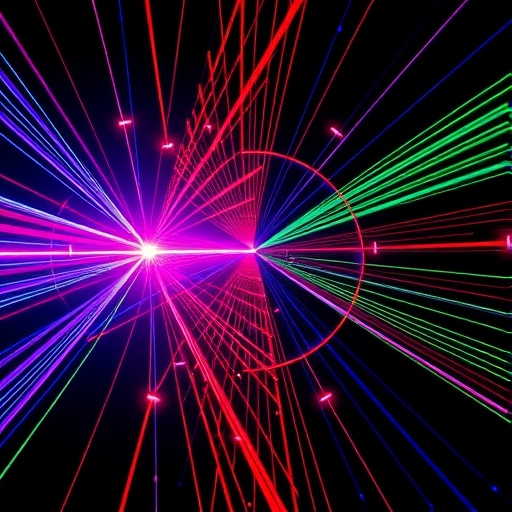
In a groundbreaking development that promises to revolutionize the field of photonics and nonlinear dynamics, researchers have unveiled new insights into the synchronization of complex spatio-temporal patterns using lasers. This breakthrough research, led by Mercadier, Bittner, and Sciamanna, delves deep into the heart of how intricate spatial and temporal behaviors can be coherently controlled and synchronized in laser systems, opening avenues for advancements in communication technologies, secure encryption, and beyond.
Spatio-temporal dynamics refer to how systems evolve in both space and time, and such complexity poses significant challenges in terms of predictability and control. Traditionally, synchronization—where multiple systems exhibit coordinated behavior—has been studied extensively in simple setups; however, achieving robust synchronization in high-dimensional systems characterized by intricate spatial structures and temporal fluctuations has remained elusive. The current study tackles this problem within the framework of nonlinear laser physics, exploring how complex patterns generated by lasers can be guided into synchrony.
Lasers, widely regarded as coherent sources of light, exhibit a variety of dynamical regimes under different operating conditions. When pushed beyond conventional steady-state operation, lasers can generate dynamic patterns that evolve over time across the spatial extent of the laser cavity. These patterns are not only fascinating from a fundamental physics perspective but are also highly relevant for practical applications where spatial and temporal coherence affect performance. The team systematically investigated how these complex spatio-temporal laser fields could be externally controlled to achieve synchronization over long temporal windows and spatial domains.
A key innovation in this work lies in the use of advanced feedback and coupling mechanisms to engage multiple laser elements or modes in a synchronized dance. The coupling design ensures that even intricate and chaotic-looking patterns, which are inherently sensitive to initial conditions and perturbations, can lock onto a common rhythm and spatial configuration. This remarkable level of control has never before been reported at this scale, revealing new physics at the intersection of chaos theory, laser optics, and nonlinear dynamics.
The authors harnessed state-of-the-art experimental setups combined with detailed theoretical modeling to reveal how synchronization unfolds through competing nonlinear interactions inside the laser medium. Their approach bridged the gap between single-variable synchronization often seen in oscillators and the far richer phenomena where multiple spatial modes and temporal frequencies interplay dynamically. This multi-dimensional synchronization promises to enhance the functionality of lasers by enabling stable and predictable output patterns tailored for specific technological demands.
One of the most striking outcomes of the study is the demonstration of stable synchronization in regimes that previously appeared too irregular or turbulent for reliable coherence. By carefully tuning parameters such as the pump current, cavity detuning, and feedback phase, the researchers could steer the system across dynamical transitions—from disordered chaos through intermittent synchronization, ultimately reaching robust, locked states with coherent spatio-temporal structures. This provides a powerful toolset for engineering laser devices capable of self-organizing into desired modes of operation on demand.
An important implication of these findings concerns telecommunications, where the demand for high bandwidth and secure data transfer drives innovation in modulation and encoding schemes. Coherent control over spatio-temporal laser patterns enables new modalities for multiplexing data channels, potentially increasing information density in optical fibers or free-space communication links. Moreover, the inherent sensitivity of chaotic laser fields to initial conditions can be exploited for encryption purposes, making eavesdropping prohibitively difficult without precisely matched synchronization protocols.
Beyond communications, the ability to tame complex laser dynamics contributes significantly to the development of ultra-precise sensing technologies. Synchronized spatio-temporal patterns can improve the resolution and stability of sensors based on interferometric or speckle imaging techniques, thereby impacting fields ranging from environmental monitoring to biomedical diagnostics. The study’s findings pave the way for integrated photonic circuits where multiple laser elements operate in concert, enabling miniaturized and multifunctional devices.
Theoretical implications of the research extend into the realm of nonlinear science, where understanding how high-dimensional chaotic systems can exhibit order is a fundamental challenge. The work provides a concrete experimental platform to test and refine theoretical models of coupled oscillators and pattern formation, enriching the dialogue between theory and experiment. This synergy will likely inspire further explorations into synchronization phenomena in other complex physical and biological systems that share structural similarities with lasers.
Furthermore, the demonstrated techniques open the door to exploring adaptive and learning capabilities in laser networks. By integrating feedback control strategies inspired by neural networks or machine learning, future laser architectures might self-optimize synchronization patterns in response to environmental changes or task requirements. This convergence of photonics and artificial intelligence represents a frontier with vast unexplored potential for innovative technologies.
The research community has widely recognized this study not only for its technical sophistication but also for its visionary outlook on controlling complexity. The blend of experimental precision, theoretical depth, and practical relevance marks a milestone that elevates the role of lasers from mere light sources to highly configurable platforms for dynamic information processing and advanced optical functionalities.
From the perspective of fundamental physics, these results challenge traditional views that associate chaos with unpredictability and disorder. Instead, they reveal that chaos can be harnessed and structured through synchronization, enabling complex systems to behave coherently over extended spatial and temporal scales. This represents a paradigm shift with far-reaching consequences for how complex phenomena are understood across disciplines.
The multi-disciplinary nature of the research, combining nonlinear dynamics, quantum optics, and information theory, underscores the necessity for collaborative approaches in tackling contemporary scientific problems. The successful demonstration of synchronized spatio-temporal dynamics in lasers is likely to catalyze new cross-disciplinary projects, fostering innovation at the interfaces of physics, engineering, and computer science.
Looking ahead, the principles outlined in this study may soon influence the design of next-generation laser arrays and photonic chips, optimizing performance for applications such as imaging, metrology, and computing. By unlocking control over previously inaccessible dynamical regimes, these innovations hold the promise to transform industries reliant on light-based technologies, propelling them into a new era of sophistication and capability.
In conclusion, this seminal research not only charts new territory in the control of complex spatio-temporal patterns but also sets a precedent for future explorations seeking to harness the full potential of nonlinear laser dynamics. It establishes a foundational framework that combines rigorous experimentation with insightful theory, opening exciting possibilities for technology and scientific discovery in the years ahead.
Cite Scienmag News
Katie Riggs. (March 1, 2026). Synchronizing Complex Spatio-Temporal Laser Dynamics. Scienmag. https://scienmag.com/synchronizing-complex-spatio-temporal-laser-dynamics/
Katie Riggs. "Synchronizing Complex Spatio-Temporal Laser Dynamics." Scienmag, 1 March 2026, https://scienmag.com/synchronizing-complex-spatio-temporal-laser-dynamics/. Accessed 4 September 2026.
Katie Riggs. "Synchronizing Complex Spatio-Temporal Laser Dynamics." Scienmag. March 1, 2026. https://scienmag.com/synchronizing-complex-spatio-temporal-laser-dynamics/


