


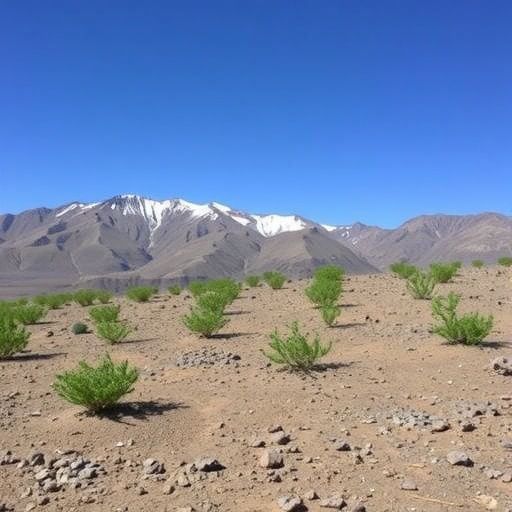
In a groundbreaking new study emerging from the arid region of Xinjiang in Northwestern China, researchers have illuminated the complex and dynamic nature of soil nitrous oxide (N2O) emissions along an expansive elevation gradient. This rigorous field investigation unveils the profound influence of climate-mediated temperature and moisture shifts on the release of nitrous oxide, a greenhouse gas whose potency in trapping heat vastly surpasses that of carbon dioxide. With drylands constituting nearly 40 percent of the global terrestrial surface, and their nitrous oxide contributions historically underexplored, these insights are poised to reshape our understanding of greenhouse gas feedbacks within arid mountain ecosystems.
The interdisciplinary research team undertook extensive field measurements spanning over 2,500 meters of elevation in the Tianshan Mountains, capturing gradients across several land-use types including forests, grasslands, croplands, and barren soils. To disentangle the multifaceted controls on N2O emissions, the investigators integrated gas flux monitoring with detailed analyses of soil chemistry and microbial community structures. This holistic approach permitted the identification of both abiotic environmental drivers and biotic mechanisms modulating nitrous oxide production in situ.
One of the most striking findings pertains to the disproportionate contribution of managed croplands to nitrous oxide emissions. Fueled by anthropogenic inputs such as irrigation and fertilization, these soils exhibited N2O fluxes several times higher than those from natural ecosystems. The augmented soil moisture and nutrient availability in cultivated areas create conditions conducive to enhanced microbial processes, effectively turning agricultural practices into dominant sources of this potent greenhouse gas within the studied region.
Conversely, emissions originating from the natural ecosystems demonstrated distinct and contrasting elevation-dependent trends shaped by vegetation type. Grassland soils revealed a clear positive correlation between elevation and N2O release. As altitude increased, cooler temperatures paradoxically coincided with higher soil moisture, fostering an environment where denitrifying microbes thrived. This ecological niche expansion led to significantly amplified nitrous oxide emissions at high elevations, emphasizing the nuanced interplay between temperature and moisture in regulating microbial activity under shifting climatic conditions.
Forested soils displayed an inverse pattern, with nitrous oxide emissions peaking at lower elevations and declining markedly toward the mountain summits. Here, temperature was identified as the predominant limiting factor, as cooler conditions at higher altitudes constrained microbial metabolism responsible for N2O production. This suggests that the forest soil microbial assemblages are more temperature-sensitive, and highlights how divergent ecosystems respond heterogeneously to the same climatic gradients.
Microbial community analyses further elucidated the baseline biological mechanisms underpinning these divergent emission patterns. Denitrifiers—the microbes mediating the conversion of nitrates to gaseous nitrogen forms including N2O—showed heightened activity and abundance in wetter, cooler grassland soils at elevation. In contrast, the forest soils’ microbial populations diminished with decreasing temperature, dampening nitrous oxide flux. These contrasting microbial responses highlight the essential role of ecological context in shaping greenhouse gas dynamics and underscore the microbial basis of emission variability.
The implications of these findings extend well beyond the arid mountains of Xinjiang. As climate change alters temperature regimes and precipitation patterns globally, analogous ecosystems may experience substantial shifts in their greenhouse gas exchange profiles. Particularly, the potential intensification of N2O emissions from natural grasslands under warming and increased moisture stands as a critical feedback mechanism that could accelerate atmospheric warming. This underscores the urgency of incorporating both climate sensitivity and land-use practices into predictive models to capture the true trajectory of greenhouse gas emissions from drylands.
Importantly, the research also signals the continuing dominance of agricultural management in driving nitrous oxide emissions. Given the scale of human-modified landscapes in arid regions, mitigation strategies must prioritize sustainable land use practices that balance productivity with greenhouse gas reductions. The capacity to modulate emissions via irrigation regimes, fertilizer application rates, and soil management offers tangible pathways to curtail agricultural contributions to climate forcing agents.
The researchers advocate for sustained, long-term monitoring programs that track soil greenhouse gas fluxes along diverse environmental gradients. Such efforts are critical to refine our predictive capabilities in the face of ongoing climatic shifts. By capturing temporal variability alongside spatial patterns, scientists can better anticipate ecosystem responses and advise nuanced land use policies that safeguard both environmental health and human livelihoods.
This study also serves as a clarion call to the broader scientific community regarding the significance of drylands in global climate dynamics. Historically overlooked or underrepresented in greenhouse gas budgets, arid and semiarid ecosystems demand concerted research attention. Improved mechanistic understanding of microbial and environmental interactions in these biomes will be indispensable for holistic climate modeling efforts and the formulation of resilient adaptation strategies worldwide.
In summary, the Xinjiang elevation gradient study offers a compelling demonstration of how intertwined climatic factors and human activities orchestrate soil nitrous oxide emissions in dryland mountain ecosystems. By elucidating the differential responses of forests, grasslands, and croplands to temperature and moisture regimes, it paves the way for more accurate and actionable climate predictions. The integration of field experimentation, microbial ecology, and biogeochemistry exemplifies a powerful framework for advancing climate science amid rapidly changing environmental conditions.
The research underlines that neglecting either the sensitivity of ecosystems to changing climatic variables or the influence of land management may lead to substantial underestimations in projected greenhouse gas emissions. Addressing this knowledge gap is paramount, especially given the expansive coverage of arid regions globally and their pivotal role in the Earth system. The synergy of climate science and sustainable agriculture emerges as a critical frontier in tackling the challenges posed by anthropogenic climate change.
Ultimately, the findings offer a sobering yet instructive perspective on the complex forces governing greenhouse gas fluxes in fragile dryland environments. They provide a foundation for informed policy and management decisions aimed at mitigating climate risks while maintaining ecosystem function and human well-being. As the planet warms and precipitation patterns shift, such interdisciplinary insights will be vital in navigating a sustainable and climate-resilient future.
Cite Scienmag News
Alan Morgan. (February 28, 2026). New Study Finds Climate Shifts May Increase Greenhouse Gas Emissions from Mountain Soils in Arid Regions. Scienmag. https://scienmag.com/new-study-finds-climate-shifts-may-increase-greenhouse-gas-emissions-from-mountain-soils-in-arid-regions/
Alan Morgan. "New Study Finds Climate Shifts May Increase Greenhouse Gas Emissions from Mountain Soils in Arid Regions." Scienmag, 28 February 2026, https://scienmag.com/new-study-finds-climate-shifts-may-increase-greenhouse-gas-emissions-from-mountain-soils-in-arid-regions/. Accessed 5 September 2026.
Alan Morgan. "New Study Finds Climate Shifts May Increase Greenhouse Gas Emissions from Mountain Soils in Arid Regions." Scienmag. February 28, 2026. https://scienmag.com/new-study-finds-climate-shifts-may-increase-greenhouse-gas-emissions-from-mountain-soils-in-arid-regions/


