


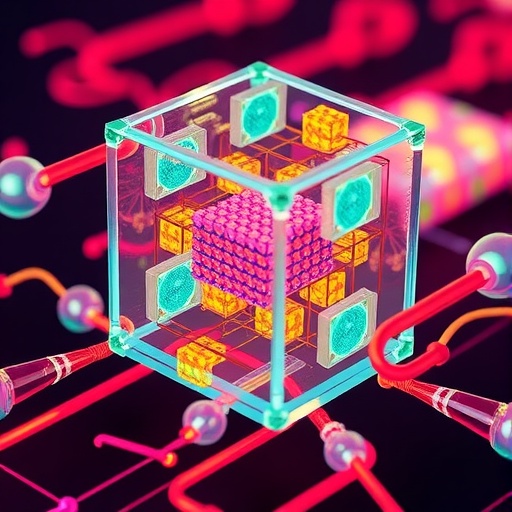
The quest for sustainable and efficient cooling technologies has reached a pivotal juncture, driving researchers to explore alternatives beyond conventional vapor-compression refrigeration. These traditional systems, relying on refrigerant gases, have long been scrutinized due to their environmental impact, notably contributing to global warming and facing stringent regulatory pressures. In response, solid-state cooling materials have emerged as a promising frontier, especially those exhibiting barocaloric effects, where pressure-induced phase transitions enable heat absorption and release without harmful gases.
Barocaloric materials function through reversible structural transitions triggered by pressure changes, making them ideal for next-generation refrigeration cycles. Among these, plastic crystals have garnered significant attention due to their pronounced barocaloric response near ambient temperatures. These materials undergo transformations between disordered (plastic crystal) and ordered crystalline phases, with the associated entropy changes dictating their thermal energy exchange capabilities. However, harnessing these caloric changes efficiently for practical applications is complicated by thermal hysteresis, which limits the reversible fraction of the entropy change achievable within operable pressures.
A multinational research effort led by institutions including the University of Glasgow and the University of Cambridge has unveiled a strategic compositional engineering approach that markedly enhances the reversible barocaloric effect in neopentyl glycol (NPG) plastic crystals. Pure NPG—renowned for its significant caloric response—has been hampered by a large thermal hysteresis, impairing its cyclic cooling reliability. By blending NPG with pentaglycerine (PG) to form a binary solution, researchers first shifted the critical transition temperature closer to room temperature, improving its pragmatic usability.
The breakthrough came with the introduction of a minute 2 mol % addition of pentaerythritol (PE), creating a ternary solid solution—NPG:PG:PE in a 60:38:2 ratio. This alteration achieved a transformative increase in barocaloric reversibility and operational temperature window at achievable pressures around 1 kbar. Specifically, the ternary material exhibited a reversible entropy change of 13.4 J kg⁻¹ K⁻¹, a sevenfold enhancement compared to pristine NPG, and broadened its effective thermal range by approximately 18 K. Consequently, the reversible refrigeration capacity soared by over seventy times, positioning this material as a highly competitive candidate for sustainable cooling technology.
Importantly, this compositional tuning does not diminish the intrinsic heat absorption capacity; the material continues to transition through the requisite ordered to disordered phases with significant thermal energy exchange. Instead, the small PE fraction subtly modifies the molecular landscape, mitigating the energy barriers responsible for hysteresis during compression and decompression cycles. This refined molecular interaction enables smoother phase transformations, vital for real-world applications demanding reliability and efficiency.
To elucidate the microscopic mechanisms underpinning these macroscopic improvements, the research team leveraged quasielastic neutron scattering (QENS) techniques at the Institut Laue-Langevin’s IN16B spectrometer. QENS is uniquely capable of capturing molecular motions on picosecond to nanosecond timescales within hydrogen-rich solids, providing a window into the dynamic rotational and translational behaviors that govern phase transitions. By deploying inelastic fixed-window scans during controlled heating and cooling, the team correlated molecular dynamics directly with calorimetric hysteresis and structural phase data from diffraction studies.
The neutron scattering data revealed striking differences in the onset and progression of molecular reorientations across the order-disorder transition. In pure NPG, molecular motions appeared abruptly and exhibited pronounced asymmetry between heating and cooling, reflecting substantial thermal hysteresis. Conversely, the ternary NPG–PG–PE material demonstrated a more gradual and extended evolution of molecular dynamics with reduced directional discrepancy. This indicates that the inclusion of PE disrupts large hydrogen-bonded clusters found in the binary and pure materials, fostering a molecular environment more conducive to reversible transformations.
This fundamental insight highlights the critical influence of hydrogen bonding networks on the phase behavior and thermo-mechanical response of plastic crystals. The attenuation of these networks by minimal PE doping translates directly to lowered hysteresis and enhanced reversibility, showcasing how precise molecular design can tailor bulk material properties. Such understanding is essential for refining barocaloric materials, bridging the gap between promising physical phenomena and technologically viable cooling solutions.
Beyond advancing the frontier of barocaloric materials, this research exemplifies the power of combining compositional tuning with cutting-edge neutron spectroscopy to unravel complex molecular phenomena. These findings not only pave the way for more reliable, efficient, and environmentally benign refrigeration technologies but also establish guiding principles for molecular engineering across functional solid-state materials. As global cooling demand escalates alongside climate concerns, innovations like this will play a pivotal role in shaping sustainable cooling infrastructures.
Furthermore, the study’s implications extend to other caloric effects and stimuli-responsive materials, suggesting broad applicability of the molecular design strategies revealed. The ability to fine-tune phase transition dynamics and hysteresis behavior at the molecular level opens new horizons for solid-state thermal management and energy conversion technologies. As research continues, integrating these insights with device engineering will be critical to translating laboratory advancements into commercial refrigeration solutions.
In sum, the enhanced reversible barocaloric effect realized through subtle compositional control in neopentyl plastic crystals demonstrates a promising path forward for solid-state cooling technologies. Through meticulous molecular engineering and sophisticated neutron-scattering investigations, researchers have unlocked a significant advancement in balancing high cooling capacity with practical operational reversibility. This paradigm shift holds promise not only for reducing the environmental footprint of cooling but also for revolutionizing the way thermal energy is managed in various sectors, from food preservation to climate control.
Credit for this transformative research belongs to the collaborative efforts of the University of Glasgow, University of Cambridge, Universitat Politècnica de Catalunya, Diamond Light Source, and the Institut Laue-Langevin. Their combined expertise and innovative use of neutron spectroscopy have been instrumental in bringing these findings to light, illustrating the profound potential of interdisciplinary research strategies in materials science.
Keywords
Materials science, Physics, Energy transfer, Heat, Spectroscopy
Cite Scienmag News
Bethany Barker. (February 27, 2026). Molecular Design Advances Solid-State Cooling, Eliminating the Need for Gases. Scienmag. https://scienmag.com/molecular-design-advances-solid-state-cooling-eliminating-the-need-for-gases/
Bethany Barker. "Molecular Design Advances Solid-State Cooling, Eliminating the Need for Gases." Scienmag, 27 February 2026, https://scienmag.com/molecular-design-advances-solid-state-cooling-eliminating-the-need-for-gases/. Accessed 31 August 2026.
Bethany Barker. "Molecular Design Advances Solid-State Cooling, Eliminating the Need for Gases." Scienmag. February 27, 2026. https://scienmag.com/molecular-design-advances-solid-state-cooling-eliminating-the-need-for-gases/


