


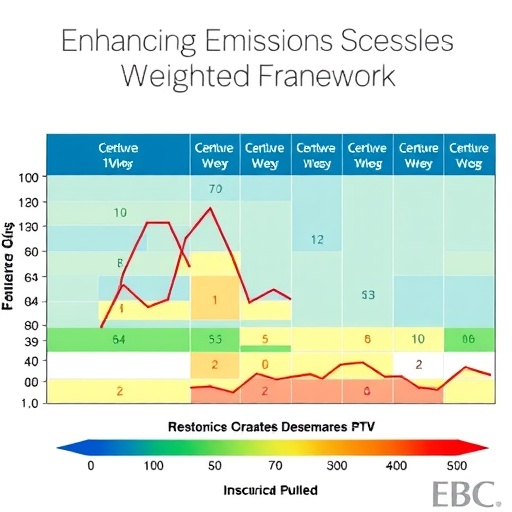
In the evolving landscape of climate modeling, researchers are increasingly grappling with the challenge of synthesizing emissions scenarios from a multitude of sources, each with its own underlying assumptions, model structures, and project origins. The fundamental issue lies in the clustering and repetition of scenarios that stem from common models or particular intercomparison projects, potentially skewing summary statistics and policy-relevant insights. Recent work has introduced an innovative weighting framework aimed at addressing these challenges by reducing the dominance of more common models or projects, thereby enhancing the diversity and robustness of scenario ensembles.
One of the key insights driving this advancement is the recognition that scenario similarity is often not purely coincidental, but heavily influenced by the extent to which models or intercomparison studies permeate the dataset. When multiple scenarios arise from the same modeling framework or collaborative initiative, the resultant ensemble becomes unbalanced, with some perspectives disproportionately influencing aggregated outcomes. The newly proposed diversity weighting framework effectively counters this issue by adjusting the relative contributions of models and projects when producing summary statistics, fostering a more representative synthesis of available emissions data.
At the heart of the diversity weighting lies the application of the Herfindahl–Hirschman index (HHI), a well-established metric in economics used to measure market concentration, now creatively repurposed for dataset analysis. In this context, a lower HHI following diversity weighting indicates a more balanced and evenly distributed dataset, where no single model or project excessively dominates the results. Empirical findings demonstrate a measurable decrease in HHI—ranging from 6 to 11 percent—across key categories such as model frameworks and projects for different emissions scenarios, signifying a substantial improvement in ensemble balance.
This approach is not simply a mathematical refinement but a foundational improvement that enhances the interpretability and utility of scenario ensembles. By dampening the overrepresentation of frequent contributors, the framework ensures that less prevalent but equally valid perspectives have a proportional influence. This guards against the inadvertent bias introduced when widely used models disproportionately drive policy conclusions, which could otherwise compromise climate mitigation strategies.
The research further acknowledges that while reducing concentration is a positive step, it does not guarantee complete elimination of bias—particularly where data gaps persist. Weighting cannot compensate for underlying deficiencies in scope or coverage, and thus, the framework is best viewed as a complement to ongoing efforts to broaden the diversity of emissions scenario inputs. Sensitivity analyses reinforce the robustness of this method, showing consistent trends even when varying the parameters of the weighting scheme.
Delving into the specifics, the impact of model and project prevalence on scenario weighting becomes apparent. Scenarios that achieve the highest diversity-weighted rankings generally emerge from model frameworks or projects with relatively low prevalence, thus escaping the pull of dominance by more common sources. Conversely, scenarios originating from highly prevalent projects or model frameworks often receive lower weights, reflecting their substantial contribution to dataset concentration and re-aligning representativeness.
An illustrative example is provided in the analysis of full-century carbon budgets. The lowest weighted scenarios, for instance, stem predominantly from the MESSAGE modeling framework, which is the second most prevalent contributor for certain carbon budget categories and often exhibits narrow differences in emission budgets. In contrast, higher weighted scenarios are linked with frameworks such as AIM, which, despite being less prevalent, contribute more distinctly varied carbon budget scenarios, highlighting the framework’s capacity to favor unique yet underrepresented perspectives.
These findings hold significant implications for decision-makers relying on climate mitigation pathways. Without such weighting, policy decisions might disproportionately reflect the biases of heavily represented models, potentially overlooking alternative but plausible scenarios. Implementing diversity weighting encourages a more balanced integration of model outputs, promoting policies that are resilient against the idiosyncrasies of any single model or project lineage.
The framework also serves as a blueprint for future scenario ensemble development, underscoring the importance of diversity not just in model construction, but also in the aggregation and interpretation stages. It challenges the climate modeling community to reevaluate how datasets are assembled and interpreted, advocating a transparent methodology that explicitly accounts for prevalence-driven biases.
Moreover, the methodological innovations extend the utility of the Herfindahl–Hirschman index beyond traditional economic applications, showcasing the versatility of cross-disciplinary metrics in enhancing climate science rigor. Such innovative application inspires further methodological cross-pollination, where tools developed for market analysis can meaningfully contribute to environmental data science.
The study’s reliance on comprehensive sensitivity tests bolsters confidence in the generalizability of the approach. These tests reveal that despite variations in input data or the particular weighting parameters chosen, the fundamental trend toward reduced dominance and increased diversity remains robust. This resilience is crucial for establishing the framework as a standard practice for climate ensemble analysis.
Looking forward, the research team emphasizes that the weighting scheme should be viewed as a step toward more equitable scenario utilization, rather than a panacea. Expanding the range of available models and improving data coverage is essential to capture the full spectrum of plausible futures. Weighting can mitigate the influence of data concentration but does not substitute the necessity of continuous model development and scenario diversification.
In practical terms, policymakers and analysts can apply this framework to reassess scenario-based reports, adjust policy recommendations, and better understand the uncertainties inherent in emissions pathways. The framework invites a recalibration of how large ensembles are summarized, potentially influencing integrated assessment models, climatological research, and international climate negotiations.
Beyond emissions scenarios, the conceptual insights presented in this work possess the potential for broader applicability across environmental modeling disciplines. Any field grappling with data clusters arising from common methodologies or data sources could benefit from analogous weighting techniques to ensure balanced representation and prevent overfitting in aggregate summaries.
In sum, this pioneering study delineates a sophisticated yet accessible strategy to balance scenario ensembles, significantly refining the accuracy and fairness of climate projections. Through judicious weighting driven by model and project prevalence, it reshapes the foundation upon which emissions scenario inferences are drawn, ensuring that climate policy is grounded in comprehensive, equitable, and less biased scientific evidence.
As climate science advances towards increasingly complex and encompassing models, frameworks like this will be indispensable for cultivating diverse and representative scenario ensembles. The stakes for effective mitigation and adaptation strategies demand nothing less than rigorously balanced data synthesis methods—tools that recognize and correct inherent dataset biases while amplifying diverse scientific voices.
This research not only informs best practices in ensemble analysis but also inspires continued innovation at the intersection of data science and climate modeling, highlighting how thoughtful methodological innovation can enhance our understanding of Earth’s future amid uncertainty.
Cite Scienmag News
Sloane Callahan. (February 27, 2026). Enhancing Emissions Scenario Ensembles with Weighted Framework. Scienmag. https://scienmag.com/enhancing-emissions-scenario-ensembles-with-weighted-framework/
Sloane Callahan. "Enhancing Emissions Scenario Ensembles with Weighted Framework." Scienmag, 27 February 2026, https://scienmag.com/enhancing-emissions-scenario-ensembles-with-weighted-framework/. Accessed 1 September 2026.
Sloane Callahan. "Enhancing Emissions Scenario Ensembles with Weighted Framework." Scienmag. February 27, 2026. https://scienmag.com/enhancing-emissions-scenario-ensembles-with-weighted-framework/


