


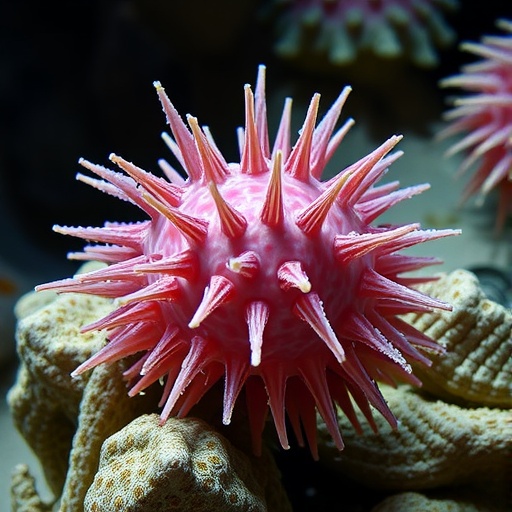
In a groundbreaking study poised to redefine our understanding of biological sensory systems, researchers have unveiled a previously hidden mechanoelectrical perception mechanism embedded within the biomineralized spines of sea urchins. This discovery uncovers remarkable insights into how these marine creatures perceive mechanical stimuli in their environment, revealing sophisticated natural engineering that transcends traditional assumptions about echinoderm sensory capabilities.
At the heart of this phenomenon lies the unique gradient cellular structure of the sea urchin’s spine, composed of biomineralized stereom—a porous microstructure exhibiting a continuous change along the central [001] axis of the spine. The researchers’ meticulous characterization shows that as one moves from the base toward the apex of the spine, the microstructural parameters—including pore diameter, porosity, and specific surface area—shift dramatically. This architectural gradient plays a vital role in amplifying the biomechanical-to-electrical conversion processes intrinsic to mechanoelectrical perception.
The apex of the spine, presenting smaller diameter pores, heightened porosity, and an increased specific surface area, emerges as a critical functional zone for generating high charge densities at the solid-liquid interface when fluid flows around the spine. These charge variations create streaming potentials that effectively transduce mechanical disturbances into electrical signals, essentially transforming the sea urchin spine into a natural mechanoelectrical sensor optimized for underwater signaling.
What renders this discovery even more compelling is the successful translation of these natural gradient structures into engineered biomimetic devices. By utilizing advanced 3D printing technologies, the research team fabricated artificial spine-like ceramic and polymer samples emulating the gradient stereom microstructure. These synthetic analogs exhibited a remarkable enhancement in voltage output—tripling the electrical response compared to uniform, gradient-free controls—and demonstrated an eightfold increase in signal amplitude differentials during water flow, highlighting the critical importance of the gradient cellular architecture in sensory performance.
This mechanistic insight holds profound implications for the design of next-generation underwater sensors. By leveraging the evolutionary-honed architecture of sea urchin spines, scientists unveiled the potential of gradient cellular materials to constitute a new class of mechanoelectrical receptors. Such devices are capable of real-time, time-resolved underwater self-monitoring, introducing unparalleled capabilities for environmental sensing in aquatic contexts that require responsiveness and durability.
Unlike conventional microlattice or porous constructs, the nature-inspired 3D metamaterial mechanoreceptors demonstrate enhanced manufacturability and structural designability. Their material universality, which spans ceramics to polymers, enables tailored performance parameters through geometric and compositional control. These advantages offer a transformative platform for applications ranging from underwater robotics to fluid flow monitoring and aquatic environmental assessment.
Fundamentally, this research challenges and expands long-held perspectives on the functional repertoire of echinoderms, organisms often noted primarily for their mechanical defense properties. Here, the mechanoelectrical perceptive capacity rooted in the gradient cellular structure reveals an underappreciated sensory modality, elevating our comprehension of echinoderm biology and pointing to broader implications for other natural cellular solids such as wood, sponge, and trabecular bone.
The conceptual revelations extend beyond biology, inspiring a new paradigm in functional material engineering. By harnessing biomimetic principles derived from the stereom gradients, material scientists can engineer gradient cellular solids with optimized mechanoelectrical properties, unlocking possibilities in underwater spatiotemporal sensing technologies and advancing water resource utilization methodologies.
Underpinning these findings is the physics of streaming potentials generated by fluid flow through gradient porous structures, a phenomenon elegantly exploited by the sea urchin’s stereom. The intricate interplay between microstructural geometry and electrokinetic effects enables the spine to convert minute fluid mechanical disturbances into measurable electrical signals—a capability that may well parallel natural mechanoreceptors in more complex organisms.
Moreover, the time-resolved signal detection achieved in the biomimetic mechanoelectrical sensors offers a powerful tool for dynamic underwater environments. Sensory systems inspired by these gradient spines could detect transient fluid motions or mechanical vibrations with high temporal resolution, opening avenues for sensitive underwater communication, movement detection, and structural health monitoring.
This research not only enriches marine biology and materials science but also paves the way for novel interdisciplinary technologies, combining bioinspired design, advanced materials processing, and electrokinetic principles. The prospect of integrating such mechanoelectrical perception mechanisms into wearable devices, autonomous underwater vehicles, or environmental sensors presents exciting opportunities for technological innovation rooted in nature’s ingenuity.
In summary, the elucidation of the gradient stereom’s role in enhancing mechanoelectrical perception in sea urchin spines offers a compelling narrative of how natural cellular solids have evolved multifunctionality beyond mechanical support or defense. The successful replication and amplification of these properties in artificial systems promise a revolution in the design of mechanoelectrical sensors tailored for aquatic environments and beyond.
Cite Scienmag News
Denise Maddox. (February 27, 2026). Echinoderm Stereom Structures Drive Mechanoelectrical Sensing. Scienmag. https://scienmag.com/echinoderm-stereom-structures-drive-mechanoelectrical-sensing/
Denise Maddox. "Echinoderm Stereom Structures Drive Mechanoelectrical Sensing." Scienmag, 27 February 2026, https://scienmag.com/echinoderm-stereom-structures-drive-mechanoelectrical-sensing/. Accessed 4 September 2026.
Denise Maddox. "Echinoderm Stereom Structures Drive Mechanoelectrical Sensing." Scienmag. February 27, 2026. https://scienmag.com/echinoderm-stereom-structures-drive-mechanoelectrical-sensing/


