


In the intricate and vast expanse of the Amazon rainforest, a subtle yet profound tale of resilience is unfolding—one that challenges our understanding of how these ancient trees withstand the relentless pressures of drought and climate variability. A groundbreaking study published in Nature Communications by Tavares, Gloor, Silva, and colleagues has revealed a compelling pattern engraved deep within the genetic families of Amazonian trees, illuminating their remarkable resistance to embolism, a critical hydraulic failure that threatens their survival in water-stressed conditions. This discovery not only reshapes our comprehension of plant hydraulics across the basin but also offers vital clues about the future fate of the Amazon amidst escalating climate change.
Embolism in tree physiology refers to the formation of air bubbles within the xylem vessels—tiny conduits responsible for transporting water from roots to leaves. Under drought conditions, these bubbles can disrupt the continuous water column, effectively blocking water movement and causing hydraulic failure, which can lead to branch dieback or even whole-tree mortality. Hence, embolism resistance constitutes a fundamental trait for tree survival in fluctuating hydrological conditions, making it a central focus in forest hydraulic research.
The Amazon rainforest, often coined the “lungs of the planet,” hosts thousands of tree species, each adapted in unique ways to local environmental gradients. However, until now, a basin-wide synthesis of embolism resistance patterns was conspicuously absent. The collaborative international team embarked on an unprecedented endeavor, compiling extensive measurements of embolism vulnerability from numerous sites across the Amazon. By integrating phylogenetic analyses with hydraulic trait data, the researchers unveiled a “family imprint”—a deep evolutionary fingerprint—governing embolism resistance throughout the basin.
At the core of this study lies the concept that embolism resistance is not randomly distributed among Amazonian tree species but is predominantly structured along taxonomic lines. Certain tree families consistently exhibit higher or lower vulnerability to embolism, regardless of their local environments. This strong phylogenetic signal suggests that evolutionary history shapes the hydraulic safety of Amazonian trees, potentially constraining their adaptive capacity amid rapid climate shifts.
One of the most striking findings is the link between embolism resistance and broader ecological strategies. Tree families with greater embolism resistance often correspond with slow-growth, conservative resource use strategies, favoring survival over rapid growth. Conversely, families more susceptible to embolism tend to display fast-growth, acquisitive traits, thriving in resource-rich sites but possibly facing heightened risk during drought episodes. This trade-off underscores the intricate balance between growth and survival strategies encoded in the evolutionary lineage of these species.
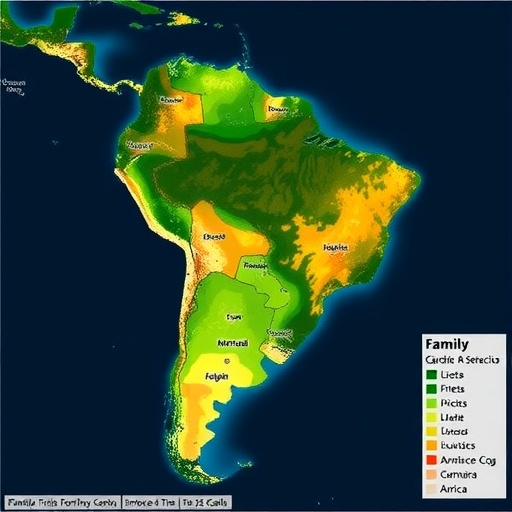
Furthermore, the study’s spatial analyses revealed basin-wide gradients in embolism resistance that mirror climatic and edaphic variations. For instance, trees in drier western Amazonian regions showcase higher embolism resistance compared to their counterparts in the wetter eastern forests. This pattern coherently aligns with the selective pressures imposed by regional climate, reflecting long-term adaptation to water availability. Such insights illuminate how Amazonian forests have been sculpted by both evolutionary forces and environmental filters.
Delving deeper, the researchers examined how embolism vulnerability impacts ecosystem dynamics and forest resilience. Embolism resistance influences not only individual tree survival but also community composition, carbon storage capacity, and ultimately, ecosystem functioning. Particularly under the increasing frequency of droughts precipitated by anthropogenic climate change, embolism-resistant species may buffer forests against widespread dieback, maintaining vital carbon sequestration services.
These findings bear profound implications for models forecasting Amazon forest responses to future climatic scenarios. By incorporating hydraulic traits and phylogenetic constraints, predictive models gain enhanced realism in estimating forest vulnerability and potential shifts in species distributions. The recognition of a family-wide hydraulic blueprint suggests that some lineages might be more vulnerable to climate-driven hydraulic failure, highlighting the need for targeted conservation strategies focusing on susceptible taxa.
In addition, the research challenges prevailing assumptions about the plasticity of embolism resistance. While some hydraulic traits show limited flexibility within species, the entrenched family-level patterns point to evolutionary inertia—traits conserved over millions of years. This revelation provokes urgent questions about whether Amazonian tree species can adapt rapidly enough to keep pace with the accelerating climatic perturbations expected in coming decades.
The study also leveraged cutting-edge methods, combining hydraulic vulnerability curves, molecular phylogenetics, and basin-scale environmental data. This integrative approach exemplifies the power of modern interdisciplinary research to unravel complex eco-physiological phenomena. By bridging plant physiology, evolutionary biology, and ecosystem ecology, the team pioneers a new frontier in understanding forest function and resilience at unprecedented scales.
Moreover, the results invite reflections on global forest conservation policies. The Amazon’s hydraulic diversity embodies intrinsic ecological resilience, yet it is increasingly threatened by deforestation, fragmentation, and climate stressors. Protecting this hydraulic heritage demands preserving not only species richness but also the evolutionary lineages representing distinct hydraulic strategies. Conservation planning must integrate trait-based vulnerabilities to sustain the functional integrity of Amazonian forests.
From a broader perspective, this study contributes crucial knowledge to the discourse on plant responses to drought worldwide. Similar hydraulic mechanisms govern tree survival in diverse forests, from African savannas to temperate woodlands. Lessons drawn from the Amazon’s family imprint on embolism resistance enrich our understanding of global forest resilience mechanisms, informing adaptation strategies under global change.
The research also underscores the necessity for comprehensive trait databases encompassing diverse taxa and geographic regions. Such repositories enable the detection of large-scale patterns and evolutionary constraints, guiding both theoretical advances and applied conservation efforts. The Amazon continues to serve as a living laboratory for studying how evolutionary history interfaces with environmental challenges.
Future research directions emerging from this work include investigating the genetic bases underpinning embolism resistance traits, exploring potential phenotypic plasticity in hydraulic function under experimental droughts, and assessing how community assemblages may restructure as climate changes unfold. Long-term monitoring coupled with experimental manipulations will be crucial to delineate adaptive capacities and thresholds.
In conclusion, the revelation of a family-level imprint on embolism resistance across the Amazon basin marks a transformative step in forest ecology and plant hydraulics. This intricate evolutionary signature encapsulates how ancient lineages have navigated millennia of climatic fluctuations, offering a beacon of hope and a cautionary tale for conservation in an era of unprecedented environmental change. For scientists, policymakers, and the broader public alike, understanding these hidden hydraulic blueprints is paramount to safeguarding the Amazon’s future and, by extension, the health of the global biosphere.
Cite Scienmag News
Violet Maxwell. (February 26, 2026). Family Traits Map Amazon Forest Embolism Resistance. Scienmag. https://scienmag.com/family-traits-map-amazon-forest-embolism-resistance/
Violet Maxwell. "Family Traits Map Amazon Forest Embolism Resistance." Scienmag, 26 February 2026, https://scienmag.com/family-traits-map-amazon-forest-embolism-resistance/. Accessed 1 September 2026.
Violet Maxwell. "Family Traits Map Amazon Forest Embolism Resistance." Scienmag. February 26, 2026. https://scienmag.com/family-traits-map-amazon-forest-embolism-resistance/


