


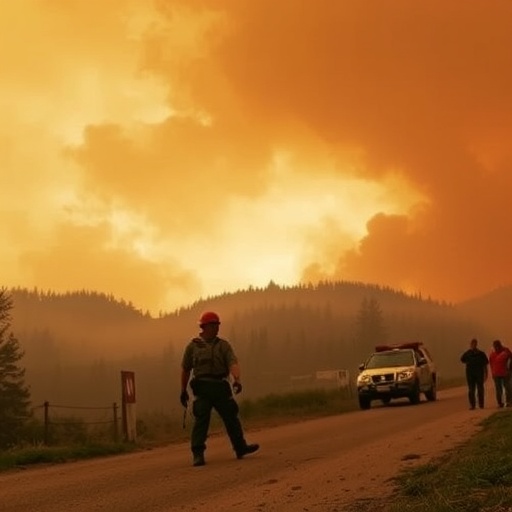
In recent years, the intersection between environmental factors and human behavior has become a critical area of research, revealing complex, and sometimes unexpected, dynamics. A groundbreaking study conducted over an eleven-year timeframe has unearthed compelling evidence demonstrating a direct causal relationship between wildfire smoke pollution and the escalation of violent assaults in Seattle. This pioneering research, which integrates advanced data analytics with atmospheric science, provides robust support that even short-term exposure to the fine particulate matter specifically generated by wildfires can significantly intensify interpersonal violence within an urban setting.
This comprehensive investigation was spearheaded by Lion Kircheis, a researcher based at the University of Konstanz, whose analytical approach employed satellite-based smoke predictions combined with sophisticated instrumental-variable statistical methods. These methodologies enabled the isolation of wildfire-specific particulate pollution from other ambient air quality variables, ensuring the research focused precisely on the influence of wildfire smoke, rather than conflating results with other urban pollution sources. The dataset spanned from 2013 to 2023, encompassing daily measures of air quality, particularly fine particulate matter (PM2.5), alongside meticulously recorded police reports of violent assaults across Seattle.
The significance of PM2.5 in this context cannot be overstated. Wildfire smoke was found to elevate daily PM2.5 concentrations by an average of 7 micrograms per cubic meter (μg/m³), a considerable increase that correlates strongly with physiological stress responses. Importantly, the data revealed that on days affected by wildfire smoke, there was approximately a 3.6% rise in the incidence of violent assaults. This correlation extended further, with each incremental rise of 1 μg/m³ in PM2.5 being associated with a 0.5% augmentation in assault rates, underscoring a dose-dependent relationship between particulate pollution and aggressive behaviors.
The researchers meticulously evaluated alternative explanations for these findings. Crucially, factors such as police response times and traffic accident rates remained unchanged during smoke events, thereby excluding the possibility that reduced law enforcement capacity or increased accident-related social stress accounted for the uptick in assaults. Furthermore, domestic violence reports remained stable, indicating that the violence increase was geographically and contextually specific, predominantly occurring in outdoor environments where wildfire smoke exposure is most acute. This specificity was further supported by an observed rise in low-severity uses of police force when smoke levels were elevated, suggesting that exposure to smoke may provoke heightened tensions leading to more frequent confrontations.
While the study did not investigate the underlying biological mechanisms directly, the patterns observed strongly implicate acute physiological and psychological reactions to the inhalation of wildfire-derived fine particulates. These reactions may include systemic inflammation, respiratory distress, discomfort, and elevated stress hormones such as cortisol, which collectively have the potential to impair judgment and increase irritability. The neural and endocrinological cascades activated by air pollution exposure could feasibly prime individuals for aggressive behavior, a hypothesis consistent with existing literature on environmental stressors and mood dysregulation.
This research arrives at a pivotal moment as climate change continues to exacerbate the frequency, intensity, and duration of wildfire seasons globally. The resultant smoke plumes contribute an increasing share to overall urban air pollution, imposing not only well-documented health burdens but, as now evidenced, also substantial social and behavioral consequences. Populations most vulnerable to these effects include outdoor workers, individuals lacking access to clean indoor environments, and people experiencing homelessness—groups whose exposure to wildfire smoke is often unavoidable and who may face compounded risks from both health and social harms.
The implications of Kircheis’s findings stretch beyond environmental and public health spheres, inviting urban planners, policymakers, and climate scientists to reframe wildfire management and climate mitigation strategies within a broader societal context. As the study suggests, interventions aimed at reducing wildfire occurrence and smoke exposure could yield substantial dividends not only in improving respiratory and cardiovascular health but also in enhancing public safety by curbing violence.
This research, published in Environmental Research Letters, draws from a robust statistical foundation and articulates a compelling narrative that underscores a previously overlooked consequence of climate-driven environmental degradation. The utilization of remote sensing data and innovative econometric techniques exemplifies how interdisciplinary approaches can unravel complex cause-effect relationships that traditional observational studies might miss.
Kircheis emphasizes that equitable public health and safety responses are crucial, as the burdens of wildfire smoke disproportionately afflict marginalized communities. Effective policy measures could include expanding access to air purification resources, developing heat and pollution early-warning systems, and prioritizing wildfire mitigation efforts in areas adjacent to urban populations. These strategies integrate public health objectives with social equity considerations, recognizing that the cumulative impact of environmental stressors extends into the social fabric of communities.
Ultimately, this study challenges the conventional understanding of air pollution effects, illuminating how environmental triggers can influence human social interactions and behaviors on a population level. It beckons further research to unravel the precise biological pathways linking particulate matter exposure to aggression and to explore potential interventions that could buffer vulnerable populations from these adverse outcomes.
As wildfires and associated smoke episodes become more prevalent in the Anthropocene epoch, the intersection of climate change, air quality, and societal well-being demands our urgent and sustained attention. This investigation lays a vital foundation for future work that bridges environmental science, public health, and social dynamics, offering a nuanced perspective on how the invisible particles carried by wildfire smoke resonate through the very fabric of urban life.
Cite Scienmag News
Russell Cooper. (February 26, 2026). New 11-Year Study Finds Link Between Wildfire Smoke and Increase in Violent Assaults. Scienmag. https://scienmag.com/new-11-year-study-finds-link-between-wildfire-smoke-and-increase-in-violent-assaults/
Russell Cooper. "New 11-Year Study Finds Link Between Wildfire Smoke and Increase in Violent Assaults." Scienmag, 26 February 2026, https://scienmag.com/new-11-year-study-finds-link-between-wildfire-smoke-and-increase-in-violent-assaults/. Accessed 5 September 2026.
Russell Cooper. "New 11-Year Study Finds Link Between Wildfire Smoke and Increase in Violent Assaults." Scienmag. February 26, 2026. https://scienmag.com/new-11-year-study-finds-link-between-wildfire-smoke-and-increase-in-violent-assaults/


