


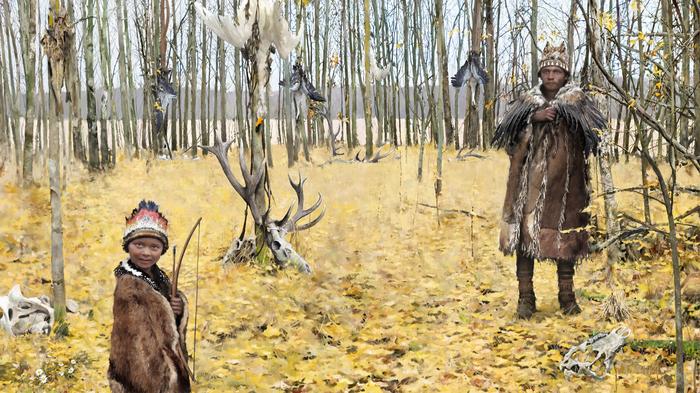
A groundbreaking study published recently has unveiled new insights into the clothing and burial practices of Mesolithic Stone Age societies around 7,000 years ago. Conducted at the renowned Skateholm I and II cemeteries in Scania, southern Sweden, the research analyzed microscopic remnants of organic materials, including fibers, hairs, and feather fragments, unearthed from 35 graves within a total of 87 excavated burial sites. This pioneering archaeological research not only deepens our understanding of prehistoric funerary customs but also opens new avenues for studying organic artifacts in contexts where preservation is typically poor.
The Skateholm cemeteries, which were excavated in the 1980s, have long been recognized as some of the most important Mesolithic burial sites in northern Europe. During the initial excavations, archaeologists uncovered an array of stone tools and remains of animals such as bones, antlers, and teeth, indicative of a complex cultural relationship with the environment. However, it wasn’t until now, thanks to advancements in microarchaeological techniques, that the scope and richness of organic burial goods have come to light, revealing a much more nuanced picture of Mesolithic life.
At the heart of this study is a revolutionary analytical method developed by the University of Helsinki’s ERC-funded Animals Make Identities project. This technique, known as water-assisted fibre separation, enables the extraction and identification of microscopic remains of fibers, hairs, and feathers from soil samples taken directly from graves. Prior to this innovation, such soft organic materials rarely survived the millennia, or were simply impossible to detect with conventional archaeological methods. Applying this technique extensively to the Skateholm grave samples marks the first large-scale implementation in archaeological research and is a testament to its effectiveness and potential.
The lead researcher, Tuija Kirkinen, an expert in microarchaeology and organic material culture, spearheaded the analytical process. Kirkinen emphasizes the challenges inherent in species-level identification of microscopic fragments, a complex task requiring highly specialized expertise and refined methods. Despite these challenges, the study successfully identified a diverse range of organic materials, including feathers from aquatic birds and mammals’ fur such as those from mustelids and felines. These findings significantly enrich our understanding of the use of natural resources in Mesolithic clothing and burial ceremonies.
One of the most striking revelations from the analysis is the evidence of elaborate headgear and footwear made from bird feathers and animal fur. The presence of hawk, eagle, and owl feathers laid around the heads of the deceased suggests that these societies adorned themselves with visually impressive and symbolically significant headdresses. Meanwhile, fragments of fur and bird feathers found near the feet of skeletons point to the production of multi-colored footwear fashioned from these natural materials, suggesting highly skilled craftsmanship and complex aesthetic sensibilities in Stone Age attire.
This study also challenges previous assumptions about graves considered empty during earlier excavations. The detection of fur and feather remains in these previously “artifact-free” burial sites reveals that organic items were more prevalent in burial rites than formerly acknowledged. For instance, in one grave, a combination of white hair from a stoat or weasel, brown feline hair, and bird feather fragments were found at the feet of a woman over 60 years old. This discovery hints at sophisticated use of multiple organic materials in funerary wear, illuminating aspects of personal identity and status that were expressed through clothing and decoration.
Beyond enriching knowledge of Mesolithic clothing, this research advances methodological approaches in archaeology. Traditional preservation of organic materials such as textiles, fur, and feathers has been notoriously difficult due to natural decay processes, especially in non-aquatic or glacier contexts. However, the water-assisted fibre separation technique delivers the ability to recover microscopic organic remains from soil samples taken in dry or otherwise suboptimal preservation environments. This breakthrough expands the possibilities for studying prehistoric soft material culture globally, offering fresh perspectives on societies that left behind little in the way of durable artifacts.
The significance of birds and their feathers in Mesolithic societies is now better understood as central to both practical and symbolic functions. Feathers were not only components of clothing but likely carried cultural meanings—potentially marking social status, ceremonial roles, or spiritual beliefs. The interplay between these natural elements and human identity, as reflected in material culture, sheds light on the complexity of Mesolithic lifeways and their sophisticated relationship with the animal kingdom.
Moreover, the use of aquatic bird skins and terrestrial mammal fur as textile materials showcases a highly adaptive use of available resources. This versatility underscores the ingenuity of these early hunter-gatherer communities in tailoring their garments to environmental conditions and social needs. It also indicates an intricate knowledge of animal biology and processing techniques, highlighting the advanced technological capabilities of prehistoric people.
The research builds on the broader objectives of the Animals Make Identities project, emphasizing the connections between humans and animals not only as subsistence resources but also as integral to identity construction and social expression. Such interdisciplinary endeavors, combining archaeology, biology, and material science, drive a deeper comprehension of cultural dynamics in prehistory, bridging gaps left by traditional archaeological methods.
In summary, the Skateholm study represents a major advance in Stone Age archaeology by providing concrete evidence of soft organic materials in burial contexts where such preservation was once thought impossible. This adds rich texture to our understanding of Mesolithic burial customs, clothing technology, and symbolic practices. With continued refinement of fibre separation techniques and microscopic analyses, the prospects for uncovering similar organic materials in other ancient sites worldwide appear promising, heralding a new era in archaeological discovery.
The study has been published in the journal Archaeological and Anthropological Sciences and involves collaboration between the University of Helsinki and Lund University. It is funded by the European Research Council, exemplifying the growing integration of innovative science in unraveling human prehistory’s remaining mysteries.
News Publication Date: 20-Feb-2026
Web References:
- https://link.springer.com/article/10.1007/s12520-026-02415-7
- https://www.helsinki.fi/en/researchgroups/animals-make-identities
References:
Kirkinen, T., Larsson, L. & Mannermaa, K. 2026. Waterbirds, mustelids and bast fibres – evidence of soft organic materials in the Late Mesolithic Skateholm I and II cemeteries, Sweden. Archaeological and Anthropological Sciences.
Cite Scienmag News
Courtney Benton. (February 24, 2026). Ancient Stone Age Individual Adorned with Elaborate Feather and Fur Headdress Discovered. Scienmag. https://scienmag.com/ancient-stone-age-individual-adorned-with-elaborate-feather-and-fur-headdress-discovered/
Courtney Benton. "Ancient Stone Age Individual Adorned with Elaborate Feather and Fur Headdress Discovered." Scienmag, 24 February 2026, https://scienmag.com/ancient-stone-age-individual-adorned-with-elaborate-feather-and-fur-headdress-discovered/. Accessed 3 September 2026.
Courtney Benton. "Ancient Stone Age Individual Adorned with Elaborate Feather and Fur Headdress Discovered." Scienmag. February 24, 2026. https://scienmag.com/ancient-stone-age-individual-adorned-with-elaborate-feather-and-fur-headdress-discovered/


