


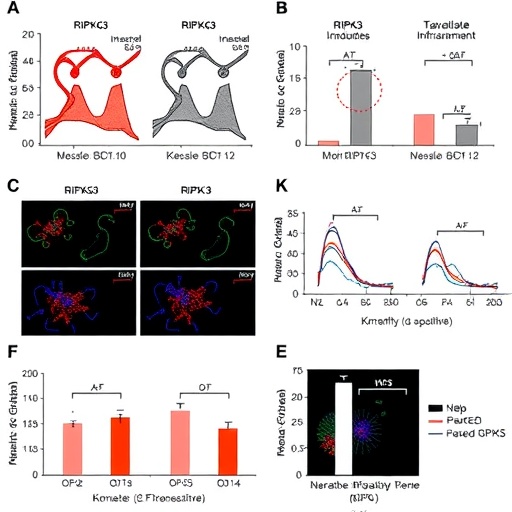
In a groundbreaking study published in Cell Death Discovery, researchers Du, Li, Zhao, and colleagues have unveiled novel insights into the enigmatic scaffolding functions of RIPK3, a critical protein historically recognized for its kinase activity in programmed cell death pathways. By engineering a viable mouse model harboring a kinase-inactive mutant form of RIPK3 — specifically the D143N mutation — the team has shifted the paradigm in understanding how RIPK3 orchestrates inflammatory disorders mediated by tumor necrosis factor (TNF). This research underscores the protein’s multifaceted role far beyond its enzymatic activity, shedding light on non-catalytic mechanisms that drive complex inflammatory responses.
RIPK3 (Receptor-Interacting Protein Kinase 3) has long been studied as a linchpin in necroptosis, a form of regulated necrotic cell death implicated in diverse pathological conditions ranging from ischemic injuries to inflammatory diseases. Traditionally, RIPK3’s pro-death function has been linked to its kinase domain’s phosphorylation events that propagate downstream signaling cascades culminating in necroptosis execution. However, the full spectrum of RIPK3’s physiological roles remains incompletely described, confounded by challenges in distinguishing kinase-dependent from kinase-independent effects in vivo.
Addressing this gap, the team employed precise genetic engineering to introduce the D143N point mutation into the RIPK3 gene. This alteration renders the kinase domain catalytically inactive while preserving the protein’s overall structural integrity and expression. Remarkably, mice harboring this kinase-dead RIPK3 variant were viable, enabling researchers to probe scaffold-dependent roles of the protein within intact biological systems without the confounding lethality often seen in complete knockouts.
The study’s findings compellingly demonstrate that despite lacking kinase activity, the RIPK3 D143N mutant retains the ability to facilitate TNF-induced inflammatory pathology. This uncouples the kinase enzymatic function from the protein’s capacity to propagate inflammatory signaling, suggesting that RIPK3’s scaffold properties — its ability to serve as a molecular platform assembling signaling complexes — are sufficient to drive inflammation under TNF stimulation. This challenges the historical dogma that kinase activity is requisite for RIPK3’s pathological roles.
Through rigorous biochemical assays and immunoprecipitation studies, the researchers mapped critical protein-protein interactions mediated by the kinase-inactive mutant. The RIPK3 D143N protein continued to recruit effector molecules such as RIPK1 and FADD, forming signaling nodes that activate downstream inflammatory mediators. This scaffold assembly promoted NF-κB activation and cytokine production independent of necroptotic cell death, revealing a kinase-independent inflammatory axis governed by RIPK3.
In vivo interventions further substantiated this model. The kinase-inactive mice exhibited pronounced inflammatory phenotypes in response to systemic TNF challenge, including tissue infiltration by immune cells and elevated proinflammatory cytokines, closely mirroring disease states seen in wild-type counterparts. Pharmacological inhibition of RIPK3 kinase activity alone would therefore be insufficient to suppress RIPK3-driven inflammation, emphasizing the need to target its scaffold functions as well for therapeutic approaches.
This discovery opens critical avenues for the development of more nuanced anti-inflammatory therapeutics for conditions such as rheumatoid arthritis, inflammatory bowel disease, and sepsis, where TNF and RIPK3-mediated pathways are pathogenically activated. Small molecules or biologics designed to disrupt protein-protein interfaces within the RIPK3 complex might offer superior efficacy over kinase inhibitors by selectively attenuating scaffold-dependent proinflammatory signaling while sparing necroptotic functions essential for host defense.
Beyond translational implications, these insights refine our conceptual framework of kinase proteins as multifunctional entities whose biological impact transcends enzymatic catalysis. scaffold functions modulated through structural domains and binding motifs emerge as equally vital in shaping cellular responses to inflammatory cues. RIPK3 thus serves as a paradigm for this emerging class of multifunctional kinases with dual enzymatic and scaffolding capacities.
The investigators further speculate that kinase-independent scaffold functions of RIPK3 may contribute to unresolved chronic inflammation in a variety of human diseases hitherto unexplained by canonical necroptotic pathways. This positions their novel D143N mouse model as an indispensable tool for dissecting complex signaling networks and assessing candidate interventions targeting scaffold interfaces in vivo with high physiological relevance.
The study also encourages revisiting other kinases long thought to act solely through phosphotransfer reactions, exploring their potential scaffold roles in pathophysiology. Dual-function kinases may be more common than previously recognized, necessitating integrated therapeutic strategies combining enzymatic and interface disruption for maximal clinical benefit.
In sum, Du and colleagues’ study stands as a transformative milestone in inflammation and cell death research, unraveling the distinct kinase-independent scaffold role of RIPK3 in TNF-induced inflammatory disorders. Their innovative mouse model and mechanistic analyses not only challenge entrenched signaling paradigms but also pave the way toward precision medicine interventions targeting intricate kinase scaffolds to quell devastating inflammatory diseases with unmet need.
By illuminating the complex molecular choreography of RIPK3 beyond its enzymatic facade, this research enriches our understanding of inflammatory biology and inspires novel therapeutic designs poised to impact millions suffering from chronic inflammatory conditions worldwide. It underscores the profound importance of teasing apart multifunctional protein roles in mammalian physiology to unlock new frontiers in drug discovery and human health.
Cite Scienmag News
Ophelia Keating. (February 24, 2026). Kinase-Inactive RIPK3 Model Unveils Scaffold Role in Inflammation. Scienmag. https://scienmag.com/kinase-inactive-ripk3-model-unveils-scaffold-role-in-inflammation/
Ophelia Keating. "Kinase-Inactive RIPK3 Model Unveils Scaffold Role in Inflammation." Scienmag, 24 February 2026, https://scienmag.com/kinase-inactive-ripk3-model-unveils-scaffold-role-in-inflammation/. Accessed 4 September 2026.
Ophelia Keating. "Kinase-Inactive RIPK3 Model Unveils Scaffold Role in Inflammation." Scienmag. February 24, 2026. https://scienmag.com/kinase-inactive-ripk3-model-unveils-scaffold-role-in-inflammation/


