


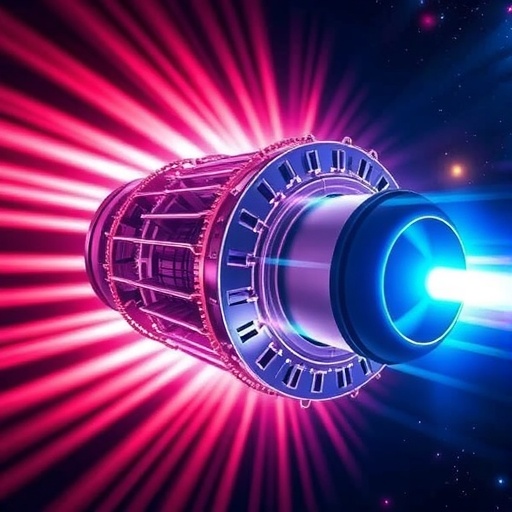
In recent years, the aerospace industry has witnessed an increasing interest in the deployment of small satellites, driven largely by their reduced costs and enhanced operational flexibility. Despite these advantages, the broader adoption and advancement of small satellite missions have been greatly hindered by one critical limitation—the lack of efficient and compact propulsion technologies capable of meeting the stringent size, weight, and power requirements intrinsic to these platforms. Spacecraft propulsion fundamentally operates on Newton’s third law, where thrust is generated through reactive forces, enabling forward motion by expelling mass in the opposite direction. Traditionally, chemical propulsion—relying on the combustion of propellants to produce high-temperature exhaust gases—has been the dominant technology. However, this method is inherently inefficient, with the majority of the launch mass dedicated to chemical fuel, severely limiting payload capacity and mission duration.
Emerging as a compelling alternative, electric propulsion technologies replicate the principles of terrestrial electric vehicles by using electrical energy to ionize and accelerate propellant particles to generate thrust. By manipulating plasma, or ionized gases, these systems achieve a significantly higher specific impulse compared to chemical propulsion, making them particularly attractive for long-duration and deep-space missions. One of the foremost contenders within the electric propulsion domain is the Magnetoplasmadynamic Thruster (MPDT). MPDTs exploit the Lorentz force arising from the interaction between high-current electrical flows and intense magnetic fields to accelerate plasma to hypersonic velocities. This interaction creates a sophisticated “electromagnetic cannon” effect, where magnetic fields precisely control the velocity vector and intensity of the plasma jet, resulting in propulsion efficiencies that surpass chemical rockets by a factor of eight to ten.
While MPDTs offer remarkable performance advantages, their practical application, especially in small satellite platforms, has been restricted by significant engineering challenges. Conventional MPDT designs incorporate voluminous copper electromagnetic coils to generate the necessary magnetic fields, adding substantial mass—often exceeding 150 kilograms—and necessitating colossal power inputs typically in the 200 to 300-kilowatt range. This high power demand equates to energy consumption on the scale of a small neighborhood, rendering the technology impractical for small-scale spacecraft with limited onboard power capacity. The sheer weight and energy inefficiency not only complicate implementation but also inflate mission costs, creating a technological bottleneck for next-generation space propulsion systems tailored to compact satellites.
Addressing these challenges, a pioneering research team led by Professor Jinxing Zheng at the Institute of Plasma Physics, part of the Hefei Institutes of Physical Science under the Chinese Academy of Sciences, has engineered a breakthrough in MPDT technology. They have successfully designed and demonstrated China’s first compact High-Temperature Superconducting (HTS) Magnetoplasmadynamic Thruster, a transformative innovation that significantly alleviates power consumption and system mass constraints. The critical advancement hinges upon replacing the traditional copper coils with coils fabricated from Yttrium Barium Copper Oxide (YBCO), a high-temperature superconducting material that functions efficiently at the relatively accessible temperature of liquid nitrogen (-196°C). This material shift profoundly reduces electrical resistance within the electromagnetic coils, curtailing power dissipation and allowing far greater magnetic field strengths without the prohibitive energy costs.
The resultant thruster system exhibits a dramatic reduction in power consumption, from 285 kilowatts down to less than 1 kilowatt, and a corresponding decrease in mass from 220 kilograms to 60 kilograms. This monumental improvement aligns tightly with the rigorous demands of small satellite architectures, enabling these spacecraft to carry more scientific instruments or communication payloads while maintaining high-efficiency propulsion. Consequently, the payload-to-launch mass ratio is significantly enhanced, providing a pivotal capability for future modest-sized missions. Moreover, the environmental benefits are profound, as lower energy requirements directly translate to cleaner, more sustainable space operations, reducing reliance on extensive chemical fuel loads and diminishing rocket launch carbon footprints.
Empirical validation of the HTS-MPDT’s performance was thoroughly documented through rigorous experimental campaigns. Among the highlights, the thruster demonstrated an extraordinary specific impulse of 3,265 seconds at an input electrical power level of 12 kilowatts, meaning the system can sustain thrust over extended periods with extraordinarily low propellant consumption. To put this into perspective, conventional chemical propulsion systems typically deliver specific impulses around 300 seconds, underscoring the superior fuel efficiency of the superconducting MPDT approach. By maintaining effective thrust with minimal propellant mass, spacecraft equipped with this technology could undertake longer missions, deeper space exploration, and more dynamic orbital adjustments without the prohibitive cost of carrying large amounts of fuel.
Additionally, the research team has developed an analytical magnetohydrodynamic (MHD) model that accurately predicts thruster performance by correlating critical variables such as magnetic field strength, plasma mass flow rate, and thrust generation. This comprehensive theoretical framework not only validates experimental findings but also provides invaluable design insights for optimizing future thruster iterations. By integrating this model with experimental data, engineers can systematically refine magnetic coil configurations, power management schemes, and plasma acceleration dynamics to further enhance efficiency, thrust density, and operational lifetimes.
Beyond immediate hardware improvements, this development signals a potential paradigm shift in how small satellites are powered and propelled. The integration of high-temperature superconductivity within space propulsion unlocks opportunities for more compact, lightweight, and power-efficient thrusters, which combined with miniaturized power sources, could revolutionize satellite constellation deployments. In practical terms, satellite operators may benefit from reduced launch costs, extended mission durations, and versatile orbital maneuverability, enhancing capabilities for Earth observation, telecommunications, and scientific inquiry.
Moreover, the scalability of this technology could extend beyond small satellites to larger spacecraft destined for deep space missions. The dramatic weight and power reductions afford mission planners new degrees of freedom to design spacecraft capable of rapid acceleration and deceleration phases, critical for crewed missions or sample-return trajectories. In the context of growing interest in lunar, Martian, and asteroid exploration, the HTS-MPDT stands out as a disruptive innovation that can integrate seamlessly with emerging space infrastructure, including in-orbit refueling stations and modular satellite assemblies.
This technological leap, published in the National Science Review under the title “High performance in high-temperature superconducting MPD thrusters: Analytical MHD modeling and experimental demonstration,” marks a milestone in electric propulsion. It exemplifies how cross-disciplinary collaboration between plasma physics, superconducting material science, and aerospace engineering can yield transformative solutions. The work spearheaded by Professor Zheng and his colleagues demonstrates the tangible value of pushing the boundaries of high-temperature superconductivity in real-world aerospace applications, paving the way towards more sustainable and capable space exploration platforms.
In conclusion, the advent of the HTS-MPDT heralds a new era in spacecraft propulsion, where the formidable challenges of energy efficiency and system miniaturization are elegantly addressed through innovative material science and electromagnetic engineering. As the aerospace community continues to embrace electric propulsion technologies, the incorporation of superconducting materials promises to unlock unprecedented levels of performance and operational economy. The horizon is now open for a lighter, cleaner, and more powerful fleet of small satellites, propelling humanity further into the final frontier with both precision and endurance.
Web References: 10.1093/nsr/nwaf589
Keywords
High-temperature superconductivity, magnetoplasmadynamic thruster, electric propulsion, plasma acceleration, small satellite propulsion, aerospace engineering, liquid nitrogen cooling, YBCO superconductors, specific impulse, magnetohydrodynamics, compact thruster design, space propulsion efficiency
Cite Scienmag News
Grant Pearson. (February 23, 2026). Revolutionizing Space Travel: High-Temperature Superconducting Engine Paves the Way for Ultra-Efficient Propulsion. Scienmag. https://scienmag.com/revolutionizing-space-travel-high-temperature-superconducting-engine-paves-the-way-for-ultra-efficient-propulsion/
Grant Pearson. "Revolutionizing Space Travel: High-Temperature Superconducting Engine Paves the Way for Ultra-Efficient Propulsion." Scienmag, 23 February 2026, https://scienmag.com/revolutionizing-space-travel-high-temperature-superconducting-engine-paves-the-way-for-ultra-efficient-propulsion/. Accessed 3 September 2026.
Grant Pearson. "Revolutionizing Space Travel: High-Temperature Superconducting Engine Paves the Way for Ultra-Efficient Propulsion." Scienmag. February 23, 2026. https://scienmag.com/revolutionizing-space-travel-high-temperature-superconducting-engine-paves-the-way-for-ultra-efficient-propulsion/


