

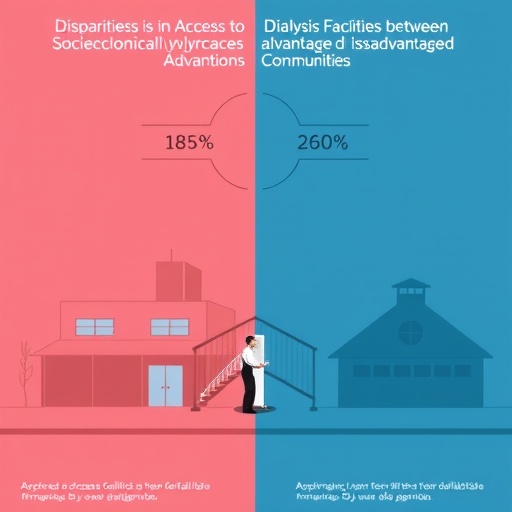
A recent investigative study published in JAMA Internal Medicine sheds critical light on a pressing healthcare disparity: the relationship between socioeconomic disadvantage and access to life-saving dialysis facilities for patients suffering from end-stage kidney disease (ESKD). The research uncovers a troubling trend—individuals residing in socioeconomically underprivileged communities face significantly diminished access to hemodialysis services, a finding with profound implications for public health policy and equity.
End-stage kidney disease represents a severe clinical condition requiring regular hemodialysis treatment to substitute for kidney function. The availability and proximity of dialysis centers are crucial determinants of health outcomes for these patients. This new study is pioneering in its methodical analysis of the geographical and socioeconomic variables influencing healthcare infrastructure distribution, revealing a stepwise decline in dialysis facility access correlating with increasing community disadvantage.
Using advanced geospatial analysis and socioeconomic metrics, the authors mapped dialysis unit locations relative to neighborhood income levels, education attainment, and other indicators of community well-being. The data showed that as communities experience greater economic hardship, the density of accessible dialysis facilities markedly diminishes. Such structural disparities force disadvantaged patients to endure longer travel times, reduced treatment options, and heightened risk of complications related to inadequate or delayed care.
From a clinical standpoint, the ramifications are significant. Consistent and timely access to dialysis mitigates morbidity and mortality in ESKD patients, whose health critically hinges on receiving treatments multiple times per week. The study’s findings expose a systemic inequity that disproportionately jeopardizes disadvantaged populations, deepening the chasm in health outcomes aligned along socioeconomic lines.
Furthermore, the research emphasizes the importance of considering social determinants of health in medical planning and resource allocation. Traditional approaches often overlook how economic status and neighborhood context influence not just disease prevalence but also the accessibility of requisite medical services. By integrating socioeconomic factors into health services research, this study contributes vital evidence for policymakers aiming to design equitable healthcare systems.
The corresponding author, Dr. Renee Y. Hsia from UCSF, elaborated on the urgency of addressing these disparities. She underlined that rectifying unequal access to dialysis facilities is not merely a matter of expanding physical infrastructure but also involves comprehensive strategies to enhance healthcare delivery in underserved areas. This includes incentivizing providers to establish services in disadvantaged neighborhoods and implementing supportive transportation solutions for patients.
Additionally, the study acknowledges the broader societal consequences of such healthcare inequities. Limited access to dialysis exacerbates social and financial burdens on affected families and communities, perpetuating cycles of poverty and poor health. It also presents challenges for the healthcare system, including increased emergency care utilization and readmissions, which collectively elevate costs.
Methodologically, the research stands out by applying rigorous statistical models to account for confounding variables, ensuring the robustness of its conclusions. It harnessed a multidisciplinary approach, blending epidemiology, health economics, and urban planning to untangle the complex interdependencies shaping access to care. This integrative perspective serves as a template for future investigations into healthcare disparities.
The implications of this study extend beyond kidney disease, signaling a broader caution about healthcare infrastructure disparities across various medical conditions. As chronic diseases proliferate and require complex, ongoing management, equitable facility distribution will play an increasingly pivotal role in patient outcomes and system efficiency.
Public health experts and social scientists alike have praised this work for its comprehensive examination of socioeconomic drivers influencing medical access. The findings call for urgent, coordinated action involving government agencies, healthcare providers, and community organizations to bridge gaps and foster an inclusive healthcare environment where all patients receive the care they need irrespective of their socioeconomic background.
In conclusion, this landmark study challenges healthcare stakeholders to confront and remediate entrenched inequalities in dialysis access. It underscores the essential principle that access to life-sustaining medical treatments must transcend socioeconomic barriers and that addressing such disparities is integral to achieving overall health equity. With robust evidence now documented, the path is set for transformative initiatives to enhance dialysis facility accessibility and improve ESKD patient outcomes nationwide.
News Publication Date: Not specified.
Web References: Not available.
References: doi:10.1001/jamainternmed.2025.8031
Cite Scienmag News
SCIENMAG. (February 23, 2026). Disparities in Access to Dialysis Facilities Between Socioeconomically Advantaged and Disadvantaged Communities. https://scienmag.com/disparities-in-access-to-dialysis-facilities-between-socioeconomically-advantaged-and-disadvantaged-communities/
SCIENMAG. "Disparities in Access to Dialysis Facilities Between Socioeconomically Advantaged and Disadvantaged Communities." Scienmag, 23 February 2026, https://scienmag.com/disparities-in-access-to-dialysis-facilities-between-socioeconomically-advantaged-and-disadvantaged-communities/. Accessed 28 August 2026.
SCIENMAG. "Disparities in Access to Dialysis Facilities Between Socioeconomically Advantaged and Disadvantaged Communities." Scienmag. February 23, 2026. https://scienmag.com/disparities-in-access-to-dialysis-facilities-between-socioeconomically-advantaged-and-disadvantaged-communities/


