


In a significant advancement for climate science, researchers at the University of Graz, led by Gottfried Kirchengast, have unveiled a groundbreaking methodology that offers an unprecedented capability to quantify the increasing severity of climate hazards worldwide. Published in the esteemed journal Weather and Climate Extremes, their work introduces a novel class of climate hazard metrics capable of tracking the amplification of complex extreme events such as heatwaves, floods, droughts, and storms with exceptional precision. This comprehensive approach marks a pivotal step forward in understanding how anthropogenic climate change is intensifying these phenomena, surpassing previous analytical frameworks that were often limited to assessing frequency changes alone.
The crux of this innovative method lies in its ability to evaluate not just the occurrence but the entire extremity of climate hazards. By incorporating a spectrum of variables including frequency, duration, intensity, and spatial magnitude of extreme events, the new framework offers a holistic lens through which these hazards can be analyzed. This multidimensional characterization addresses a longstanding challenge in climate research—accurately quantifying combined impacts rather than observing isolated metrics. Kirchengast and his colleagues have mathematically resolved the intricate high-dimensional threshold exceedance problem, allowing for a versatile computational model that can be applied globally wherever sufficient long-term climate data exist.
Such advancement holds profound implications across multiple sectors vulnerable to climate stressors. Human health, infrastructure integrity, agricultural productivity, forestry systems, and energy networks are all increasingly jeopardized by extreme weather events. The novel hazard metrics enable an improved quantification and attribution of related damages, thereby supporting better risk assessment and adaptive responses. For instance, exposure to temperatures exceeding critical thresholds, such as 30 degrees Celsius, can induce heat stress detrimental to both public health and economic activities. Prior methodologies lacked the ability to capture the intricate interplay between duration, intensity, and spatial extent of heatwaves, leaving a critical gap now addressed by this new class of metrics.
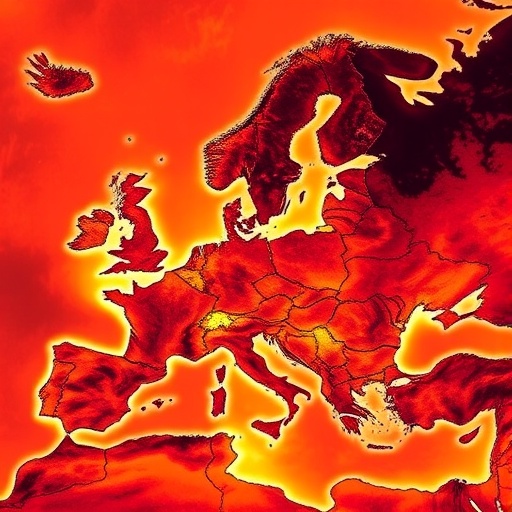
To demonstrate the power of their approach, the researchers applied it to Europe, utilizing extensive datasets of daily maximum temperatures spanning over six decades, from 1961 to 2024. By defining “extreme” heat thresholds as the 99th percentile of daily temperatures during the baseline period 1961–1990, they were able to track subsequent changes relative to this benchmark. The results were staggering: a tenfold increase in the total extremity of heat events across Austria and much of Central and Southern Europe post-2010. This metric includes not just how often extremes occur, but also how prolonged, severe, and geographically expansive they have become—a level of amplification far beyond natural variability and directly attributable to human-driven climate change.
Kirchengast emphasizes that the magnitude of these findings is unprecedented even within the context of his extensive experience as a climate scientist. The research underscores the desperation of contemporary climate dynamics, highlighting a dramatic shift in baseline risks faced by populations and ecosystems. By quantifying this escalation rigorously, the study provides not only scientific validation but also critical evidence that can influence policy decisions, adaptation strategies, and climate litigation efforts. Methodologies capable of attributing responsibility to high-emission entities based on these metrics could prove instrumental in holding actors accountable for exacerbating climate hazards.
Technically, the methodology revolves around a complex mathematical framework that integrates multi-dimensional exceedance functions, thereby enabling simultaneous consideration of multiple extremes parameters. This contrasts sharply with traditional single-metric approaches. Implemented as a computational tool by Kirchengast in collaboration with Stephanie Haas and Jürgen Fuchsberger, the solution leverages advanced statistical analyses applied to climate reanalysis datasets and observational records. Its generality allows it to be adapted effortlessly to various types of hazards, regions, and spatial scales, thereby constituting a universal tool in the arsenal of climate hazard analytics.
Beyond heatwaves, the model holds promise for evaluating other climatic hazards such as flooding, drought, and tropical storms. These events are also known to exhibit multi-faceted extremity features, including frequency spikes, escalations in severity, and altered geographic distribution patterns. The ability to synthesize these diverse parameters into a unified metric offers a powerful new perspective for understanding how the cumulative risk landscape is evolving under global warming. It shines a new light on compounding climate hazards that traditional discrete analyses may underestimate or overlook.
Universally accessible data emanating from this study, including comprehensive heat extreme metrics for Austria and wider Europe, have been made available via the Graz Climate Change Indicators – ClimateTracer web portal, promoting transparency and encouraging further scientific inquiry. This open-access approach supports broader scientific collaboration and enables stakeholders to integrate robust hazard metrics into risk management, urban planning, agriculture, and health system resilience efforts. The availability of continuous and regionally detailed hazard profiles can empower decision-makers to tailor adaptive measures according to dynamic climate realities.
Crucially, this methodological breakthrough aligns synergistically with the goals of climate impact attribution science, which seeks to unravel anthropogenic contributions to observed environmental changes. By furnishing precise evidence of how human activity amplifies hazard extremity, the framework enriches the empirical basis for international climate negotiations and domestic policy formulation. It bridges the gap between climate science and societal response, ensuring that adaptation and mitigation can be guided by nuanced, quantifiable insights rather than coarse approximations.
The research is embedded within the University of Graz’s Field of Excellence “Climate Change Graz,” underscoring the institution’s commitment to addressing climate challenges through innovative research and interdisciplinary collaboration. The Wegener Center for Climate and Global Change, which hosts Kirchengast’s Atmospheric Remote Sensing and Climate System Research Group, continues to be at the forefront of climate science, translating complex data into actionable knowledge. This new hazard metrics tool complements other pioneering efforts aimed at uncovering the multi-dimensional impacts of climate change and scaling up regional and global resilience.
As climate extremes continue to impose escalating challenges worldwide, this novel class of hazard metrics represents a crucial step forward in the collective scientific endeavor to apprehend and combat these threats. By moving beyond frequency counting to a comprehensive multi-metric evaluation, Kirchengast and colleagues have set a new standard in hazard quantification. Their work not only deepens our understanding of climatic extremity but also equips society with the analytical tools necessary to anticipate, mitigate, and manage the growing risks posed by a warming planet.
Cite Scienmag News
Violet Maxwell. (February 23, 2026). Researchers at University of Graz Unveil New Climate Computation Method, Reveal Tenfold Increase in European Heat Extremes. Scienmag. https://scienmag.com/researchers-at-university-of-graz-unveil-new-climate-computation-method-reveal-tenfold-increase-in-european-heat-extremes/
Violet Maxwell. "Researchers at University of Graz Unveil New Climate Computation Method, Reveal Tenfold Increase in European Heat Extremes." Scienmag, 23 February 2026, https://scienmag.com/researchers-at-university-of-graz-unveil-new-climate-computation-method-reveal-tenfold-increase-in-european-heat-extremes/. Accessed 1 September 2026.
Violet Maxwell. "Researchers at University of Graz Unveil New Climate Computation Method, Reveal Tenfold Increase in European Heat Extremes." Scienmag. February 23, 2026. https://scienmag.com/researchers-at-university-of-graz-unveil-new-climate-computation-method-reveal-tenfold-increase-in-european-heat-extremes/


