


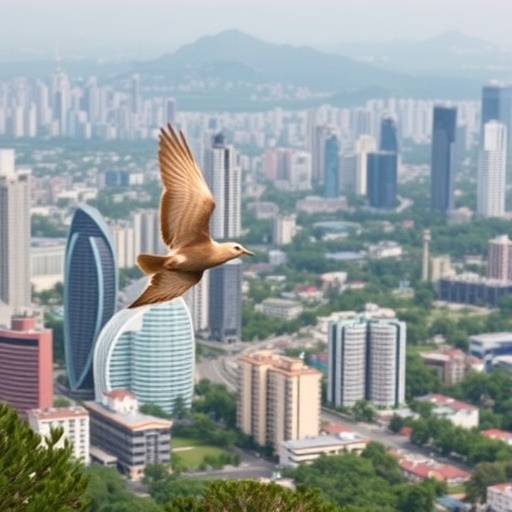
Urbanization ranks as one of the most formidable forces reshaping the planet’s ecological landscape, driving profound transformations across biodiversity worldwide. Yet, despite its undeniable impact, the lingering effects of historical urban developments on present-day ecosystems have remained elusive, obscuring our grasp on the true consequences of urban expansion. A groundbreaking recent investigation from China now unveils a detailed picture of how uneven urban growth over three decades is silently orchestrating ongoing shifts in bird biodiversity, revealing hidden ecological debts and delayed biological responses that could redefine future conservation strategies.
China’s rapid and variable urbanization serves as a living laboratory for understanding long-term ecological legacies. The study synthesizes 31 years of data on urban environments and bird communities, applying sophisticated equilibrium and non-equilibrium modeling approaches to decipher how past landscape changes continue to reverberate through avian populations. Contrary to prevailing assumptions that ecological communities rapidly adjust to new environments, this research exposes substantial time lags—extinction debts and colonization credits—that delay the full expression of urbanization’s impacts on bird species richness, functional traits, and evolutionary relationships.
Extinction debt refers to the future biodiversity loss that current populations are effectively ‘committed’ to but have yet to exhibit, whereas colonization credit denotes species not yet present but potentially colonizing in response to prior habitat improvements or urban development changes. The study’s nuanced analyses highlight that both phenomena coexist widely across China’s urban bird communities, with the magnitude and duration of these temporal lags varying significantly according to specific environmental and human-driven factors. This complexity underscores how urban landscapes remain in ecological flux long after initial development phases, challenging the notion of cities as static ecosystems.
One of the most compelling revelations emerges from the distinct lag durations associated with different urban environmental metrics. Historical vegetation cover around urban areas exhibits pronounced legacy effects, exerting influence on bird assemblages decades after changes occur. Meanwhile, anthropogenic factors—ranging from pollution levels to infrastructural intensity—produce their own unique time-delayed responses, suggesting that different urban pressures imprint contrasting temporal signatures on biodiversity. Such findings indicate that past urban planning decisions cast long shadows on ecological resilience and function.
Fundamentally, this study distinguishes itself by bridging the taxonomic, functional, and phylogenetic dimensions of bird biodiversity. Rather than relying solely on species counts, the researchers delve into the diversity of bird life histories, ecological roles, and evolutionary histories, uncovering how urban legacies mold community composition beyond surface-level metrics. Through this lens, they detect significant shifts in functional traits critical to ecosystem health, such as feeding habits and nesting strategies, which could cascade through urban food webs and alter ecosystem processes in unforeseen ways.
Moreover, the investigation provides fresh insights into species-specific responses to urban legacies. These responses hinge largely on the degree of urban tolerance inherent to each bird species—traits that determine a species’ ability to adapt, survive, or thrive in human-dominated landscapes. Species with greater adaptability tend to exhibit shorter lag periods or even capitalize on urban changes, thus potentially gaining an advantage as cities evolve. Conversely, more sensitive or specialized species face prolonged extinction debts, their declines painfully slow but likely inevitable unless active conservation steps intervene.
The spatial heterogeneity of urbanization is another critical element highlighted by the study. China’s sprawling urban growth is far from uniform; variations in development intensity, land-use change, and green space distribution create patchworks of habitat quality that modulate biodiversity outcomes. The resulting unevenness means that some urban areas may harbor surprisingly resilient bird communities, while others experience rapid biodiversity erosion. This spatial complexity reinforces the importance of localized conservation policies tailored to unique urban ecological footprints rather than broad-brush urban planning approaches.
Importantly, these revelations carry profound implications for the future of biodiversity-friendly urban governance. Recognizing that urban ecological legacies operate on multidecadal timescales calls for policymakers and planners to integrate long-term perspectives into urban development frameworks. Traditional short-term assessments will miss impending biodiversity declines hidden by extinction debts or overlook opportunities for colonization credit realization. Proactive, forward-thinking strategies must therefore embrace ecological time lags to mitigate risks and maximize the benefits of habitat restoration or green infrastructure investments.
The methodologies underpinning this research combine cutting-edge statistical modeling with rigorous empirical data, positioning it at the forefront of urban ecology. By integrating equilibrium assumptions—where species distributions are stable—with non-equilibrium frameworks that account for ongoing ecological dynamics, the study offers a robust toolset for disentangling historical impacts from contemporaneous urban changes. This hybrid modeling approach could be adapted globally to understand legacy effects across diverse cities and taxa, enhancing predictive capacity for biodiversity trajectories amid accelerating urban expansion.
Furthermore, the research contributes to a growing recognition that urban environments are not mere biological sinks but dynamic ecosystems with intrinsic ecological processes and evolutionary pressures. The acknowledgment of ongoing colonization credits confirms that urban landscapes can provide novel habitats and refuges if managed thoughtfully. As such, urban biodiversity planning must emphasize habitat connectivity, heterogeneity, and restoration to realize these potentials, countering the trend of species isolation and homogenization commonly observed in cities.
An additional layer of significance rests in highlighting previously underappreciated links between historical urban vegetation and present ecological outcomes. Vegetation legacy effects suggest that conserving or restoring native plant communities and green spaces within urban matrices is paramount, not only for immediate habitat provision but as a foundation for sustaining avian diversity over time. This elevates the role of urban forestry, park design, and green corridors in buffering the negative consequences of human footprint expansion.
It is also worth noting that this research aligns with broader global biodiversity conservation goals by framing urban areas as critical arenas for species survival amid increasing land conversion pressures. As over half the world’s population now lives in cities, understanding and managing urban biodiversity legacies will become indispensable for halting species declines at large scales. China’s example illustrates that rapid urbanization need not preclude biodiversity preservation, provided that governance systems incorporate ecological memory and species-specific needs.
In sum, the multidecadal legacy of uneven urbanization uncovered in this study challenges entrenched perceptions of urban ecosystems as permanently degraded or irreversibly simplified. Instead, it paints a picture of urban environments as evolving ecological mosaics where past urban footprints dictate present and future biodiversity outcomes. This nuanced perspective demands a paradigm shift in how urban planning, wildlife conservation, and sustainability science intersect, compelling stakeholders to acknowledge and harness historical legacies in shaping more resilient cities.
By illuminating hidden extinction debts and colonization credits, the research generates critical knowledge that could transform urban biodiversity conservation from a reactive endeavor into a strategic, anticipatory process. It calls for embracing the complexity and temporality of ecological responses to human activity, underscoring the need for continuous monitoring and adaptive management as urban landscapes further evolve. Embracing such holistic frameworks could enable harmonizing urban growth with biodiversity persistence in one of the most dynamic regions of the world and beyond.
This study’s integrative approach and its powerful implications exemplify how interdisciplinary science can reveal the silent narratives embedded in cities, offering hope and guidance for crafting urban futures where human prosperity and biodiversity coexist. The research sets a benchmark for future investigations into the ecological legacies of urbanization globally, urging the scientific community and policymakers alike to rethink urban ecosystems through the lens of temporal depth and multifaceted biodiversity dimensions.
Cite Scienmag News
Margaret Porter. (February 21, 2026). Legacy of Uneven Urbanization Shapes Bird Biodiversity. Scienmag. https://scienmag.com/legacy-of-uneven-urbanization-shapes-bird-biodiversity/
Margaret Porter. "Legacy of Uneven Urbanization Shapes Bird Biodiversity." Scienmag, 21 February 2026, https://scienmag.com/legacy-of-uneven-urbanization-shapes-bird-biodiversity/. Accessed 4 September 2026.
Margaret Porter. "Legacy of Uneven Urbanization Shapes Bird Biodiversity." Scienmag. February 21, 2026. https://scienmag.com/legacy-of-uneven-urbanization-shapes-bird-biodiversity/


