


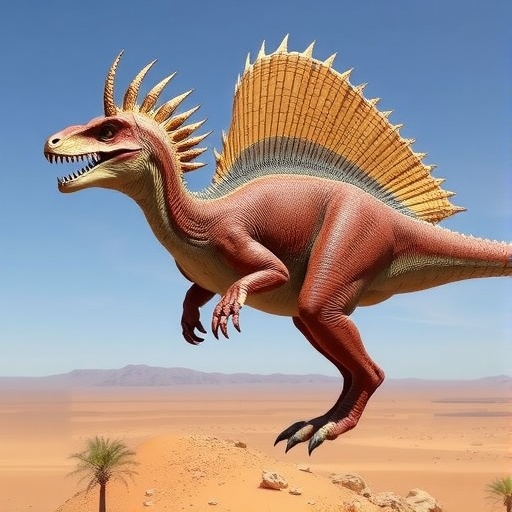
In a groundbreaking discovery set to reshape our understanding of spinosaurid evolution, paleontologists have unearthed a previously unknown species of Spinosaurus in the heart of the Sahara Desert. This new species, named Spinosaurus mirabilis, was uncovered in a remote region of Niger by an international team led by renowned paleontologist Paul Sereno of the University of Chicago. The find not only enriches the fossil record but also challenges prevailing notions about the habitats and adaptations of these enigmatic theropods.
The defining feature that first caught the eyes of the research team was the dinosaur’s extraordinary scimitar-shaped cranial crest. Initially overlooked when discovered in 2019 due to its unfamiliar morphology, subsequent expeditions unearthed additional crests, confirming the presence of a novel species. Detailed analysis of the crest’s surface texture revealed a dense network of vascular canals, indicating it was likely covered in keratin during the animal’s life. The crest’s elegant, blade-like curve is hypothesized to have served as a vivid display structure, possibly brightly colored, projecting skyward as a remarkable evolutionary adaptation for visual communication.
Beyond the crest, the skull of S. mirabilis presents an extraordinary dental configuration rarely seen among dinosaurs. Its interdigitating tooth rows — where the teeth of the lower jaw fit precisely between those of the upper jaw — form a specialized mechanism perfectly suited for capturing elusive aquatic prey. Such an adaptation parallels convergent features observed in other prehistoric fish-eating taxa, including marine reptiles like ichthyosaurs, semi-aquatic crocodilians, and even airborne pterosaurs. This dental architecture underscores the highly piscivorous lifestyle of Spinosaurus and its evolutionary kin.
The discovery’s emotional impact on the research team resonated deeply, as Paul Sereno recounts a profoundly memorable moment when the assembled team gathered around a laptop in their desert camp. Utilizing solar power in one of Earth’s harshest environments, one member generated detailed 3D digital reconstructions of the fossils, bringing the skull to life in virtual space. This fusion of cutting-edge technology and fieldwork exemplifies the modern era of paleontology, where science and innovation coalesce to decode the mysteries of deep time.
Previously, spinosaurid fossils had been predominantly associated with coastal sedimentary deposits, suggesting that their ecology was closely tied to shorelines and possibly fully aquatic lifestyles. However, S. mirabilis was found far inland—estimates range between 500 and 1000 kilometers from the nearest ancient sea. The surrounding fossil assemblage, which includes partial skeletons of long-necked sauropods and riverine fauna, implies a forested and fluvially dissected environment, marking a significant extension of the spinosaurid ecological niche.
This inland context reshapes hypotheses about Spinosaurus behavior and habitat preference. Sereno envisions S. mirabilis as an apex predator akin to a “hell heron,” a large wader able to navigate through water up to two meters deep. Rather than diving in pursuit of prey, it likely hunted in shallower waters, stalking and snapping up sizeable fish in riverine pools and channels. Such a lifestyle contrasts with interpretations that label spinosaurids as primarily aquatic, instead reinforcing their role as semi-aquatic ambush predators.
The journey to this monumental discovery is a testament to perseverance and serendipity. It began with a cryptic note from a 1950s French geologist who referenced a single, saber-like tooth reminiscent of Carcharodontosaurus teeth found decades earlier in Egypt’s Western Desert. No paleontologist had revisited the site for over seventy years, and the search required a daring expedition into the treacherous Sahara sands. Local assistance was crucial—a Tuareg guide led the team on motorcycles deep into the desert’s core, finally directing them to a fossil field where the new Spinosaurus remains were located just before their time expired.
Sereno’s long-standing fascination with the Sahara’s vast, untamed landscapes fueled his commitment. His three-decade journey through the region has not only yielded exceptional scientific treasures but has also deepened ties with local communities, offering mutual benefits through research and heritage preservation. Excavating over 100 tons of fossils from some of the most inhospitable terrain on Earth, Sereno emphasizes the Sahara’s unmatched combination of stark beauty and scientific potential—a lost world waiting to be reclaimed.
Beyond excavation, the research extended into the digital realm. Back at the University of Chicago’s Fossil Lab, detailed CT scans facilitated the construction of a comprehensive digital skull model. Collaborating remotely with paleoartist Dani Navarro in Madrid, the team translated these data points into vivid paleoart, animating dynamic scenes depicting S. mirabilis engaged in predation over a coelacanth fish. Navarro’s work included crafting a physical 3D model, meticulously fleshing out the creature’s skeletal framework and rendering its anatomical features with unprecedented fidelity.
Further bringing this spinosaurid to life, collaborations with animators Jonathan Metzger and Davide la Torre infused movement into these reconstructions, leveraging sophisticated visualization technologies including drones and high-resolution cameras. These multidisciplinary approaches exemplify the transformative power of integrating field discoveries with emerging digital art and science communication tools, enhancing public engagement and academic dissemination alike.
A critical component of the project involved educational outreach aimed at inspiring younger generations. Replicas of the extraordinary skull and its vibrant scimitar crest were produced for hands-on exhibits, now featured in the Chicago Children’s Museum’s Dinosaur Expedition. By allowing children to experience tangible connections to the ancient past through tactile and interactive displays, the team hopes to ignite curiosity and passion for paleontology, fostering the next generation of explorers who will uncover further secrets of Earth’s prehistoric life.
The implications of this find ripple beyond the paleontological community. Documenting an inland spinosaurid species broadens our understanding of dinosaur biodiversity and biogeography during the Cretaceous period. It challenges entrenched assumptions about habitat specificity, indicating these apex predators were more ecologically versatile than previously conceived. This nuanced view prompts re-evaluation of predator-prey dynamics in Mesozoic freshwater systems and underscores the evolutionary plasticity within Spinosauridae.
The discovery of Spinosaurus mirabilis, crowned by its spectacular scimitar-shaped crest, heralds a new chapter in dinosaur research. By blending rigorous scientific methodology, collaboration across continents, innovative technology, and engaging visual storytelling, this work encapsulates the vibrant and evolving nature of modern paleontology. As the Sahara continues to yield its fossil treasures, the story of life on Earth in deep time becomes ever clearer and more compelling.
News Publication Date:
19-Feb-2026
Web References:
DOI: 10.1126/science.adx5486
References:
Paul C. Sereno et al., “New scimitar-crested Spinosaurus species from the Sahara caps stepwise spinosaurid radiation,” Science, February 2026.
Cite Scienmag News
Gavin Prescott. (February 19, 2026). New Species of ‘Scimitar-Crested’ Spinosaurus Unearthed in the Heart of the Sahara. Scienmag. https://scienmag.com/new-species-of-scimitar-crested-spinosaurus-unearthed-in-the-heart-of-the-sahara/
Gavin Prescott. "New Species of ‘Scimitar-Crested’ Spinosaurus Unearthed in the Heart of the Sahara." Scienmag, 19 February 2026, https://scienmag.com/new-species-of-scimitar-crested-spinosaurus-unearthed-in-the-heart-of-the-sahara/. Accessed 3 September 2026.
Gavin Prescott. "New Species of ‘Scimitar-Crested’ Spinosaurus Unearthed in the Heart of the Sahara." Scienmag. February 19, 2026. https://scienmag.com/new-species-of-scimitar-crested-spinosaurus-unearthed-in-the-heart-of-the-sahara/


