


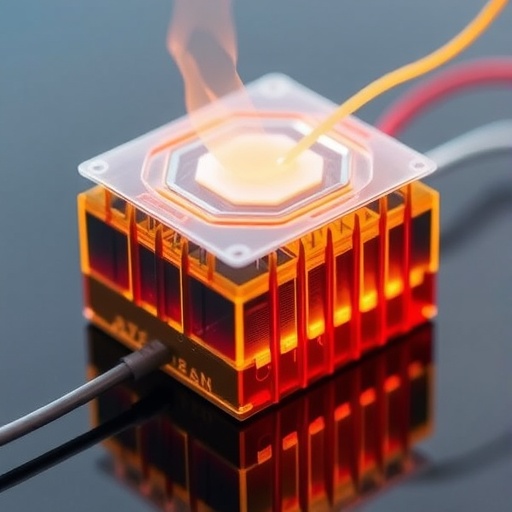
In the relentless pursuit of sustainable energy solutions, a groundbreaking development emerges from the Laboratory of Nanoscience for Energy Technology (LNET) at EPFL’s School of Engineering. This advancement centers around an innovative hydrovoltaic (HV) system that effectively converts the natural evaporation of fluids into usable electrical power. The research team, led by Giulia Tagliabue, has unveiled a novel platform that intricately harnesses the interplay of heat and light to dramatically amplify power generation from evaporating saltwater. This marks a significant leap beyond conventional evaporation-based energy harvesting technologies, not only due to the magnitude of energy output but also because of the system’s novel mechanism that decouples and optimizes critical physical and chemical interactions at the nanoscale.
Historically, hydrovoltaic energy generation has predominantly relied on the basic principle that heat accelerates evaporation, leading to increased ion flow across charged surfaces, which can generate electricity. However, the underlying physics governing the process were not fully exploited until now. The EPFL researchers identified an additional, previously untapped mechanism rooted in the semiconductor properties of silicon nanopillars composing their device. When exposed to solar photons, the silicon’s electronic structure becomes excited, producing mobile electrons. Concurrently, thermal energy enhances the negative charge density on the silicon surface. This dual stimulus – photonic excitation and heat-induced surface charge modulation – orchestrates the ion dynamics in the adjacent evaporating saltwater layer, establishing a condition for efficient charge separation and robust electrical current generation.
What sets this hydrovoltaic device apart is its meticulously engineered architecture composed of three distinct layers—each dedicated to a specific function: evaporation, ion transport, and electrical charge collection. This separation allows for unprecedented control over the electromechanical interactions, enabling precise tuning of the system for maximum efficiency. By disentangling these processes, the team has managed to optimize the ion flux and electron flow independently, thereby leveraging the synergistic effects of heat and light to amplify the overall power output while minimizing material degradation.
The hexagonal lattice of silicon nanopillars is thoughtfully designed to serve as both the active harvesting material and the conduit for fluid evaporation. Between these nanopillars, nanoscale channels facilitate the capillary-driven movement and subsequent evaporation of saltwater samples. Heat elevates the evaporation rate, inducing ionic gradients that shift ion distributions within the fluid. Simultaneously, light photons stimulate electron-hole pairs within the silicon pillars, while the thermal modulation of surface charge enhances the electric field across the liquid-solid interface. This electrified interface becomes a powerful driving force propelling electrons through the connected external circuit, thereby transforming natural environmental dynamics into usable electrical energy.
Importantly, the device’s oxide-coated nanopillars confer significant chemical resilience and operational stability, even under prolonged exposure to challenging saltwater environments and fluctuating thermal conditions. This oxide layer effectively shields the underlying silicon from corrosion and inhibits unwanted chemical reactions that typically lead to device degradation. The resultant robustness paves the way for continuous, autonomous, and reliable energy output—a critical feature for real-world applications where long-term stability is paramount.
Quantitatively, the system achieves a remarkable voltage generation of approximately 1 volt coupled with a power density near 0.25 watts per square meter. While these values might appear modest in absolute terms, they represent a significant threshold for self-powered nanodevices and sensor networks that require low-power, maintenance-free operation. The ability to harness ubiquitous environmental resources such as sunlight, heat, and saltwater in tandem offers a promising avenue for powering distributed Internet-of-Things (IoT) sensor arrays, wearable electronics, and environmental monitoring devices without reliance on batteries or external power sources.
The LNET team has further advanced this technology by developing a comprehensive physical model that delineates the complex interactions between the evaporative, ionic, and electronic phenomena. This model facilitates predictive tuning of parameters such as nanopillar geometry, spacing, and salt concentration to strategically maximize energy conversion efficiency. Real-time monitoring tools are also being refined, employing solar simulators to emulate environmental conditions and enable dynamic modulation of heat and light inputs during experimentation. Such experimental fidelity accelerates optimization and practical deployment prospects.
Beyond academic inquiry, this breakthrough holds the potential to catalyze new paradigms in sustainable micro-energy generation. Its capacity to autonomously harvest power in remote or off-grid locations could transform how small-scale electronics are energized, reducing dependence on conventional batteries and minimizing environmental footprints. Moreover, leveraging a naturally occurring physical effect—once overlooked—for technological gain represents an inspiring example of how fundamental science can drive revolutionary applications.
The essence of this innovation underscores that the power of nanotechnology lies not solely in miniaturization but in the ability to intricately control and couple multiple physical stimuli. The EPFL researchers’ insight that combined heat and light do not merely hasten evaporation but actively modulate surface charge dynamics breaks novel ground in energy harvesting science. This layered nanoengineered approach holds promise for scaling and integrating novel HV devices into next-generation wearable, environmental, and IoT platforms.
In summary, the LNET team’s pioneering work delineates a powerful new method to enhance hydrovoltaic energy generation by leveraging coupled heat-driven ion transport and light-driven electron excitation in silicon nanopillar architectures. Their breakthrough demonstrates that by separating evaporation, ion transport, and electric charge collection into distinct layers and exploiting semiconductor physics, it is possible to achieve stable, efficient, and continuous power output that exceeds previous designs. This innovation opens promising new vistas for sustainable, autonomous micro-energy generation in diverse applications.
As the energy landscape evolves, harnessing subtle natural phenomena such as the hydrovoltaic effect with nanotechnology may prove crucial for meeting global demands. The findings from EPFL’s LNET team invigorate this exciting field and provide a tangible pathway to practical devices that turn everyday environmental conditions into reliable electrical power—a true testament to the transformative potential of interdisciplinary research and engineering excellence.
News Publication Date: 9-Jan-2026
Web References:
https://www.epfl.ch/labs/lnet/
https://actu.epfl.ch/news/nanodevices-can-produce-energy-from-evaporating-ta/
https://www.nature.com/articles/s41467-025-68261-8
References:
Giulia Tagliabue et al., “Enhancing hydrovoltaic power generation through coupled heat and light-driven surface charge dynamics,” Nature Communications, 2026.
Keywords
Electrical power, Physics, Hydrovoltaic energy, Nanotechnology, Silicon nanopillars, Surface charge dynamics, Semiconductor physics, Renewable energy harvesting, Internet-of-Things, Environmental monitoring, Micro-energy generation, Heat and light coupling
Cite Scienmag News
Florence R. (February 19, 2026). Nanodevice Generates Continuous Electricity Through Evaporation. Scienmag. https://scienmag.com/nanodevice-generates-continuous-electricity-through-evaporation/
Florence R. "Nanodevice Generates Continuous Electricity Through Evaporation." Scienmag, 19 February 2026, https://scienmag.com/nanodevice-generates-continuous-electricity-through-evaporation/. Accessed 28 August 2026.
Florence R. "Nanodevice Generates Continuous Electricity Through Evaporation." Scienmag. February 19, 2026. https://scienmag.com/nanodevice-generates-continuous-electricity-through-evaporation/


