


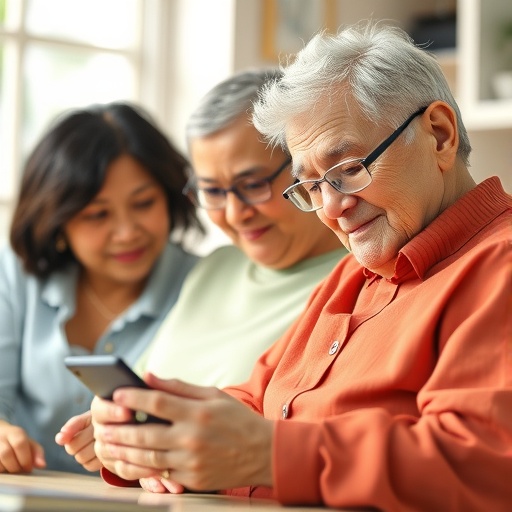
In an era where the intersection of technology and healthcare constantly evolves, a groundbreaking study has emerged that shines a light on an often-overlooked population: community-dwelling older adults. This demographic, increasingly vulnerable to loneliness and social isolation, has been the focus of a pioneering randomized controlled trial conducted by Partovirad, Negarandeh, and Nikpeyma. Their research meticulously compares the effects of mobile learning interventions against traditional self-care education methods, addressing the critical mental health concerns that face aging populations globally.
Loneliness and social isolation have been recognized as significant risk factors contributing to adverse health outcomes among older adults. These conditions not only exacerbate physical maladies but also catalyze psychological distress, leading to deteriorating quality of life and heightened mortality rates. The study underlines the pressing need for innovative methods to mitigate these detrimental impacts, given the constraints of conventional health education programs that may lack accessibility and engagement.
The study’s design employs a sophisticated three-arm randomized controlled trial framework, rigorously crafted to ensure the validity and reliability of its findings. One group of participants received interventions through mobile learning platforms, which leverage the ubiquity of smartphones and digital technology to deliver educational content directly to users in an interactive format. Another group was exposed to traditional self-care education, typically characterized by face-to-face sessions or printed materials, while a control group did not receive any specific intervention during the study period.
Mobile learning as a concept represents a paradigm shift in how educational content can be disseminated and absorbed, particularly within healthcare contexts. Its potential lies in its adaptability, interactivity, and scalability. The trial scrutinized whether this mode of education could surpass traditional approaches in not only imparting knowledge but also in fostering social connections and reducing feelings of loneliness among elderly participants.
One of the study’s pivotal technical advances was its careful calibration of the mobile learning content, which was designed to be user-friendly for older adults who may face technological proficiency barriers. The interface incorporated large fonts, intuitive navigation, and multimedia elements such as videos and audio instructions to accommodate varying sensory and cognitive abilities. This level of customization is crucial in ensuring that digital interventions reach their intended audience effectively.
The traditional self-care education arm relied on well-established pedagogical techniques previously demonstrated to be beneficial but limited by logistical constraints such as the necessity for physical presence and scheduled sessions. These factors often impede consistent participation, particularly for older adults with mobility challenges or residing in rural areas with limited access to healthcare facilities.
The trial’s outcomes were measured across a spectrum of social and psychological parameters, with a primary focus on quantifying changes in loneliness and perceived social isolation. Instruments employed included validated scales like the UCLA Loneliness Scale and the Lubben Social Network Scale, allowing researchers to draw robust conclusions about the interventions’ efficacy.
Remarkably, the findings revealed that mobile learning interventions produced a statistically significant reduction in self-reported loneliness and social isolation scores compared to the traditional education group and the control group. This suggests that mobile learning not only educates but also creates virtual communities and social interaction opportunities that older adults might otherwise lack.
One potential explanation for these positive effects lies in the interactive nature of mobile learning, which encourages real-time communication, peer support through forums or chat features, and personalized feedback mechanisms. This fosters a sense of connectedness that mirrors, or in some cases augments, in-person interactions, thus alleviating the profound sense of social disconnection experienced by many elderly individuals.
The study also delves into the mechanistic underpinnings of why technology-based education may influence social behaviors. Cognitive-behavioral theories posit that increased access to information and skills empowers individuals to engage more confidently in social contexts. When older adults feel more knowledgeable about self-care, psychological barriers such as anxiety and low self-esteem diminish, enabling them to seek and maintain social ties more effectively.
Moreover, the adaptability of mobile learning platforms allows for ongoing content updates and tailored interventions, which can be calibrated based on user feedback and evolving needs. This dynamic quality distinguishes mobile learning from static traditional methods, which may become outdated or irrelevant as medical knowledge and best practices advance.
Importantly, the researchers emphasized the role of technology acceptance in achieving these outcomes. To address initial resistance common among older adults, the study incorporated introductory training sessions and ongoing technical support. This methodological consideration ensured that participants were not only recipients of education but active users of the technology, thereby maximizing intervention fidelity.
The societal implications of these findings are profound. With global populations rapidly aging, scalable and effective interventions to combat loneliness and social isolation could alleviate healthcare burdens and improve well-being on a massive scale. Mobile learning, delivered through ubiquitous digital devices, offers a promising avenue to reach older adults irrespective of geographic barriers or pandemic-related social restrictions.
Nonetheless, the authors caution against viewing mobile learning as a panacea. They acknowledge the persistent digital divide, noting that not all older adults have equal access to smartphones or reliable internet connections. Hence, complementary traditional methods remain essential, ensuring inclusivity and that no demographic is left unsupported.
The research team also calls for further studies to explore long-term effects of mobile learning interventions, assess cost-effectiveness, and expand content to address comorbidities such as depression and cognitive decline, which often coexist with social isolation among seniors.
In sum, this expansive trial pioneers a new frontier in geriatric healthcare by empirically establishing that mobile learning can surpass traditional education in mitigating loneliness and social isolation in community-dwelling older adults. By harnessing digital innovation thoughtfully tailored to the unique needs of the elderly, the study sets a precedent for future programs aimed at enhancing mental health through accessible and engaging self-care education.
As society grapples with the complex challenges posed by aging populations, the integration of technology into public health strategies emerges not merely as an option but as an imperative. This research underscores how mobile learning, far from being a mere convenience, holds transformative potential to reshape the landscape of elderly care and improve lives in profoundly meaningful ways.
Partovirad, M., Negarandeh, R. & Nikpeyma, N. Comparison of the effects of mobile learning and traditional self-care education on loneliness and social isolation in community-dwelling older adults: a three-arm randomized controlled trial.
BMC Geriatr (2026). https://doi.org/10.1186/s12877-026-07185-4
Cite Scienmag News
Ophelia Keating. (February 19, 2026). Mobile Learning vs. Traditional Care: Impact on Elder Loneliness. Scienmag. https://scienmag.com/mobile-learning-vs-traditional-care-impact-on-elder-loneliness/
Ophelia Keating. "Mobile Learning vs. Traditional Care: Impact on Elder Loneliness." Scienmag, 19 February 2026, https://scienmag.com/mobile-learning-vs-traditional-care-impact-on-elder-loneliness/. Accessed 4 September 2026.
Ophelia Keating. "Mobile Learning vs. Traditional Care: Impact on Elder Loneliness." Scienmag. February 19, 2026. https://scienmag.com/mobile-learning-vs-traditional-care-impact-on-elder-loneliness/


