


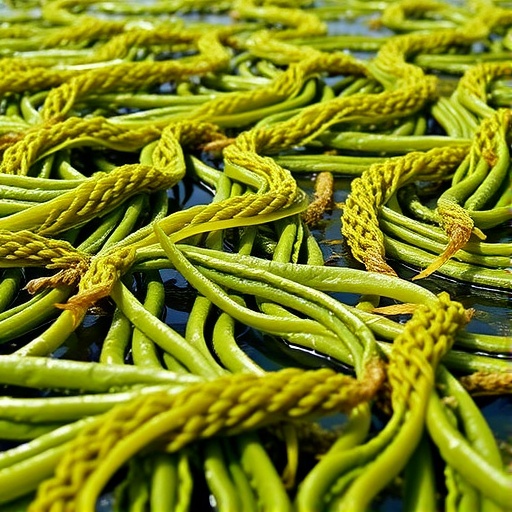
In the face of mounting concerns about climate change and the urgent need for effective carbon sequestration strategies, recent research highlights a promising and largely underappreciated natural ally: seaweed farms. These dynamic aquatic systems offer more than just nutritional and economic value; they may serve as powerful agents in mitigating atmospheric CO2. A groundbreaking study led by Mojtaba Fakhraee, an assistant professor at the University of Connecticut’s Department of Earth Sciences, alongside co-author Noah Planavsky of Yale University, elucidates a novel mechanism by which seaweed aquaculture enhances alkalinity production, thereby significantly contributing to long-term carbon capture.
Seaweed has long been recognized for its versatility as a source of food, medicine, and industrial products. However, its potential as a carbon sink has remained contentious, largely due to prevailing assumptions that the organic biomass produced during seaweed farming is rapidly decomposed by microbes, releasing CO2 back into the environment. Fakhraee and Planavsky challenge this notion by examining the complex biogeochemical processes occurring beneath seaweed farms, revealing a critical but overlooked pathway for CO2 sequestration that centers on the chemical dynamics within sediment layers beneath these farms.
At the core of this newly uncovered process is the interplay between organic matter deposition from seaweed growth and the sedimentary microbial environment. Seaweed farms expedite sediment accumulation as organic debris sinks to the ocean floor, creating anoxic—or oxygen-depleted—zones known as anaerobic sediments. Within these low-oxygen environments, microbial communities metabolize organic carbon differently compared to those in oxygen-rich conditions. Crucially, these anaerobic microbes produce bicarbonate ions (HCO3–), a chemical species that dramatically alters the local aquatic chemistry.
Bicarbonate serves as a fundamental component in the carbonate buffer system, which regulates the pH of seawater and stabilizes the balance between carbon dioxide forms dissolved in the ocean. The enhanced production of bicarbonate compounds beneath seaweed farms results in increased alkalinity, which shifts the water chemistry toward less acidic conditions. This shift effectively drives more atmospheric CO2 to dissolve into the ocean, where it is chemically transformed and retained in stable forms, deeply mitigating its potential to contribute to greenhouse gas concentrations in the atmosphere.
The researchers employed advanced computational simulations and modeling techniques to track the fate of organic carbon deposited within sediments, quantifying the rates of bicarbonate production alongside other carbon fluxes such as calcium carbonate dissolution. Their models indicate that the bicarbonate produced is not merely a transient species but contributes to a long-lived alteration in marine chemistry, potentially sequestering carbon on timescales of thousands of years. This suggests a much more durable carbon sink effect from seaweed farming than previously understood, overturning skepticism rooted in assumptions of rapid biomass re-release as CO2.
Fakhraee emphasizes that this bicarbonate-mediated carbon capture is a form of nature-based climate technology with significant scalability and sustainability advantages. Unlike more energy-intensive carbon capture and storage techniques, seaweed aquaculture requires minimal technological input while simultaneously delivering food and economic benefits. Additionally, from an ecosystem perspective, seaweed farms do not compete with terrestrial agriculture for land use and avoid the controversy associated with protein production from conventional livestock, which is often linked to high greenhouse gas emissions.
Currently, global seaweed aquaculture spans approximately 3.5 million hectares, with the potential to sequester up to seven million tons of CO2 annually. Projections suggest that as industry demand and farmed acreage increase, the total carbon capture capacity of this sector will scale correspondingly. This positions seaweed farming alongside established blue carbon ecosystems like mangroves and seagrasses, historically regarded as some of the most efficient coastal carbon sinks. Remarkably, seaweed farms may sequester carbon at rates slightly surpassing seagrasses and rivaling mangroves, all while providing an expanded suite of ecosystem services beneficial to human well-being.
One of the revolutionary implications of this research lies in its economic potential. By systematically quantifying the carbon capture capabilities of seaweed farms, the industry could partake in emerging carbon credit markets, monetizing the carbon sequestration service they deliver. This could incentivize investments and expand aquaculture operations, driving a virtuous cycle of environmental and economic benefits. However, Fakhraee cautions that further large-scale empirical measurement campaigns are essential to refine these models and elucidate factors influencing carbon sequestration dynamics, such as seasonal variability and farm management practices.
The study advocates a paradigm shift in how we view the intersection of marine aquaculture and climate mitigation. Seaweed farming must be recognized not merely as a source of sustainable food production but as a robust and reliable strategy for capturing and sequestering atmospheric CO2. By integrating biological, chemical, and modeling insights, this research opens pathways toward harnessing the full potential of seaweed ecosystems in global carbon management frameworks.
In summary, seaweed farms emerge as a promising, scalable, and multifaceted nature-based solution to climate change challenges. Through the facilitation of bicarbonate production in anaerobic sediments, these systems enhance alkalinity and drive long-lasting carbon sequestration processes. With ongoing research and policy attention, seaweed aquaculture could become a cornerstone in the global portfolio of carbon capture technologies, aligning ecological restoration with economic development and climate resilience.
News Publication Date: 8-Jan-2026
Web References:
http://dx.doi.org/10.1038/s44458-025-00004-8
References:
Fakhraee, M., & Planavsky, N. (2026). Seaweed farms enhance alkalinity production and carbon capture. Nature Communications Sustainability. https://doi.org/10.1038/s44458-025-00004-8
Cite Scienmag News
Lila Stark. (February 19, 2026). Seaweed Farms: Harnessing the Power of Dynamic Blue Carbon Systems. Scienmag. https://scienmag.com/seaweed-farms-harnessing-the-power-of-dynamic-blue-carbon-systems/
Lila Stark. "Seaweed Farms: Harnessing the Power of Dynamic Blue Carbon Systems." Scienmag, 19 February 2026, https://scienmag.com/seaweed-farms-harnessing-the-power-of-dynamic-blue-carbon-systems/. Accessed 3 September 2026.
Lila Stark. "Seaweed Farms: Harnessing the Power of Dynamic Blue Carbon Systems." Scienmag. February 19, 2026. https://scienmag.com/seaweed-farms-harnessing-the-power-of-dynamic-blue-carbon-systems/


