


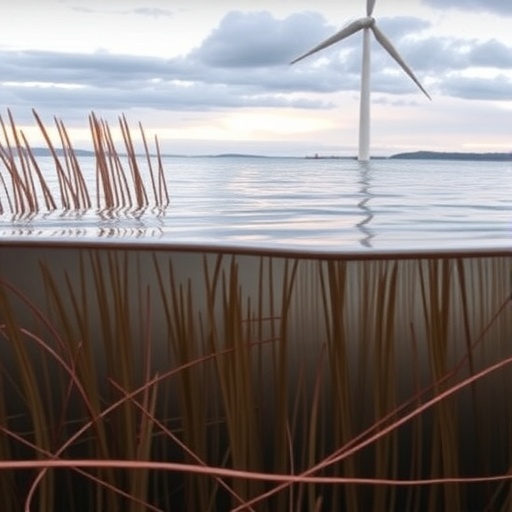
In the delicate coastal networks where marine ecosystems thrive, recent research has unveiled a profoundly disturbing phenomenon: the collapse of eelgrass meadows triggered by a confluence of human-driven hydropower projects and accelerating climate change. This groundbreaking study elucidates how anthropogenic interventions, superimposed on climatic stressors, have precipitated an irreversible shift in these vital ecosystems, with significant ecological and socio-economic repercussions. The findings not only highlight the fragility of oceanic habitats but also cast a stark warning on the cascading effects of environmental mismanagement in a warming world.
Eelgrass (Zostera marina), a foundational species in temperate coastal zones, performs critical ecological functions. It creates habitat complexity, supports biodiversity by serving as nursery grounds for fish and invertebrates, and plays a substantial role in carbon sequestration, thus mitigating climate change impacts. The collapse documented in this research pinpoints the demise of eelgrass meadows, fundamentally altering marine biodiversity and disrupting ecosystem services essential to local communities and global health.
The nexus between hydropower development and climate change forms the crux of this unfolding ecological disaster. Hydropower, often perceived as a clean energy alternative, involves dam constructions that manipulate freshwater flow—a key determinant of estuarine salinity levels and sediment deposition vital for eelgrass survival. The research details how damming activities upstream have significantly altered freshwater influx patterns, resulting in heightened salinity fluctuations and sediment starvation downstream. This shift creates inhospitable conditions for eelgrass, which requires stable salinity and nutrient regimes to maintain its rhizome network and photosynthetic efficiency.
Concurrently, climate change exacerbates these stressors by elevating sea surface temperatures and intensifying storm frequency and severity. Rising temperatures breach physiological thresholds for eelgrass, reducing its reproductive success and resilience. Increased storm activity promotes physical disturbance and sediment resuspension, degrading light penetration necessary for photosynthesis. Combined, these stressors amplify eelgrass vulnerability, accelerating its decline beyond previously anticipated rates.
Central to the study is the concept of social-ecological regime shifts—complex transitions whereby ecosystems and associated human communities undergo fundamental changes in structure and function. The eelgrass collapse initiates a feedback loop wherein ecological degradation undermines fisheries that local populations rely upon, prompting alterations in livelihoods, cultural practices, and economic stability. The regime shift reflects not just environmental loss but also destabilization of socio-economic systems tethered to these coastal ecosystems.
In-depth field analyses supplemented by satellite imagery and hydrological data converge to construct a comprehensive picture of the shifting estuarine dynamics. Notably, the researchers observed a dramatic reduction of eelgrass coverage exceeding 75% over two decades in regions impacted by large hydropower dams. Water quality assessments revealed increased turbidity linked to altered sediment flow, while salinity regimes exhibited unprecedented variability, both factors critically impairing eelgrass photosynthetic capacity and growth cycles.
Laboratory experiments simulated future climate scenarios, including elevated temperature and altered salinity ranges, confirming eelgrass’s sensitivity to combined stressors. The physiological stress observed manifested as reduced chlorophyll content, impaired nutrient uptake, and increased mortality rates. These outcomes signal that without significant mitigation strategies, eelgrass populations are unlikely to recover naturally, indicating a trajectory towards local extinction in affected zones.
The research team employed ecological modeling to forecast potential outcomes under various management and climate scenarios. Models predict that without modification to hydropower operation protocols and concerted climate mitigation efforts, eelgrass meadows will continue their decline inexorably. Conversely, adaptive management that incorporates environmental flow regimes designed to mimic natural freshwater variability, combined with emissions reductions, could stabilize or even partially restore eelgrass habitats.
This work challenges the conventional perception of hydropower as an environmentally benign energy source, illuminating its indirect yet potent ecological ramifications. The findings call for integrated policy frameworks that recognize the interconnectedness of energy production, freshwater management, and marine ecosystem health to avoid unintended environmental consequences that transcend traditional boundaries.
Moreover, the study underscores the urgency of addressing climate change not merely as a global issue but as a localized driver of ecosystem transformations affecting human well-being. The integrative approach combining ecological, social, and hydrological data presents a model for future assessments of environmental interventions and their cascading impacts.
Local indigenous and coastal communities have historically depended on eelgrass meadows for subsistence fishing, coastal protection, and cultural identity. The loss of these habitats threatens food security and cultural heritage, thereby exacerbating social vulnerabilities. The social-ecological regime shift thus transcends environmental degradation, encapsulating a multidimensional crisis requiring cross-sectoral collaborations for resilience building.
In light of these insights, the research advocates for multifaceted intervention strategies. These include redesigning hydropower operations to restore natural estuarine flow dynamics, implementing habitat restoration projects to revive eelgrass meadows, and enacting comprehensive climate policies aligned with ecosystem conservation goals. Crucially, such efforts demand stakeholder engagement ranging from policy makers to local communities to ensure sustainable and equitable solutions.
The extensive implications of this study resonate beyond eelgrass ecosystems, serving as a cautionary exemplar of how engineered hydrological alterations combined with climate-induced pressures can precipitate irreversible loss in critical habitats worldwide. It invites a reassessment of infrastructure development paradigms through an ecological resilience lens, promoting precautionary principles in environmental stewardship.
Ultimately, this pivotal research highlights the intertwined fate of nature and society in the Anthropocene. It compels an urgent reflection on humanity’s role in safeguarding coastal ecosystems amidst expanding energy demands and shifting climate regimes. The holistic understanding offered herein lays foundational knowledge to guide future conservation efforts and sustainable development initiatives in vulnerable marine landscapes globally.
As we face the daunting challenges posed by climate change and anthropogenic modifications, the collapse of eelgrass ecosystems stands as a stark testament to the fragility of natural systems we rely upon. It calls for innovative science, integrated policy, and collective action to chart pathways toward resilience, ensuring that the vital functions and services these ecosystems provide continue to sustain biodiversity and human communities alike.
Cite Scienmag News
Gavin Prescott. (February 18, 2026). Hydropower, Climate Threaten Eelgrass Ecosystem Collapse. Scienmag. https://scienmag.com/hydropower-climate-threaten-eelgrass-ecosystem-collapse/
Gavin Prescott. "Hydropower, Climate Threaten Eelgrass Ecosystem Collapse." Scienmag, 18 February 2026, https://scienmag.com/hydropower-climate-threaten-eelgrass-ecosystem-collapse/. Accessed 3 September 2026.
Gavin Prescott. "Hydropower, Climate Threaten Eelgrass Ecosystem Collapse." Scienmag. February 18, 2026. https://scienmag.com/hydropower-climate-threaten-eelgrass-ecosystem-collapse/


