


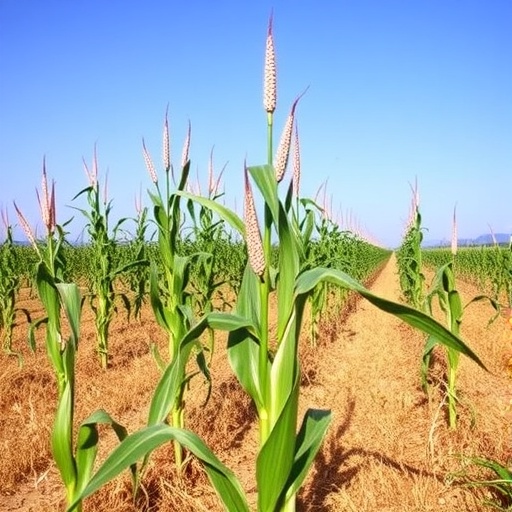
In an era marked by escalating global temperatures, recent research has illuminated critical nuances in how extreme heat impacts staple crop yields across the Northern Hemisphere. The study by Zhao et al., published in Nature Food, challenges the conventional reliance on fixed temperature thresholds to gauge heat stress on crops, revealing significant geographic variability in heat tolerance that could reshape agricultural practices and climate adaptation strategies worldwide.
Historically, climate and agronomic models have utilized uniform temperature benchmarks to predict when heat stress begins to irreversibly damage crop yield. These thresholds, often globally applied, have failed to incorporate regional differences in genetics, microclimates, and management practices, resulting in broad generalizations that obscure localized vulnerabilities or resilience. Zhao and colleagues have bridged this gap by leveraging an extensive subnational yield census dataset spanning the Northern Hemisphere, from 20°N to 55°N latitude, to establish data-driven, crop-specific heat tolerance thresholds with unprecedented granularity.
Their investigation centered on two of the world’s most fundamental crops: maize and soybean. By analyzing extreme degree days (EDDs)—a temperature-based index that measures cumulative exposure above critical temperature levels—they derived precise EDD thresholds (EDD_threshold) that mark the onset of significant yield loss. For maize, this threshold averaged 34.8°C with a margin of error of ±4.0°C, while for soybean it was slightly lower at 33.7°C with ±3.9°C variability. These values not only confirm that heat stress effects are crop-specific but also underscore that substantial spatial heterogeneity exists in the temperatures at which damage begins to escalate.
What emerges is a landscape of complex thermal responses that fluctuate across latitudes, environmental conditions, and cultivation techniques. State-of-the-art crop simulation models, the study reveals, systematically underestimate these thresholds and display an insufficient capacity to capture regional variation. This shortfall leads to an overprediction of the duration and severity of heat exposure in growing seasons, skewing assessments of vulnerability and adaptation needs. As a consequence, prior models have tended to underestimate the magnitude of yield losses during extreme heat episodes by failing to appreciate the nuanced thermal tolerance developed under diverse regional contexts.
Forecasting into the future, the research projects an alarming escalation in growing-season extreme heat exposure by the century’s end, assuming no adaptive changes take place. Maize could face increases ranging from 2.4% to 16.1%, while soybean may experience a rise between 4.9% and 16.0%. These projections reflect not only anticipated climatic shifts but also hinge on the newly identified thresholds that more faithfully represent crop-specific and regional sensitivities. The stakes are enormous; with agriculture already grappling with the twin challenges of feeding a growing population and conserving resources, an accurate understanding of heat-induced stress is pivotal for global food security.
The study further critiques the efficacy of conventional adaptation measures, particularly shifts in sowing dates intended to avoid peak heat stress periods. The data suggest that such temporal adjustments, though beneficial, cannot fully mitigate the projected intensification of extreme heat exposure. This insight compels a broader reconsideration of adaptive strategies that integrate crop breeding, landscape management, and potentially transformative agronomic innovations to sustain yields under warming scenarios.
Zhao and colleagues’ methodological approach represents a leap forward in crop-climate interaction research. By incorporating subnational yield data with fine temporal resolution, their work transcends regional averages and brings unprecedented resolution to heat stress assessment across diverse agro-ecological zones. This approach holds the potential to refine climate risk models globally and adjust policy formulations based on more locally relevant temperature thresholds rather than sweeping generalizations.
Moreover, the identification of EDD_threshold variability enables a nuanced exploration of genetic and environmental factors underlying thermal tolerance. The differential thresholds hint at genetic adaptations and agronomic practices that either exacerbate or alleviate heat vulnerability. Understanding these dynamics can propel breeding programs towards developing heat-resilient crop varieties tailored to specific environmental contexts, improving long-term adaptive capacity.
The correction of bias in crop models illuminated by this research also lays a foundation for improving yield forecasts under climate change. Accurate estimation of both the onset and spatial distribution of heat stress exposure is critical for anticipating food production shocks, designing insurance systems, and guiding investment in agricultural infrastructure. Models that adequately reflect thermal tolerance diversity will be indispensable in crafting robust socio-economic responses to climate-induced disruptions.
This study arrives at a crucial moment when climatic extremes are becoming increasingly frequent and severe, demanding that agricultural science not only keeps pace but anticipates future risks with precision. The heterogeneity uncovered in heat stress thresholds reinforces that “one-size-fits-all” approaches to climate mitigation and adaptation are no longer viable. Instead, localized data and tailored responses must assume priority if global agriculture is to maintain resilience amid warming.
In dissecting how maize and soybean yields respond to heat across a vast spatial scale, Zhao et al. have spotlighted a path forward for integrating environmental variability into crop assessment protocols. Their findings call for enhanced collaboration among climate scientists, agronomists, breeders, and policymakers to develop region-specific strategies that align with biological realities on the ground.
Looking ahead, research building on these insights will likely explore the interplay between heat stress and other abiotic factors such as drought, nutrient availability, and pest pressures. Multi-factorial stress assessments could further refine the delineation of vulnerable zones and critical intervention points. Additionally, expanding such analyses to include other staple crops and broader latitudinal bands would deepen understanding of global food system vulnerabilities.
Ultimately, this work underscores the urgent imperative to fortify global food production systems against the escalating threats of climate change with approaches that respect complexity and variability. Success in this endeavor will be a cornerstone of human well-being and socio-economic stability in the decades to come.
Cite Scienmag News
Alan Morgan. (February 18, 2026). Geographic Heat Limits Impact Maize, Soybean Yields. Scienmag. https://scienmag.com/geographic-heat-limits-impact-maize-soybean-yields/
Alan Morgan. "Geographic Heat Limits Impact Maize, Soybean Yields." Scienmag, 18 February 2026, https://scienmag.com/geographic-heat-limits-impact-maize-soybean-yields/. Accessed 4 September 2026.
Alan Morgan. "Geographic Heat Limits Impact Maize, Soybean Yields." Scienmag. February 18, 2026. https://scienmag.com/geographic-heat-limits-impact-maize-soybean-yields/


