


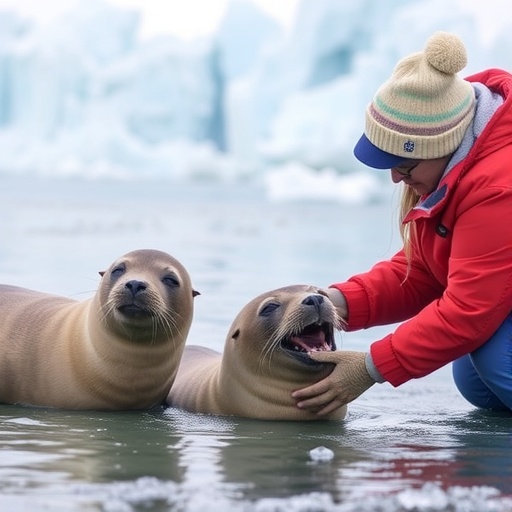
In the remote and largely inaccessible Arctic marine environment, understanding the foraging habits of marine mammals has long posed a formidable challenge to researchers. Unlike terrestrial animals whose feeding behaviors can be observed with relative ease, Arctic marine mammals such as ringed seals conduct their feeding underwater, often in vast, ice-covered expanses that are difficult to monitor. Traditional dietary studies have relied heavily on the analysis of stomach contents from stranded individuals; however, this method falls short in providing contextual information on the location and timing of feeding events. A groundbreaking study led by Project Assistant Professor Monica Ogawa from the National Institute of Polar Research, Japan, has ingeniously exploited the cultural practices of Inuit communities to bridge this critical knowledge gap, offering unprecedented insights into the spatial foraging ecology of Arctic ringed seals.
The study harnessed the unique advantage afforded by Inuit subsistence hunting practices around Inglefield Bredning (Kangerlussuaq), Greenland. Inuit hunters, intimately familiar with local marine environments, provided researchers with harvested ringed seals along with precise capture locations. By meticulously comparing the stomach contents of these seals with their respective hunting coordinates, the research team was able to establish a direct link between diet composition and geographic foraging zones. Published in the esteemed journal Communications Earth & Environment, the study offers a compelling narrative on the ecological significance of tidewater glacier fronts as crucial foraging grounds for ringed seals, revealing intriguing spatial variations in diet closely tied to proximity to glacial fronts.
A remarkable aspect of the research is the innovative use of stomach content analysis, a classical biological method often criticized for its limitation of representing only very recent feeding activity, typically within a few hours prior to capture. The team astutely turned this limitation into a methodological strength by integrating it with precise spatial data from the hunting locations. This approach enabled a fine-scale examination of feeding patterns, mapping the immediate dietary intake of seals to specific environmental hotspots. Such spatially explicit dietary data is rare in marine mammal studies and represents a significant advance in understanding how these apex predators utilize diverse Arctic habitats.
Data revealed that seals captured near tidewater glacier fronts possessed stomachs that were not only heavier but also overwhelmingly dominated by polar cod, a fish species closely associated with the unique nutrient conditions at glacier margins. These glacier fronts foster dynamic ecological conditions, including upwelling of nutrient-rich deep waters and mixing of freshwater and marine systems, creating highly productive foraging hotspots. Seals capitalize on these zones, where concentrated prey availability supports greater feeding success and potentially better overall body condition.
Importantly, the study delineates a clear gradient in diet composition corresponding to distance from glacial fronts. Seals captured farther away from these productive zones exhibited more varied and lighter stomach contents, indicating less abundant or different prey resources. This spatial dietary stratification underscores the critical role of these glacier-influenced habitats in sustaining Arctic marine predators. The findings suggest that the loss of tidewater glacier fronts, driven by accelerating climate change and glacial retreat, could cascade through the Arctic food web, affecting not only seal populations but also their predators, including polar bears, and ultimately impacting indigenous communities reliant on these species for subsistence.
The ongoing retreat of Arctic tidewater glaciers—where glaciers calve directly into the ocean—is altering the physical and biological landscape of high-latitude waters. As glaciers shrink and withdraw onto land, the mechanical and hydrodynamic processes that generate nutrient upwelling and sustain rich ecosystems at glacier fronts are disrupted or lost entirely. This degradation of foraging habitat for seals may force them to modify their spatial distribution and diet, potentially leading to declines in body condition and reproductive success. Such ecological shifts could reverberate throughout the larger ecosystem, disrupting predator-prey dynamics and threatening the resilience of Arctic marine biodiversity.
Collaboration with Inuit hunters was fundamental to the research’s success, providing an unparalleled depth and breadth of sample collection that would have been otherwise impossible. Inuit hunters’ intimate knowledge of marine environments and their continued subsistence hunting practices enabled the assembly of a robust dataset linking animal diet to specific foraging locations. This synergy between traditional ecological knowledge and modern scientific inquiry exemplifies the value of Indigenous partnerships in Arctic research and highlights the ethical imperative of involving local communities in studying ecosystems on which they depend.
Dr. Monica Ogawa emphasizes the novelty and utility of this methodological fusion, stating, “This study transformed what was traditionally seen as a limitation—the short temporal window of stomach content analysis—into an advantage by associating feeding data precisely with capture locations. This approach provides new avenues to unravel the spatial ecology of marine mammals, advancing our understanding of their foraging behavior in a changing world.” Her research contributes markedly to the field of marine mammal ecology, integrating ethnographic collaboration and rigorous scientific methods to shed light on critical ecological processes in the Arctic.
The study was supported by multiple funding sources, including the Arctic Challenge for Sustainability II and III projects funded by Japan’s Ministry of Education, Culture, Sports, Science and Technology (MEXT), JST SPRING, and the Environmental Support Program of the Danish Environmental Protection Agency. These collaborative international efforts underscore the broad recognition of Arctic ecosystems’ vulnerability and global significance.
The National Institute of Polar Research (NIPR), where Dr. Ogawa is based, plays a pivotal role in advancing polar science through multidisciplinary research and international cooperation. NIPR’s infrastructure supports diverse research activities spanning the atmosphere, ice sheets, ecosystems, and Earth’s magnetic field across polar regions. The institute is also engaged in training graduate students, fostering new generations of researchers equipped with a global perspective on polar challenges.
As Arctic environments rapidly transform under the influence of climate change, innovative research such as this offers vital clues to the future of marine ecosystems. Understanding how key species like ringed seals adapt—or fail to adapt—to loss of critical foraging habitats has profound implications for conservation strategies. It also informs the stewardship practices of indigenous Arctic peoples, who have coexisted with these animals for millennia and whose cultural well-being is intertwined with marine resource sustainability.
In sum, this study reveals that tidewater glacier fronts are not merely physical landmarks sculpting Arctic coasts but are dynamic ecological hubs sustaining rich predatory marine life. Protecting these unique habitats and mitigating the impacts of glacier retreat emerge as urgent priorities to preserve the integrity of Arctic marine ecosystems. The innovative integration of indigenous knowledge and classical scientific techniques demonstrated here charts a promising path forward in polar research, offering a model for addressing complex environmental challenges globally.
Web References:
https://doi.org/10.1038/s43247-025-03174-4
Cite Scienmag News
Gavin Prescott. (February 18, 2026). Glacier Proximity Boosts Seal Feeding Success, Study Finds. Scienmag. https://scienmag.com/glacier-proximity-boosts-seal-feeding-success-study-finds/
Gavin Prescott. "Glacier Proximity Boosts Seal Feeding Success, Study Finds." Scienmag, 18 February 2026, https://scienmag.com/glacier-proximity-boosts-seal-feeding-success-study-finds/. Accessed 4 September 2026.
Gavin Prescott. "Glacier Proximity Boosts Seal Feeding Success, Study Finds." Scienmag. February 18, 2026. https://scienmag.com/glacier-proximity-boosts-seal-feeding-success-study-finds/


