


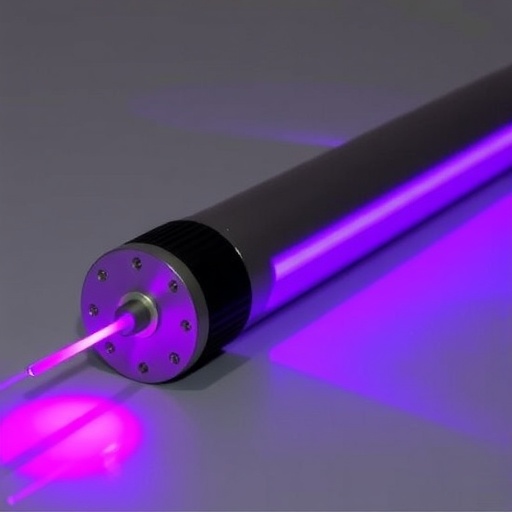
In a groundbreaking advance poised to revolutionize precision measurement and quantum control, researchers have unveiled a continuous-wave (CW) vacuum ultraviolet (VUV) laser operating at the exceptionally narrow linewidth and wavelength that matches the elusive nuclear isomeric transition in thorium-229 (^229Th). This nuclear transition, occurring at around 148.4 nm, has fueled growing excitement in physics due to its unique suitability for the development of next-generation nuclear clocks and coherent nuclear manipulation. The new laser source, developed through innovative four-wave mixing in cadmium vapor, delivers coherent, ultranarrow linewidth VUV radiation that overcomes major longstanding challenges in the field.
The search for an intense, narrow-linewidth laser resonant with the ^229Th nuclear isomeric transition has been arduous. This nuclear transition, which lies unusually low in energy for a nuclear excitation—just in the vacuum ultraviolet regime—provides an unparalleled platform for probing nuclear structure and fundamental constants with unprecedented precision. Previous attempts to access this transition spectrally have been thwarted by the lack of suitable lasers emitting below 190 nm with narrow linewidths and sufficient power output. The newly demonstrated CW laser at 148.4 nm surmounts these barriers, achieving output powers exceeding 100 nW paired with a projected linewidth well below 100 Hz, representing a five orders of magnitude improvement over earlier single-frequency sources.
This extraordinary feat hinges on exploiting nonlinear optical processes within cadmium vapor to generate coherent VUV light through a phase-matched four-wave mixing (FWM) technique. The researchers carefully engineered the mixing scheme to ensure high efficiency and spectral purity, enabling the generation of frequency-tunable radiation precisely at the ^229Th isomeric transition wavelength. The choice of cadmium as the nonlinear medium allowed favorable phase-matching conditions and low propagation losses in the VUV regime—a notoriously challenging spectral domain to access due to strong material and atmospheric absorption.
Key to evaluating the laser’s coherence performance, the authors developed an innovative spatially resolved homodyne interferometric technique. This method meticulously characterizes and places stringent upper bounds on any phase noise introduced during the FWM process. The results confirm that the VUV radiation maintains an astonishing degree of temporal coherence, supporting the ultimate goal of sub-hertz linewidth operation. Such coherence levels are unprecedented in the VUV spectral domain and lay the foundation for the nuclear laser spectroscopy needed to unlock the full potential of ^229Th nuclear clocks.
The implications of this development ripple far beyond nuclear physics. The availability of a widely tunable, CW, ultranarrow linewidth laser source in the VUV opens new horizons in quantum information science, particularly for precision quantum logic spectroscopy of nuclear systems. It may enable exploiting the nuclear degrees of freedom for quantum control schemes with coherence times and precision far superior to those achievable in electronic transitions. Additionally, the ultrastable VUV laser holds promise for solid-state physics applications, allowing optical interrogation of nuclear transitions embedded in transparent crystal hosts, with profound implications for new clock architectures and tests of fundamental symmetries.
Previous research efforts have incorporated ensembles of ^229Th nuclei into transparent crystalline matrices, to enable optical access to the nuclear transition while benefiting from long coherence times and environmental isolation. However, laser sources remained limiting, as pulsed and broadband VUV sources lacked the spectral and power requirements to drive coherent nuclear excitation. The newly reported CW laser source directly addresses these limitations and paves the way for coherent nuclear manipulation, a critical step toward realizing optically driven nuclear timekeeping surpassing existing atomic clocks.
In addition to the technical merit, the laser’s broad wavelength tunability promises adaptability to study other narrow VUV transitions and exotic nuclear or electronic states. The high spectral brightness and stability offered by this approach are likely to catalyze innovations in high-resolution VUV spectroscopy, enabling investigation of hitherto inaccessible atomic and molecular processes with exceptional spectral resolution. This capability could profoundly impact fields such as condensed matter physics, materials science, and fundamental tests of quantum electrodynamics.
The pioneering generation of continuous-wave VUV laser radiation with a linewidth narrowed by orders of magnitude exemplifies the power of nonlinear optics combined with precision metrology methods. By cleverly exploiting the resonant nonlinearities of Cd vapor and innovating characterization techniques, the researchers have set a new benchmark for VUV coherent sources. This effort propels the quest for a thorium-based nuclear clock—a new paradigm in timekeeping with potential accuracy and stability rivaling or exceeding the best atomic clocks.
From an experimental perspective, implementing such a clock will require further advances in laser stabilization, environmental isolation, and integration with thorium-doped hosts or trapped ions. Nonetheless, this milestone laser source’s performance assures that the technological obstacles blocking coherent nuclear excitation can now be feasibly overcome. With this laser tool in hand, the nuclear quantum optics community is equipped to perform ground-breaking studies of the 229Th isomeric transition, explore ultimate limits of clock stability, and even probe potential variations in fundamental constants over time.
The continuous-wave VUV laser also heralds new opportunities for fundamental science, including investigations of nuclear structure, nuclear quantum optics phenomena, and tests of physics beyond the Standard Model. The exceptional coherence and tunability of the source enable experiments probing nuclear excitation dynamics, multi-photon nuclear processes, and the coupling between electronic and nuclear degrees of freedom on unprecedented timescales. These experiments will enrich our understanding of nuclear systems at the quantum limit and open routes to novel quantum technologies based on nuclear transitions.
In summary, the introduction of a robust, narrow-linewidth, and tunable CW laser source at 148.4 nm embodies a quantum leap toward harnessing the ^229Th nuclear isomeric transition for clock applications and quantum control. This laser breaks through technical barriers, delivering the wattage and coherence properties required for high-fidelity spectroscopic interrogation of nuclear states in the VUV. As researchers implement this source in diverse experimental platforms, they will advance the realization of nuclear clocks and enable transformative research across quantum information science, condensed matter, and high-resolution spectroscopy.
This extraordinary advance exemplifies the remarkable progress possible when cutting-edge nonlinear optics intersects with the physics of ultra-precise measurement and nuclear quantum dynamics. The unprecedented spectral purity and stability of the continuous-wave vacuum ultraviolet laser are poised to make ^229Th nuclear clocks a reality, opening a new frontier for precision fundamental physics and new technology. The research marks a milestone that will reverberate through spectroscopy, quantum optics, and metrology for years to come.
Cite Scienmag News
Denise Maddox. (February 18, 2026). Continuous-Wave Narrow-Linewidth Vacuum UV Laser. Scienmag. https://scienmag.com/continuous-wave-narrow-linewidth-vacuum-uv-laser/
Denise Maddox. "Continuous-Wave Narrow-Linewidth Vacuum UV Laser." Scienmag, 18 February 2026, https://scienmag.com/continuous-wave-narrow-linewidth-vacuum-uv-laser/. Accessed 3 September 2026.
Denise Maddox. "Continuous-Wave Narrow-Linewidth Vacuum UV Laser." Scienmag. February 18, 2026. https://scienmag.com/continuous-wave-narrow-linewidth-vacuum-uv-laser/


