


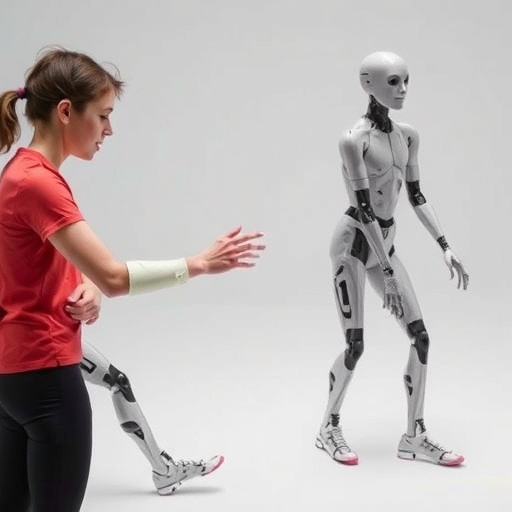
Understanding how the human brain perceives and controls body movement is fundamental to mastering physical activities, from athletic endeavors to the artistry of dance. Recent groundbreaking research from North Carolina State University reveals that this neural and perceptual process undergoes a striking transformation when individuals learn to walk using robotic prosthetic legs. Contrary to what might be expected, the integration of a mechanical limb into one’s body image—a person’s mental representation of their own body—does not simply mirror the natural learning process seen with biological limbs, but instead follows a complex and counterintuitive trajectory.
The study, spearheaded by Helen Huang, Jackson Family Distinguished Professor of Biomedical Engineering at NC State and UNC Chapel Hill, delves deeply into how able-bodied individuals adapt their body image while walking with a robotic prosthetic attached at a fixed knee angle. Remarkably, when using these devices, participants initially overestimated the awkwardness of their movements. They perceived their gait as more imbalanced and unnatural than biomechanical data indicated, suggesting that their internal sense of movement was distorted early in the learning process. Over four days of intensive treadmill training, while their physical performance improved significantly, these perceptions shifted markedly—but not towards accuracy. Instead, participants became overconfident, confident in a fluidity and naturalness that objective measurements failed to confirm.
This divergence highlights a novel dissociation between actual motor skill acquisition and self-perceptual accuracy unique to robotic prosthetic use. Typically, the mental model one harbors about their body motion aligns more closely with reality as skills develop; however, with wearable robotics, people’s assessments of their own gait become increasingly disconnected from the measurable kinematics of their movements. This raises critical questions about how robotic limbs are incorporated—or not—into the users’ sensorimotor framework and body schema, challenging assumptions about body image plasticity and motor feedback loops in the context of prosthesis learning.
To unravel these intricacies, nine able-bodied volunteers were tested under controlled laboratory conditions. The study employed a robotic knee prosthetic locked at a right angle, attached to the participants’ leg. Their task was to walk on a treadmill at maximal safe speeds without using handrails—an exercise designed to mimic dynamic gait challenges encountered during everyday walking. Following each training session, participants evaluated their own movement by selecting from a series of animated gait patterns representing varying degrees of biomechanical fidelity. This method provided real-time insight into the subjective evolution of body image in relation to externally visible and measurable prosthetic motion.
Throughout the sessions, one striking observation was the predominant focus on torso positioning during self-assessment. Participants appeared to neglect the role of the robotic limb itself, despite its integral function in locomotion. This neglect likely stems from limited sensory feedback from the prosthesis; users cannot directly see their lower limb’s movement and receive scant haptic signals. The lack of robust sensory integration impedes the development of an embodied experience with the device, thereby impairing accurate internal representation of movement. This understanding opens important avenues to enhance training regimes through multimodal feedback systems such as augmented reality visualizations or vibrotactile cues that could better synchronize perceived and actual biomechanical states.
Another key implication from the research relates to motivational psychology in skill acquisition. The overconfidence that emerges with practice may paradoxically hinder further improvement. If prosthesis users believe their gait is more precise and natural than it objectively is, they may reduce the effort invested in refining their movement, thereby plateauing prematurely. This underscores the necessity of designing interventions that promote accurate self-evaluation, potentially incorporating objective performance metrics or expert-guided feedback to recalibrate body image and support continued learning progression.
The scholarly article titled “Projecting the New Body: How Body Image Evolves During Learning to Walk with a Wearable Robot,” with first authorship by I-Chieh Lee and co-authorship by Huan Min and Ming Liu, elaborates the experimental protocol, data analytics, and theoretical insights in depth. Published in the open-access journal PNAS Nexus on February 17, 2026, the paper marks a pivotal contribution to the biomedical engineering and neurorehabilitation communities. The research was supported by the National Institutes of Health and the National Science Foundation, reflecting the high priority and interdisciplinary interest in advancing human-robot interaction technologies for health and mobility applications.
This study not only challenges conventional wisdom about embodiment and motor learning but also catalyzes innovation in wearable robotics design and rehabilitation strategies. Enhanced sensory feedback integration, adaptive training modules, and real-time performance visualization could collectively enable prosthesis users to more accurately internalize their augmented body schema, accelerating skill mastery and improving quality of life. Moreover, these findings have broader relevance for brain-machine interfaces and the integration of assistive technologies across diverse populations.
In summary, the process of learning to walk with a robotic prosthetic leg entails a complex transformation in body image that diverges markedly from healthy biological motor learning patterns. Users initially underestimate their movement competence but develop misplaced confidence despite persistent inaccuracies in self-perception. Addressing these perceptual gaps through sensory feedback enhancements and calibrated assessments holds promise to revolutionize prosthesis training and human-robot symbiosis. This research marks a foundational step towards fully unlocking the neuro-cognitive potential embedded in wearable robotics for human mobility restoration.
Cite Scienmag News
Cassandra Pierce. (February 18, 2026). How Using Robotic Prosthetics Transforms Personal Perception of Body Movement. Scienmag. https://scienmag.com/how-using-robotic-prosthetics-transforms-personal-perception-of-body-movement/
Cassandra Pierce. "How Using Robotic Prosthetics Transforms Personal Perception of Body Movement." Scienmag, 18 February 2026, https://scienmag.com/how-using-robotic-prosthetics-transforms-personal-perception-of-body-movement/. Accessed 5 September 2026.
Cassandra Pierce. "How Using Robotic Prosthetics Transforms Personal Perception of Body Movement." Scienmag. February 18, 2026. https://scienmag.com/how-using-robotic-prosthetics-transforms-personal-perception-of-body-movement/


