


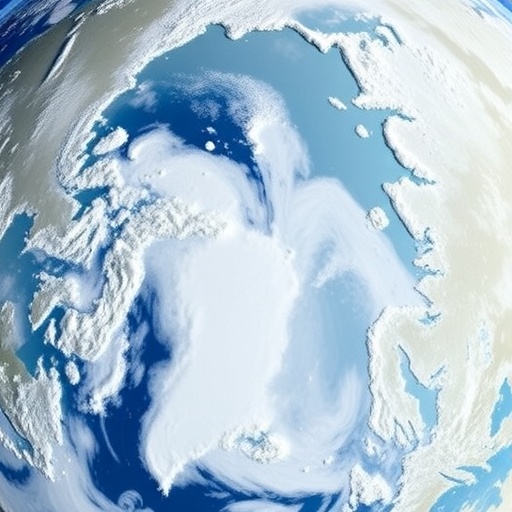
In the spring of 2020, the Arctic region experienced an unprecedented episode of ozone layer depletion, marking a record-breaking anomaly that sent ripples throughout the atmospheric science community. This phenomenon, traditionally linked to natural and anthropogenic chemical processes involving chlorine and bromine compounds, drew new attention when recent research suggested an intriguing compensatory mechanism at play. A team of scientists led by Zhong, Q., Veraverbeke, S., and Yu, P., has uncovered compelling evidence that stratospheric biomass burning aerosols significantly mitigated the extent of this ozone depletion, providing a fascinating insight into the complex interactions governing Earth’s upper atmosphere.
Ozone depletion over the Arctic typically occurs in the polar spring when sunlight returns to the region, triggering photochemical reactions that break down ozone molecules. This depletion can be exacerbated by unique meteorological conditions and the presence of halogens released from human-made compounds. However, in 2020, the scale of the ozone hole was notably severe, largely attributed to exceptionally cold stratospheric temperatures facilitating enhanced polar stratospheric cloud formation, which serves as a platform for catalytic ozone destruction. Despite this, the expected magnitude of ozone loss was not as extensive as models had predicted, prompting researchers to investigate potential mitigating factors.
Through rigorous analysis combining satellite observations, ground-based measurements, and advanced atmospheric modeling, the research team identified that smoke particles from extensive biomass burning events in boreal forests and wildfires had ascended into the stratosphere. This vertical transport allowed aerosols to interact directly with stratospheric chemistry. Biomass burning aerosols—composed of black carbon, organic compounds, and inorganic species—possess unique radiative and chemical properties, influencing atmospheric processes in ways not fully appreciated prior to this study.
One of the critical insights from this research lies in the radiative effects of these aerosols. The biomass burning particles absorb and scatter solar radiation, leading to localized heating in the stratosphere. This warming alters temperature profiles, which in turn affects the microphysical properties and lifetimes of polar stratospheric clouds. By subtly elevating stratospheric temperatures, these aerosols inhibit the formation of the clouds that catalyze ozone destruction reactions, thus reducing the rate of ozone loss during the critical spring period.
Beyond temperature modulation, the aerosols serve as heterogeneous surfaces that can alter chemical reaction pathways. Unlike the surfaces provided by polar stratospheric clouds, biomass burning aerosols may sequester reactive halogen species or facilitate alternative chemical reactions that limit halogen activation. This shift in chemical dynamics presents an additional layer of complexity in understanding stratospheric ozone chemistry, as these aerosols act both as physical and chemical agents capable of mitigating destructive processes.
Analyzing data from the Monitoring Atmospheric Composition and Climate (MACC) and NASA’s Aura satellite, the researchers correlated episodic biomass burning events with stratospheric aerosol optical depth and compositional anomalies. The 2020 fire season, which included massive wildfires in Siberia and North America, injected a significant volume of plumes into the upper atmosphere. These plumes were detected at altitudes surpassing 15 kilometers, with some reaching the lower stratosphere, thereby providing a pathway for aerosols to influence polar atmospheric chemistry directly.
The timing and positioning of these aerosol injections were critical. The latitudinal transport mechanisms, including the Brewer-Dobson circulation, facilitated the movement of biomass burning particles towards the polar vortex region. Consequently, these particles were entrained within the vortex, coinciding spatially and temporally with periods of intense ozone depletion. The research highlights how natural combustion events can unexpectedly intersect with polar atmospheric chemistry, yielding a net effect that partially counterbalances anthropogenically driven ozone loss processes.
Importantly, the study utilized state-of-the-art chemical transport models enriched with detailed aerosol microphysics and chemistry modules. These models simulated the interactions between aerosol particles and halogen species, integrating complex feedbacks between stratospheric temperature perturbations, cloud formation dynamics, and O3 destruction rates. Model simulations closely matched observed ozone column densities when biomass burning aerosol effects were included, supporting the hypothesis that these aerosols played a vital role in moderating Arctic ozone depletion in 2020.
This research does not suggest that biomass burning aerosols are beneficial in a broad environmental sense. Rather, it underscores the multifaceted nature of atmospheric chemistry where distinct processes can produce counterintuitive outcomes. The climatic and health implications of widespread biomass burning—particularly regarding particulate pollution and greenhouse gas emissions—remain overwhelmingly detrimental. The study, however, challenges atmospheric scientists to refine their understanding of how natural and anthropogenic forces interact in the stratosphere.
The findings also have profound implications for ozone recovery trajectories projected under the Montreal Protocol’s regulatory regime. Understanding the extent to which episodic natural phenomena, such as stratospheric aerosol injections from biomass burning, influence ozone dynamics is essential for accurate modeling and prediction of ozone layer health. Variability induced by these aerosols could mask or amplify trends related to chlorofluorocarbon phaseouts, thereby complicating policy assessments.
From a scientific perspective, this study advances the field by bridging gaps between wildfire science, aerosol chemistry, and stratospheric physics. The complexity of atmospheric feedbacks highlighted in this research exemplifies the need for integrated observational platforms and interdisciplinary collaboration. Furthermore, the aerosol-mediated modulation of polar ozone offers a new lens for studying how extreme climate events, such as unprecedented wildfire seasons, influence global atmospheric chemistry.
Future research directions emerging from this study include investigating how climate change-driven alterations in wildfire frequency and intensity might impact long-term stratospheric ozone variability. Additionally, the chemical composition and aging of stratospheric biomass burning aerosols require detailed characterization to elucidate their reactive roles fully. The potential for feedback loops that link tropospheric warming, enhanced wildfire activity, and stratospheric chemical cycles remains a tantalizing area for further exploration.
In conclusion, the 2026 publication by Zhong, Q., Veraverbeke, S., Yu, P., et al., represents a groundbreaking revelation in atmospheric sciences, demonstrating that stratospheric aerosols originating from biomass burning substantially compensated for record-breaking ozone depletion over the Arctic in spring 2020. This discovery enriches our understanding of stratospheric chemistry and highlights a novel natural mechanism mitigating the detrimental impacts of ozone loss during extreme polar conditions. As the planet continues to grapple with evolving climate and environmental challenges, such insights are vital to forecasting and managing Earth’s fragile atmospheric systems.
Cite Scienmag News
Violet Maxwell. (February 18, 2026). Stratospheric Biomass Aerosols Offset Arctic Ozone Loss. Scienmag. https://scienmag.com/stratospheric-biomass-aerosols-offset-arctic-ozone-loss/
Violet Maxwell. "Stratospheric Biomass Aerosols Offset Arctic Ozone Loss." Scienmag, 18 February 2026, https://scienmag.com/stratospheric-biomass-aerosols-offset-arctic-ozone-loss/. Accessed 3 September 2026.
Violet Maxwell. "Stratospheric Biomass Aerosols Offset Arctic Ozone Loss." Scienmag. February 18, 2026. https://scienmag.com/stratospheric-biomass-aerosols-offset-arctic-ozone-loss/


