


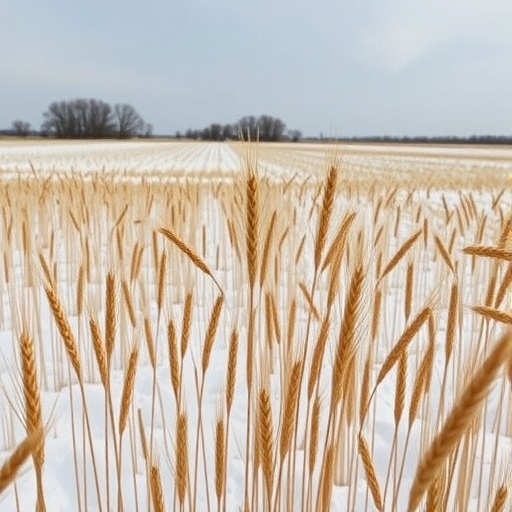
In recent decades, global agriculture has faced mounting challenges from changing climatic patterns, with snow availability emerging as a critical yet underexplored factor influencing crop yields. Snowpack not only acts as a natural reservoir, gradually replenishing soil moisture during the critical early growing season, but also shields winter crops from extreme cold damage. A groundbreaking study published in Nature Food now uncovers a worrying rise in the frequency and impact of snow droughts on winter wheat production throughout the Northern Hemisphere, signaling a pressing threat to global food security in a warming world.
Winter wheat, constituting a substantial fraction of global cereal production, depends heavily on sufficient snowpack during the dormant winter months. Snowmelt provides essential moisture that sustains plant growth in the early spring, while stable snow cover insulates crops from freezing temperatures that can cause cellular damage. However, as winters become warmer and precipitation patterns shift, many snow-dependent regions are experiencing “snow droughts” – periods characterized by below-average snow water equivalent due to insufficient snow accumulation or premature snowmelt. Despite their potential influence on crop yields, the relationship between snow droughts and agricultural productivity has remained poorly quantified, particularly on a hemispheric scale.
Researchers Chen, Wang, Zhu, and colleagues have addressed this knowledge gap by conducting an extensive analysis over six decades (1960–2020) using multiple data streams to characterize snow drought trends and their agricultural consequences. They report an alarming rise in snow drought frequency of between 5.3 and 6.7 percent per decade across Northern Hemisphere winter wheat croplands. These findings indicate that nearly every decade brings a notable increase in the occurrence of these events, which could exacerbate the vulnerability of critical food systems as climate change intensifies.
To rigorously evaluate how winter wheat yields respond to snow drought conditions, the team employed explainable machine learning techniques paired with gridded yield datasets and the standardized snow water equivalent index, spanning from 1982 to 2016. This integrative methodological approach allowed them to disentangle complex interactions among climate variables, agricultural management, and crop responses over vast spatial scales. The analysis revealed a pronounced growth in yield sensitivity to snow water equivalent index in over a quarter of the Northern Hemisphere’s winter wheat areas, underscoring a systemic increase in the crops’ vulnerability to snowpack deficits.
A key insight emerging from the study is that the exacerbated sensitivity of winter wheat yields is not a simple consequence of declining snowpack alone. Instead, it involves a multifaceted interplay of environmental stressors intensified by modern agricultural practices. The authors identify three main factors amplifying yield susceptibility: elevated fertilizer application rates, increased freezing stress, and modest declines in precipitation during critical growth phases. Excessive fertilizers, while boosting growth potential, may paradoxically increase crop sensitivity to moisture stress by altering physiological thresholds. Simultaneously, diminished snow cover reduces natural insulation, exposing crops to harsher freeze-thaw cycles that damage plant tissues. These stressors combined with less precipitation compound the drought-related yield losses.
These findings hold grave implications for agricultural resilience under future climatic scenarios marked by warming winters and more erratic snowfall patterns. Reduced snowpack not only diminishes soil moisture reserves but also alters the thermal regime experienced by overwintering crops. As the frequency and intensity of snow droughts increase, winter wheat’s adaptive capacity may reach critical limits, threatening staple food production across major growing regions. This vulnerability necessitates urgent innovations in crop breeding, field management, and climate risk forecasting to safeguard yields.
Moreover, the study highlights the importance of integrating snowpack dynamics into agricultural risk assessments and adaptation frameworks. Traditional drought metrics often emphasize precipitation deficits during the growing season, overlooking the unique but essential role snow water equivalence plays in winter crop productivity. By incorporating snow drought indicators into predictive models, policymakers and farmers can better anticipate yield fluctuations and implement timely interventions such as adjusted sowing dates, protective agronomic practices, or diversified crop portfolios.
In addition to advancing scientific understanding, this research raises pivotal questions about sustainability and trade-offs embedded in contemporary farming systems. For instance, while intensified fertilizer use has underpinned yield gains in recent decades, its contribution to exacerbating yield sensitivity under snow drought conditions calls for optimization of nutrient management strategies that balance productivity with climatic resilience. Similarly, landscape-level approaches to conserve and enhance natural snow retention processes could mitigate some impacts of warming winters.
The observed temporal trends in snow drought frequency also underscore the urgency of mitigating climate change drivers. Without substantial reductions in greenhouse gas emissions, ongoing warming will likely continue eroding snowpack stability, deepening threats related to moisture stress and freeze damage in winter wheat croplands. Thus, bridging climate mitigation efforts with adaptive agricultural technologies forms a crucial axis for ensuring global food security.
This comprehensive hemispheric-scale study represents a critical advance in climate-agriculture science, elucidating a subtle yet powerful dimension of crop vulnerability that has been underestimated until now. By harnessing machine learning’s explanatory power and integrating diverse climatic and agricultural datasets, Chen et al. provide a nuanced understanding of how winter wheat’s yield resilience is evolving amid an era of changing snow hydrology.
The findings call for intensified interdisciplinary collaboration among climatologists, agronomists, ecologists, and policymakers to co-develop targeted solutions that address both climatic hazards and farming system vulnerabilities. Investing in research on crop varieties better equipped to tolerate freeze damage and moisture stress could substantially enhance adaptation capacity. Additionally, developing early warning systems incorporating snowpack forecasts and crop growth models would empower proactive management responses.
Finally, this emerging narrative about snow droughts reshaping winter wheat productivity reminds us of the intricate dependencies between climate systems and food production. As the planet warms and weather patterns shift unpredictably, safeguarding agricultural stability demands a holistic approach that recognizes and addresses all environmental controls on crop success, including those hidden beneath the winter snowpack.
In conclusion, the study’s revelation that winter wheat yield sensitivity to snow droughts is increasing across the Northern Hemisphere presents a compelling framework for future research and adaptation strategies. The intensification of this vulnerability spotlights an urgent front in global food security challenges, underscoring the need for concerted action to mitigate climatic impacts, optimize agricultural practices, and enhance ecosystem resilience. Amid a warming planet, understanding and managing the multifaceted role of snow in crop production will be essential to sustaining harvests and feeding a growing world population.
Cite Scienmag News
Alan Morgan. (February 18, 2026). Rising Snow Drought Threatens Northern Hemisphere Wheat. Scienmag. https://scienmag.com/rising-snow-drought-threatens-northern-hemisphere-wheat/
Alan Morgan. "Rising Snow Drought Threatens Northern Hemisphere Wheat." Scienmag, 18 February 2026, https://scienmag.com/rising-snow-drought-threatens-northern-hemisphere-wheat/. Accessed 3 September 2026.
Alan Morgan. "Rising Snow Drought Threatens Northern Hemisphere Wheat." Scienmag. February 18, 2026. https://scienmag.com/rising-snow-drought-threatens-northern-hemisphere-wheat/


