


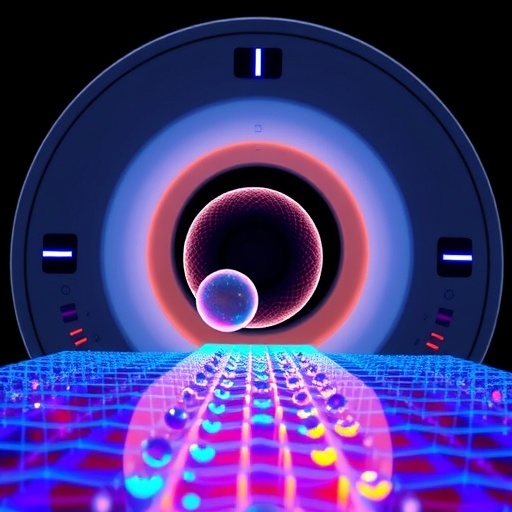
In a groundbreaking advancement combining the realms of machine learning, acoustic manipulation, and medical imaging, researchers Wu, Li, and Tang have unveiled a novel technique enabling real-time acoustic trapping within dynamic, multi-medium environments. This pioneering study, set to appear in the 2026 volume of Communications Engineering, heralds a new era for precise microbubble manipulation guided by magnetic resonance imaging (MRI). The implications of this work extend across biomedical fields, promising enhanced control over microscale agents within complex biological milieus.
The team’s innovation lies in their seamless integration of machine learning algorithms with acoustic trapping technology. Acoustic trapping, which employs focused ultrasonic waves to maneuver microscopic particles, faces significant technical challenges when applied in heterogeneous and time-varying environments, such as human tissues with varying acoustic properties. Traditional methods often falter due to the unpredictable interactions of sound waves with different media interfaces, limiting precision and reliability in real-time applications. Wu and colleagues confronted this obstacle by training advanced machine learning models to adaptively predict and compensate for these environmental fluctuations, thereby revolutionizing acoustic trapping’s operational landscape.
Central to their approach is the employment of real-time feedback loops, wherein acoustic signals and MRI data synergize to refine the trapping accuracy continuously. Magnetic resonance imaging, with its superior soft tissue contrast and non-invasive nature, serves not only as a visualization tool but as an active participant in the manipulation process. Here, MRI detects microbubble positions and trajectory changes with high spatial and temporal resolution, feeding this critical information back into the machine learning model. This dynamic system then recalibrates the acoustic parameters instantaneously, ensuring stable confinement of microbubbles despite the otherwise disruptive variations across tissues and fluids.
The choice of microbubbles as the focal agents for trapping represents an insightful strategy. Microbubbles are used extensively in medical diagnostics and therapeutics, especially as ultrasound contrast agents and drug delivery vehicles. Their controllability could significantly elevate capabilities in targeted therapies, enabling precise delivery to challenging anatomical sites without invasive procedures. However, their manipulation demands exquisite expertise given their diminutive size and susceptibility to displacement by physiological flows and mechanical perturbations. By leveraging machine learning to harness acoustic forces more effectively, the research surmounts the traditional barriers inhibiting real-time microbubble management within bodily environments.
Wu, Li, and Tang’s methodology encompasses a sophisticated combination of supervised learning algorithms trained on extensive datasets collected from controlled experiments mimicking human tissue heterogeneity. By simulating different medium compositions and dynamic environmental changes, the model learns to anticipate acoustic wave distortions and predict how to adjust wave parameters accordingly. Unlike static calibration approaches, this adaptive system remains resilient against temporal fluctuations such as blood flow, respiratory movements, and tissue deformation, which traditionally degrade the precision of acoustic trapping.
The potential applications of this technology in clinical settings are wide-ranging. For instance, in MR-guided focused ultrasound (MRgFUS) therapy, the ability to manipulate microbubbles with unprecedented accuracy could amplify treatment efficacy for cancers and neurological disorders. The localized mechanical effects generated by trapped microbubbles could enhance blood-brain barrier permeability or ablate tumors selectively. Moreover, this technique provides a platform for delivering targeted therapeutics directly at the cellular level, minimizing systemic side effects and optimizing dosing regimens in oncology and beyond.
From a technical perspective, the fusion of MRI compatibility with acoustic trapping necessitates overcoming substantial electromagnetic interference and hardware integration challenges. The researchers devised custom coil designs and sequence synchronization protocols ensuring that acoustic emission devices and MRI scanning operate simultaneously without compromising image quality or trapping stability. This feat required an interdisciplinary blend of expertise spanning biomedical engineering, acoustics, machine learning, and medical imaging physics, underscoring the multidisciplinary nature of the breakthrough.
Experimental validation of the system revealed remarkable robustness. The researchers demonstrated stable microbubble confinement in heterogenous phantoms simulating complex human tissues whose acoustic impedance varied continuously over time. Real-time adjustments allowed the system to maintain control despite introducing perturbations that mimicked physiological conditions. These results affirm the practical applicability and pave the way for in vivo studies and eventual clinical translation.
Additionally, the researchers investigated the system’s ability to trap multiple microbubbles simultaneously in divergent regions, showcasing scalability. The AI model deftly managed multiple acoustic foci by dynamically allocating energy and adjusting wavefront phases to account for inter-bubble interactions and environmental shifts. Such multi-target manipulation holds promise for parallel therapeutic delivery or simultaneous imaging contrast enhancement within different anatomical zones.
Looking forward, the team expresses optimism about expanding machine learning frameworks to incorporate reinforcement learning approaches where the system autonomously explores parameter spaces to optimize trapping strategies. Coupling this with real-time physiological monitoring data could further personalize treatments, adapting acoustic parameters to individual patient anatomy and disease states. Such intelligent, adaptive platforms could revolutionize precision medicine frameworks by enabling minimally invasive microscale interventions that are continuously optimized throughout therapeutic procedures.
The convergence of cutting-edge computational intelligence with physical manipulation technologies embodied by this work also sparks exciting opportunities beyond medicine. Industrial applications involving microscale sorting, assembly, or inspection in fluidic environments could benefit from agile and adaptive acoustic control systems. The discoveries and methodologies presented chart a decisive path toward smarter, faster, and more precise manipulation mechanisms at microscopic scales governed by complex environmental dynamics.
In summary, the research spearheaded by Wu, Li, and Tang epitomizes the transformative potential arising at the intersection of acoustic physics, machine learning, and MRI technology. By overcoming longstanding obstacles in multi-medium acoustic trapping through real-time adaptive control, this work establishes a functional blueprint for next-generation microscale manipulation systems with extensive biomedical and engineering applications. As this technology progresses toward clinical deployment, it promises to significantly advance non-invasive therapeutic capabilities and accelerate innovation in microscale biomedical engineering.
The future envisioned by this study is one where virtual intelligence enhances physical instrumentation, allowing clinicians and researchers to interact with microscopic agents with unprecedented precision and flexibility. This technological synergy not only extends the boundaries of what can be achieved in microscale manipulation but also refines the interface between machine intelligence and human healthcare, potentiating new paradigms in personalized medicine and device-assisted therapies.
Cite Scienmag News
Denise Maddox. (February 16, 2026). AI-Driven Real-Time Acoustic Trapping for MRI Microbubble Control. Scienmag. https://scienmag.com/ai-driven-real-time-acoustic-trapping-for-mri-microbubble-control/
Denise Maddox. "AI-Driven Real-Time Acoustic Trapping for MRI Microbubble Control." Scienmag, 16 February 2026, https://scienmag.com/ai-driven-real-time-acoustic-trapping-for-mri-microbubble-control/. Accessed 3 September 2026.
Denise Maddox. "AI-Driven Real-Time Acoustic Trapping for MRI Microbubble Control." Scienmag. February 16, 2026. https://scienmag.com/ai-driven-real-time-acoustic-trapping-for-mri-microbubble-control/


