


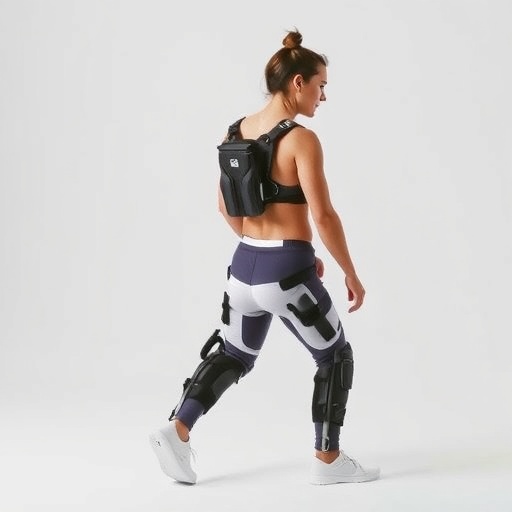
The dawn of a new era in neuro-rehabilitation has arrived with a rhythmic mechanical hum that promises to redefine human mobility for millions of individuals living with the long-term aftermath of a stroke. In a groundbreaking study published in the prestigious journal Nature Communications, a multidisciplinary team of researchers led by Pruyn, Murray, and Gabert has unveiled a portable hip exoskeleton designed to alleviate the crushing metabolic burden that typically accompanies post-stroke gait. For decades, the medical community has struggled to provide stroke survivors with tools that offer more than just stability; the holy grail has always been the restoration of walking economy—the efficiency with which the body moves through space. This latest innovation represents a monumental leap forward, blending sophisticated biomechanical engineering with intuitive control systems to bridge the gap between biological limitation and mechanical liberation.
The physiological toll of a stroke is often measured in the arduous, asymmetrical steps that characterize hemiparetic walking, where one side of the body fails to synchronize with the other, leading to an exhausting expenditure of energy. This metabolic inefficiency is not merely a clinical observation but a profound barrier to social reintegration and physical health, as the sheer effort required to cross a room can leave a survivor breathless and discouraged. The exoskeleton developed by the Pruyn team targets this specific vulnerability by providing assistive torque directly to the hip joint, which serves as the primary engine for forward propulsion during the gait cycle. By intelligently augmenting the paretic limb’s swing and stance phases, the device effectively offloads the muscular work required from the patient, allowing for a gait that is not only faster but significantly more metabolically sustainable.
At the heart of this technological marvel lies a complex suite of sensors and algorithms that interpret the wearer’s intent in real-time, a feat of engineering that distinguishes it from the clunky, pre-programmed orthotics of the past. Unlike stationary treadmill-based systems that confine rehabilitation to the sterile environment of a laboratory, this portable hip exoskeleton is a lightweight, untethered masterpiece designed for the chaotic unpredictability of the real world. The researchers utilized high-frequency inertial measurement units and sophisticated force transducers to map the precise nuances of each individual’s unique walking signature. This data is then processed by an on-board computer that calculates the exact millisecond to deliver a supportive burst of power, ensuring that the machine works in perfect harmony with the human nervous system rather than fighting against it.
The technical implications of improving walking economy cannot be overstated, particularly when considering the metabolic cost of transport which, for stroke survivors, is often double that of healthy adults. Through rigorous testing involving diverse cohorts of survivors, the study demonstrated a substantial reduction in oxygen consumption and carbon dioxide production, the gold standards for measuring physical exertion. By decreasing the metabolic rate required to walk at a given speed, the exoskeleton essentially expands the “operational range” of the human body, turning what was once a grueling marathon into a manageable stroll. This efficiency gain is achieved by optimizing the hip flexion during the initiation of the swing phase, which reduces the compensatory movements like hip trekking or circumduction that frequently lead to secondary joint pain and chronic fatigue.
One of the most remarkable aspects of the Pruyn, Murray, and Gabert study is the emphasis on portability and user autonomy, moving beyond the traditional “robot-as-a-trainer” model to a “robot-as-a-partner” paradigm. The device is constructed from aerospace-grade materials and high-density polymers, ensuring that the added weight does not negate the energy savings provided by the mechanical assistance. The compact battery technology integrated into the waist belt provides hours of continuous operation, allowing users to navigate parks, shopping centers, and their own homes with a newfound sense of confidence. This shift from clinical supervision to daily-life assistance is what makes this research viral-worthy; it represents the democratization of advanced robotics, shifting the focus from high-cost hospital equipment to accessible, life-enhancing personal technology.
Deep within the biomechanical data lies the secret to the exoskeleton’s success: the optimization of the “power-to-weight” ratio in human-machine interaction. The researchers meticulously programmed the device to deliver torque profiles that mimic the healthy biological activation of the iliopsoas and gluteal muscles. This means that when the wearer begins to swing their leg forward, the exoskeleton provides a crisp, timed pull that accelerates the limb with minimal effort from the user. Conversely, during the stance phase, the device offers stabilizing support that prevents the sudden collapse or buckling of the hip, a common fear among stroke survivors. This dual-action assistance not only saves energy but also improves the symmetry of the gait, reducing the long-term wear and tear on the non-affected side of the body.
The emotional and psychological impact of this research is just as significant as the technical data, as the ability to move freely is intrinsically tied to one’s sense of self and independence. For a stroke survivor, the world often shrinks to the distance they can walk without pain or extreme fatigue, but this portable hip exoskeleton effectively pushes those boundaries outward. Test participants reported not just physical ease, but a profound boost in morale, describing the sensation of the device as a “gentle hand” guiding them forward. This psychological feedback loop is crucial; when walking feels easier, patients are more likely to engage in physical activity, leading to improved cardiovascular health and a reduced risk of secondary strokes, thereby creating a virtuous cycle of recovery and wellness.
From a neuro-plasticity perspective, the exoskeleton may also play a vital role in retraining the brain to recognize more efficient patterns of movement through repetitive, assisted practice. While the primary goal of the study was to improve walking economy, the consistent reinforcement of a more natural gait cycle might encourage the nervous system to reorganize its motor pathways. By providing a stable, reliable assistance platform, the device allows users to explore higher walking speeds and more complex terrains that would otherwise be too risky or taxing. This suggests that the portable hip exoskeleton is not just a crutch, but a sophisticated therapeutic tool that empowers the body to rediscover its innate potential for movement through the clever application of external mechanical force.
The mathematical precision required to synchronize a motor with the idiosyncratic rhythms of a stroke survivor’s gait is nothing short of extraordinary. The Pruyn team utilized peak-power delivery algorithms that adjust on-the-fly to changes in walking speed and terrain inclination, ensuring that the assistance is always relevant to the task at hand. If a user speeds up to cross a street, the exoskeleton senses the increase in cadence and adjusts its torque output accordingly. This level of responsiveness is vital for safety, as any lag or misalignment between the human and the machine could result in a fall. By solving the latency problem, the researchers have created a seamless interface where the boundaries between biology and technology become increasingly blurred.
In terms of global health impact, the implications of this study are staggering, given that stroke remains a leading cause of long-term disability worldwide. As populations age and the incidence of cardiovascular events remains high, the demand for effective mobility solutions will only continue to rise. The portable hip exoskeleton offers a scalable solution that transcends geographic and economic barriers, provided that manufacturing can be optimized for mass production. Unlike complex surgical interventions or lifelong pharmacological regimens, this wearable technology offers a non-invasive, adjustable, and highly effective way to restore quality of life. The 2026 findings by Pruyn et al. will likely be remembered as the moment when the “bionic human” moved from the realm of science fiction into the reality of the local neighborhood sidewalk.
Technically, the study also addresses the critical issue of “metabolic transparency,” where the device must assist without adding a cognitive load to the wearer. The control system is designed to be largely invisible to the user’s conscious mind, requiring no manual input or complex setting changes during a walk. This is achieved through a hierarchical control architecture that separates high-level intention recognition from low-level motor control. The result is a device that feels like a natural extension of the body’s own musculoskeletal system. By minimizing the mental effort required to operate the exoskeleton, the researchers ensure that survivors can focus on their surroundings and social interactions, truly reclaiming the joy of movement that was stolen by the stroke.
Furthermore, the data collected during the clinical trials showed that the benefits of the exoskeleton were consistent across a wide range of impairment levels, suggesting a broad utility for the device. Whether a survivor is in the early stages of recovery or has been living with a chronic gait deficit for years, the mechanical assistance provided by the portable hip exoskeleton can be tuned to meet their specific needs. This versatility is a testament to the robust design of the hardware and the flexibility of the software algorithms. As the technology continues to evolve, we can expect even lighter materials, longer battery lives, and even more sophisticated artificial intelligence that can predict a user’s movement before they even take their first step.
The publication of this research in Nature Communications serves as a clarion call to the medical and engineering communities to prioritize the integration of wearable robotics into standard post-stroke care. The evidence is clear: augmenting the hip joint with portable, intelligent power is a viable and highly effective strategy for overcoming the metabolic hurdles of hemiparetic walking. As we look to the future, the work of Pruyn, Murray, Gabert, and their colleagues provides a definitive blueprint for how we can harness the power of technology to heal the human spirit. The portable hip exoskeleton is more than just a collection of gears and circuits; it is a beacon of hope for anyone who has ever faced the daunting task of learning to walk again in a world that never stops moving.
Ultimately, the success of this device lies in its ability to translate complex biomechanical principles into a simple, life-changing experience for the end user. By focusing on walking economy, the researchers have targeted the single most important factor in determining whether a stroke survivor will lead an active or sedentary life. With every assisted step, the portable hip exoskeleton chip away at the walls of disability, offering a path toward a future where a stroke is no longer a life sentence of limited mobility. This is the story of human ingenuity at its finest, where the pursuit of scientific excellence meets the fundamental human desire for freedom, walking hand-in-hand—or rather, step-for-step—into a brighter, more mobile tomorrow.
Pruyn, K., Murray, R., Gabert, L. et al. Portable hip exoskeleton improves walking economy for stroke survivors.
Nat Commun (2026). https://doi.org/10.1038/s41467-026-69580-0
Cite Scienmag News
Cassandra Pierce. (February 14, 2026). Portable Hip Exoskeleton Boosts Stroke Survival Mobility. Scienmag. https://scienmag.com/portable-hip-exoskeleton-boosts-stroke-survival-mobility/
Cassandra Pierce. "Portable Hip Exoskeleton Boosts Stroke Survival Mobility." Scienmag, 14 February 2026, https://scienmag.com/portable-hip-exoskeleton-boosts-stroke-survival-mobility/. Accessed 4 September 2026.
Cassandra Pierce. "Portable Hip Exoskeleton Boosts Stroke Survival Mobility." Scienmag. February 14, 2026. https://scienmag.com/portable-hip-exoskeleton-boosts-stroke-survival-mobility/


