


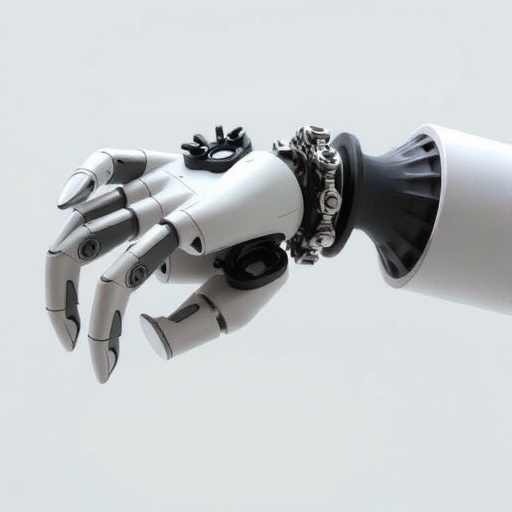
In the rapidly advancing world of prosthetic technology, the integration of artificial intelligence (AI) offers promising horizons that extend far beyond mere mechanical replacements. The concept of autonomous prosthetic limbs—devices that move independently yet harmoniously with their users—represents a radical leap forward in restoring not only function but also a sense of natural embodiment. Recent experimental research conducted by a team led by Harin Manujaya Hapuarachchi and colleagues at Toyohashi University of Technology harnesses virtual reality (VR) to probe the delicate interplay between movement speed of an autonomous prosthetic arm and the wearer’s psychological acceptance of the device as a part of their own body.
The core challenge lies in overcoming the unsettling sensation often experienced when a prosthetic limb operates autonomously. While conventional prostheses rely heavily on direct user control through biosignals such as electromyography (EMG) or electroencephalography (EEG), AI-powered limbs are designed to interpret environmental context and user intent to provide semi-autonomous or fully autonomous movement. This detachment from explicit user command can disrupt the wearer’s sense of body ownership and agency, essential psychological components for prosthetic acceptance and usability.
To systematically investigate how movement speed influences these factors, the researchers employed a VR simulation wherein participants embodied a digital avatar with an autonomous prosthetic arm replacing their left forearm. In this controlled environment, the virtual prosthetic executed reaching tasks at varying speeds calibrated by movement durations ranging from ultra-rapid 125 milliseconds to a deliberate 4 seconds. This setup allowed precise modulation of movement dynamics to assess their effects on embodiment metrics including body ownership, the sense of agency, usability ratings, and social impressions like perceived competence and discomfort attributed to the robotic limb.
The experimental findings revealed a nuanced relationship between movement speed and user acceptance. Movements executed at an intermediate velocity, approximately one second in duration, elicited the highest ratings of ownership and agency. This moderate speed closely approximates natural human reaching motions, suggesting that autonomous prosthetic systems tuned to mimic biologically plausible dynamics can foster stronger psychological integration. Conversely, speeds at the extremes, both the fastest and slowest intervals, markedly diminished these positive perceptions, indicating that unnatural temporal profiles disrupt the limb’s perceived affiliation with the user’s body schema.
Further insight emerged from assessments of sociotechnical attributes of the prosthetic arm. Competence—a measure of perceived effectiveness and skill displayed by the device—scaled positively with increasing movement speed up to a certain threshold but dropped when motions became excessively rapid or sluggish. Discomfort associated with the robotic limb peaked during the fastest movement condition, underscoring that excessively brisk autonomous actions induce unease and degrade acceptance. Interestingly, warmth—a dimension reflecting interpersonal affective impressions—remained invariant across speed variations, suggesting that mechanistic or temporal factors predominantly influence functional aspects of embodiment rather than emotional warmth.
These experimental outcomes carry profound implications for the future design and deployment of AI-enabled prosthetic limbs. Traditional engineering paradigms have often prioritized maximizing responsiveness and precision; however, this study highlights that optimizing movement speed to align with human perceptual and cognitive norms is equally vital. Autonomous prostheses must balance technical performance with psychological compatibility, as the latter significantly influences usability and long-term wearability.
Beyond prosthetic arms, the principles delineated here extend to other domains of robotic body augmentation such as supernumerary robotic limbs, wearable exoskeletons, and other assistive devices functioning as extensions of the human body. Designers should consider temporally realistic motion profiles to achieve seamless integration and positive user experiences. The embodiment facilitated by proper movement speed ensures not only functional efficiency but also a more natural and comfortable user interface with robotic augmentations.
The use of virtual reality in this research proves indispensable, providing a safe and controllable platform to simulate autonomous prosthetic function and systematically manipulate movement parameters. VR circumvents current limitations in hardware availability and clinical feasibility, offering a flexible environment to explore psychological and ergonomic responses prior to the development of physical prototypes. Such preemptive evaluation expedites iterative design and addresses acceptance barriers early in the innovation lifecycle.
Future research is poised to investigate how extended use and adaptation influence embodiment and user perception over time. The human sensorimotor system is remarkably plastic; daily experience with an autonomous prosthetic arm—even one initially perceived as less natural—may gradually recalibrate expectations and afford enhanced incorporation into body representation. This longitudinal perspective promises to deepen understanding of the dynamic interplay between prosthesis mechanics, control strategies, and cognitive acceptance.
Moreover, integrating machine learning models that adapt movement speed based on real-time feedback from the user’s responses could create personalized motion profiles enhancing sense of ownership and usability. Adaptive systems that fine-tune themselves to individual preferences and comfort levels might ultimately overcome current acceptance challenges and unlock the full potential of autonomous prosthetic technology.
This research represents a pivotal step toward realizing prosthetic devices that are not only mechanically capable but also psychologically attuned to their users. By rigorously quantifying the impact of movement speed on embodiment, agency, and social impression within immersive VR settings, the study lays critical groundwork for engineering next-generation prostheses that empower users with greater autonomy while feeling intrinsically part of the self.
As AI-enabled prosthetic limbs become more prevalent, these insights will drive the convergence of robotics, neuroscience, and human factors engineering, fostering a new era where artificial limbs transcend traditional boundaries and are perceived genuinely as extensions of the human body. Crafting movement dynamics with psychological resonance will be as crucial as mechanical design, shaping the future of assistive technology and human-machine symbiosis.
News Publication Date:
7 February 2026
Web References:
http://dx.doi.org/10.1038/s41598-026-38977-8
References:
Hapuarachchi, H., Inoue, Y., Shigemasu, H., & Kitazaki, M. (2026). Movement speed of an autonomous prosthetic limb shapes embodiment, usability and robotic social attributes in virtual reality. Scientific Reports.
Cite Scienmag News
Courtney Benton. (February 13, 2026). How Strongly Can an Autonomous Robotic Arm Become an Extension of the Body? Scienmag. https://scienmag.com/how-strongly-can-an-autonomous-robotic-arm-become-an-extension-of-the-body/
Courtney Benton. "How Strongly Can an Autonomous Robotic Arm Become an Extension of the Body?" Scienmag, 13 February 2026, https://scienmag.com/how-strongly-can-an-autonomous-robotic-arm-become-an-extension-of-the-body/. Accessed 3 September 2026.
Courtney Benton. "How Strongly Can an Autonomous Robotic Arm Become an Extension of the Body?" Scienmag. February 13, 2026. https://scienmag.com/how-strongly-can-an-autonomous-robotic-arm-become-an-extension-of-the-body/


