

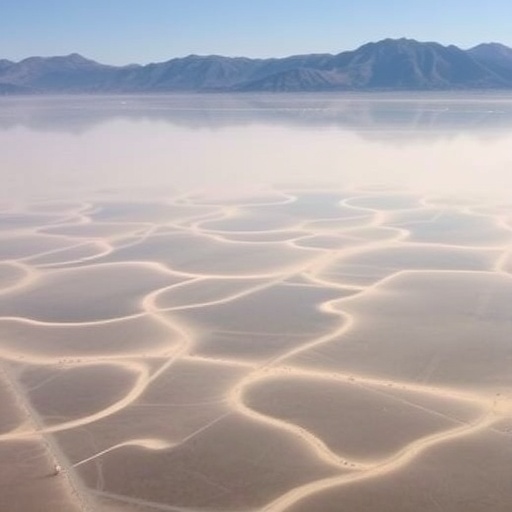
As the shimmering expanse of the Great Salt Lake continues to dwindle under the relentless grip of climate change and prolonged drought, a stark new reality emerges from the exposed lakebed: an alarming surge in dust emissions with profound environmental and public health ramifications. In a pivotal new observational study led by Professor Kevin Perry of the University of Utah’s atmospheric sciences department, a rigorous scientific evaluation has been conducted to systematically assess the viability, costs, and ecological consequences of dust mitigation strategies designed to address this escalating threat.
The Great Salt Lake, a critical ecosystem in the western United States, has long been subject to fluctuating water levels. However, recent years have witnessed unprecedented declines, revealing vast sections of playa vulnerable to wind erosion. This unveils a pressing environmental hazard, as fine particulate matter laden with salts and potentially toxic elements can become airborne, traversing to nearby communities and beyond. The health implications linked to such dust include respiratory distress, increased hospitalizations, and broader economic costs related to regulatory compliance and ecosystem services loss.
This study integrates a broad interdisciplinary approach, collaborating with regional policymakers and environmental agencies to craft an encompassing framework that transcends mere theoretical models. Emphasizing empirical data, it articulates real-world applicability and implications of twelve distinct dust control interventions ranging from water-intensive flooding techniques to innovative non-water reliant methods such as gravel cover installation and artificial surface roughness enhancement. Each method is meticulously analyzed for its operational efficacy, water consumption, financial burdens, and ecological footprint.
Water availability emerges as a paramount constraint in the feasibility of these mitigation technologies. Flooding and brine cap approaches display superior dust suppression efficacy but are constrained by regional water scarcity and competing demands for agricultural and urban consumption. Non-water strategies offer a vital alternative, especially in arid zones of the exposed lakebed, although they generally fall short in long-term sustainability and may not confer associated ecological benefits that water-based methods can provide.
A salient revelation of the research is the advocacy for an integrated, site-specific portfolio approach. Recognizing the heterogeneity of lakebed conditions, a blend of tailored interventions allows optimized allocation of resources, maximizing dust suppression while minimizing adverse tradeoffs. The adoption of this adaptive management paradigm necessitates dynamic monitoring infrastructure to track atmospheric particulate levels rigorously, ensuring interventions are justified and responsive to environmental signals rather than reactive mandates.
The study does not advocate for immediate large-scale implementation but rather underscores the critical importance of establishing baseline air quality monitoring networks to detect repeated exceedances of federal air quality standards. Without this empirical foundation, Utah risks suboptimal investment strategies—either premature, costly actions or delayed responses that amplify health and economic repercussions. This science-based threshold approach aligns with sustainable environmental policy frameworks, balancing precaution with pragmatism.
Long-term strategy highlights restoring the natural hydrological inflows to the Great Salt Lake as the most promising and sustainable dust abatement measure. By bolstering lake volume through basin-wide water conservation, dust emissions can be inherently minimized as the exposed erosive surfaces are re-submerged. However, this approach requires cross-sectoral coordination and policy reforms to optimize upstream water use and balance ecological preservation with growing water demands from urban and agricultural stakeholders.
Lessons drawn from dust control successes and challenges at Owens Lake and the Salton Sea exemplify the necessity of sustained maintenance and foresighted planning. There is an explicit warning about unintended ecological consequences, such as disruption to habitat or introduction of invasive species, which underscores that dust control measures must be integrated within a holistic ecosystem restoration strategy rather than stand-alone interventions.
The study also illuminates the socio-political dimensions inherent to dust control policymaking. Policymakers, air quality regulators, and community stakeholders require transparent, data-driven tools to navigate the tradeoffs between environmental health, economic costs, and social acceptance. As highlighted by Professor John Lin of the Wilkes Center for Climate Science & Policy, disseminating quantitative information empowers informed decision-making and public trust—a critical currency in environmental governance.
Financial feasibility remains a pressing concern; dust suppression technologies entail significant upfront capital and ongoing maintenance expenditures. The study provides detailed economic analyses, aiding resource managers to juxtapose immediate intervention costs against long-term savings incurred through avoided health care costs and federal regulatory penalties. This economic framing supports prioritization within constrained budgets and enhances policy resilience.
Moreover, the interconnection between dust control measures and broader climate adaptation efforts is critical. Dust mitigation cannot be decoupled from water management, land use planning, and ecological conservation policies in the Great Salt Lake Basin. Integrative approaches that harness synergies between these sectors are essential to ensure the resilience and sustainability of the lake’s ecosystem amidst climatic uncertainties.
In sum, this comprehensive research advances a scientifically rigorous and pragmatically nuanced roadmap for confronting the escalating challenge of dust emissions from the Great Salt Lake. Its emphasis on adaptive, evidence-triggered interventions rooted in robust monitoring infrastructure embodies a forward-looking model of environmental stewardship. By fostering collaboration between scientists, policymakers, and communities, the path toward safeguarding public health and preserving ecological vitality in the face of evolving environmental stressors becomes clearer and more achievable.
- Great Salt Lake Basin Integrated Plan: https://water.utah.gov/gsl-basin-integrated-plan/
- Great Salt Lake Commissioner: https://greatsaltlake.utah.gov/
- Wilkes Center for Climate Science & Policy: https://wilkescenter.utah.edu/great-salt-lake/study-dust-mitigation-options-and-costs/
Image Credits: Kevin Perry
Keywords: Environmental policy, Climate policy, Environmental issues, Environmental monitoring, Land use policy, Water resources, Freshwater resources, Watersheds, Hydrogeology, Groundwater, Estuaries, Erosion, Air pollution, Air quality, Heavy metal pollution, Soil science
Cite this news
SCIENMAG. (February 13, 2026). New Study Evaluates Dust Mitigation Strategies for the Great Salt Lake. https://scienmag.com/new-study-evaluates-dust-mitigation-strategies-for-the-great-salt-lake/
SCIENMAG. "New Study Evaluates Dust Mitigation Strategies for the Great Salt Lake." Scienmag, 13 February 2026, https://scienmag.com/new-study-evaluates-dust-mitigation-strategies-for-the-great-salt-lake/. Accessed 28 August 2026.
SCIENMAG. "New Study Evaluates Dust Mitigation Strategies for the Great Salt Lake." Scienmag. February 13, 2026. https://scienmag.com/new-study-evaluates-dust-mitigation-strategies-for-the-great-salt-lake/


