


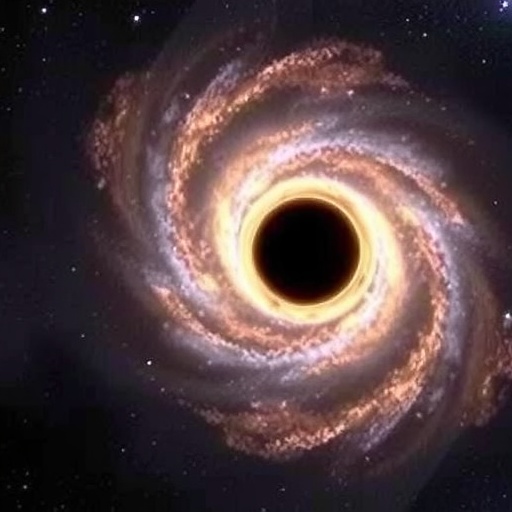
Astronomers have recently uncovered a groundbreaking phenomenon in the vast universe of the Andromeda Galaxy, revealing a striking example of a massive star that is in the process of a quiet demise, ultimately collapsing into a black hole rather than exploding in a brilliant supernova. This observation sheds light on the intriguing field of stellar evolution, specifically addressing the so-called “failed supernovae” and their capacity to generate stellar-mass black holes in the absence of explosive events. Such discoveries not only deepen our understanding of the life cycles of stars but also challenge long-held assumptions about stellar death and the nature of black holes.
As massive stars approach the end of their life cycles, they undergo significant transformations that render them unstable. This instability can lead to the expansion of the star, causing fluctuations in brightness that can be observed from numerous light-years away. Commonly, these dying giants culminate in spectacular supernovae, celestial fireworks that are both beautiful and powerful, radiating energy across the electromagnetic spectrum. However, the astronomers involved in this study were intrigued by a different scenario—one where a massive star fades quietly without the dazzling display of a supernova.
According to theoretical models of stellar evolution, a subset of massive stars fails to achieve a successful supernova explosion. Rather than dispersing their outer layers in a cataclysmic release of energy, these stars experience a core collapse that leads to a subsequent infall of the outer material back toward the newly formed dense core. In this quiet collapse, the star’s remnants can manifest as stellar-mass black holes, a dramatic yet subtle transition that leaves little trace for astronomers to detect. This research provides crucial evidence that supports the existence of these failed supernovae and the birth of black holes that might otherwise go unnoticed.
The research team led by Kishalay De utilized archival data from the NEOWISE space mission to investigate variable stars within the Andromeda galaxy. Their analysis uncovered a peculiar stellar object labeled M31-2014-DS1, which exhibited an increase in infrared brightness over a period of approximately two years, beginning in 2014. This unexpected behavior raised the team’s hopes that they might be witnessing the early stages of a catastrophic stellar event. However, as they continued their observations, they noted that the brightness of M31-2014-DS1 began to steadily decline, culminating in an eventual vanish from view in optical light by the year 2022.
The follow-up observations conducted using both the Hubble Space Telescope and several large ground-based telescopes revealed an intriguing outcome: the remnant of the once-magnificent star appeared as a faint, red object, heavily obscured by surrounding dust. The stark contrast to its previous luminous state suggested that M31-2014-DS1 had shed its outer layers and transitioned into the realm of black holes. The characteristics of this remnant indicated that the star underwent significant changes—transforming from a brilliant supergiant into a quiet shadow, now almost entirely shrouded and hidden from direct observation.
These findings not only advance our comprehension of black hole formation but also highlight the enigmatic nature of stellar lifecycles. The gravitational interplay involved in the circumstances leading to black hole creation is a critical area of future research. To comprehend how many of these subtle transitions occur in the cosmos, more observatory resources may need to be allocated for vigilant monitoring of similar celestial objects, especially those showing patterns that deviate from typical supernova activity.
Connecting the dots from observations to theory, the conclusions drawn from this research point toward the vital conclusion that not all massive stars meet their end with explosive grandeur. The implications extend to reconsidering how scientists categorize and understand various phases of stellar evolution. The diverse behaviors of massive stars necessitate an updated framework to account for those that collapse without a dramatic exit. This insight into failed supernovae could have vast consequences for our understanding of cosmic evolution and the distribution of black holes throughout the universe.
In addition to enhancing theoretical models, this discovery opens the door to further investigative paths that could yield additional revelations about the lifecycle of stars. The methods employed in examining M31-2014-DS1 and other similar instances provide a blueprint for future explorations. By refining detection techniques, astronomers may develop better strategies for identifying the subtle signatures of these elusive black holes, which could ultimately reshape our understanding of stellar dynamics and galactic structure.
Moreover, M31-2014-DS1 serves as a reminder of how much remains to be learned in the field of astrophysics. Each new discovery builds an intricate tapestry of knowledge that illustrates the complex interactions of matter and energy at cosmic scales. As researchers continue to delve into these fascinating questions, we can expect that each revelation will pave new pathways for understanding black holes, supernovae, and the life cycles of stars—phenomena that lie at the very heart of the universe’s intricate web.
As the scientific community eagerly digests these findings, collaboration across institutions and disciplines will be paramount. Only through shared knowledge and resources will the challenges posed by such enigmatic cosmic phenomena be met head-on. The path forward in this exciting realm lies in synthesis—merging observational prowess with robust theoretical frameworks that offer explanations for what it means to be a star in its final moments and the subsequent journey into the darkness of a black hole.
In closing, the discovery of M31-2014-DS1 marks a monumental step in astronomy’s exploration of stellar endpoints, reaffirming the ongoing quest to elucidate the mysteries that pervade the cosmos. Every element of this narrative speaks to the power of observation, the complexities of stellar evolution, and the inexorable pull of the unknown, encouraging future generations to look skyward and embrace the wonderment of the universe.
Keywords
black holes, massive stars, supernovae, Andromeda Galaxy, stellar evolution, astrophysics
Cite Scienmag News
Grant Pearson. (February 12, 2026). A Vanishing Star: A Black Hole Emerges in the Andromeda Galaxy. Scienmag. https://scienmag.com/a-vanishing-star-a-black-hole-emerges-in-the-andromeda-galaxy/
Grant Pearson. "A Vanishing Star: A Black Hole Emerges in the Andromeda Galaxy." Scienmag, 12 February 2026, https://scienmag.com/a-vanishing-star-a-black-hole-emerges-in-the-andromeda-galaxy/. Accessed 3 September 2026.
Grant Pearson. "A Vanishing Star: A Black Hole Emerges in the Andromeda Galaxy." Scienmag. February 12, 2026. https://scienmag.com/a-vanishing-star-a-black-hole-emerges-in-the-andromeda-galaxy/


