


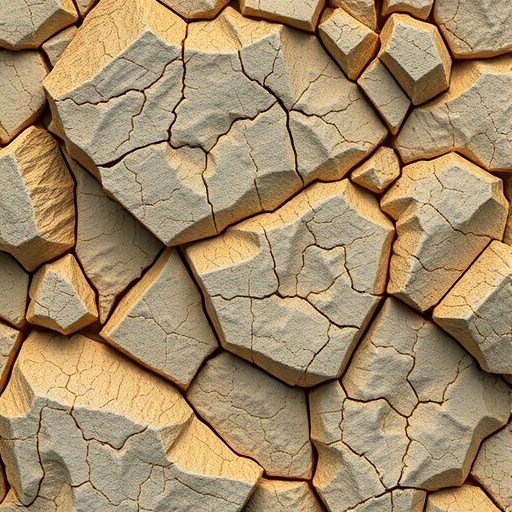
In 2016, on the rugged hillsides of Morocco, Associate Professor Rowan Martindale from The University of Texas at Austin’s Jackson School of Geosciences stumbled upon a geological anomaly that challenged longstanding assumptions in earth sciences. What caught her eye was a sedimentary rock slab adorned with an intriguing wrinkly pattern akin to the textured folds of elephant skin. These delicate wrinkle structures sparked immediate scientific curiosity because they did not conform to the expected geological narratives linked to such formations.
Martindale’s examination revealed that these wrinkles were not arbitrarily placed but were characteristic of microbial mat fossils — biological imprints created by dense colonies of microorganisms living together. Unlike the more dramatic ripples etched by underwater currents, these wrinkle textures were subtle, overlaying larger sedimentary features shaped by turbidity currents hundreds of feet below the ocean surface. The deepwater sedimentary environment, nearly 600 feet beneath sea level, defied previous beliefs that microbial wrinkle structures existed strictly within shallow or stressed aquatic settings.
The prevailing geological wisdom presumed these wrinkle formations to be the product of surface-illuminated microbial communities that thrived in sunlit shallow waters or emerged transiently following mass extinction events. In such habitats, photosynthesis-driven microbes had access to sunlight and avoided predation by other marine life. However, the setting in Morocco posited an environment where sunlight was absent, challenging the idea of conventional photosynthetic involvement in wrinkle production.
Physical processes such as underwater landslides had been the accepted explanation for wrinkle-like textures in deepwater settings, with sediment laced ridges and furrows attributed to sediment displacement and compaction during slumps. Nevertheless, Martindale’s detailed observations suggested otherwise. The wrinkle morphology bore the discernible signature of microbial mats — layered colonies of microorganisms that create textures as part of their growth and metabolic processes.
This realization led to a transformative hypothesis embedded in Martindale and her co-authors’ recent pivotal publication in the journal Geology. Their work postulates that these wrinkle structures originated not from mechanical sedimentary forces but from chemosynthetic microbial communities that prospered in the absence of sunlight. Instead of relying on photosynthesis, these microbes derived their energy through chemosynthesis — the conversion of inorganic chemical compounds into organic matter, a metabolic pathway that allows life to thrive in deep ocean realms.
Underwater landslides, instead of purely modifying physical sediment structure, may have delivered essential nutrients to the ocean floor, fostering the growth of these chemosynthetic microbial mats. The microbes’ unique chemical metabolism likely led them to produce sulfur compounds toxic to marine organisms, potentially explaining the absence or scarcity of grazing sea life in these locales. This interaction would have permitted the microbial colonies to flourish undisturbed, preserving their delicate wrinkle imprint in the stratigraphy.
Modern analogs supporting this interpretation are found in contemporary deep-sea ecosystems. Microbial mats coating whale carcasses, known as “whale falls,” illustrate how chemosynthetic communities can suddenly thrive in nutrient-rich, sunlight-deprived environments. These transient ecosystems sustain diverse life through sulfur and methane-based metabolic pathways, paralleling the ancient microbial processes inferred in the Moroccan turbidites.
Experts outside the immediate research team have recognized the groundbreaking nature of Martindale’s findings. Jake Bailey, a microbial Earth systems scientist at the University of Minnesota, emphasized that the study disrupts the simplistic categorization of ancient wrinkle fossils as solely the product of photosynthetic microbial communities. Instead, it highlights that dark, deep ocean microbial ecosystems — driven by chemolithotrophic organisms extracting energy from chemical compounds — may have been as significant in the geological past as they are today.
This revelation invites a reconsideration of the fossil record. Chemosynthetic microbial communities, potentially more abundant and diverse than previously acknowledged, might be obscured by a prevailing interpretative bias that categorizes wrinkles in rocks primarily as physical sedimentary features rather than biological fossils. This bias is compounded by the vague and non-specific vocabulary often used to describe wrinkle textures, creating obstacles to accurately identifying these microbial signatures in ancient strata.
Martindale’s journey from coral reefs and mass extinctions to uncovering these cryptic microbial mats exemplifies scientific serendipity paired with rigorous observational acuity. Her familiarity with microbial mat textures gave her the critical “search image” necessary to recognize the significance of these structures during a seemingly routine field excursion — a testament to the power of expertise meeting opportunity in advancing scientific knowledge.
The study’s broader implications extend beyond paleontology into environmental and evolutionary sciences. It underscores the adaptability of microbial life in extreme conditions and enriches our understanding of early Earth environments and their biosignatures. Chemosynthetic communities, which harness chemical energy rather than sunlight, represent essential components of the biosphere’s resilience and ancient carbon cycling mechanisms, with modern parallels informing astrobiological exploration as well.
Funding from the National Science Foundation supported this research, highlighting the importance of investments in fundamental geosciences. By revealing hidden dimensions of ancient microbial ecosystems, the study not only rewrites chapters of Earth’s biological and geological history but also prompts the scientific community to refine the diagnostic criteria used for fossil identification, ensuring future discoveries can be interpreted with greater precision.
Rowan Martindale’s unexpected detour into deep-sea microbial mat research serves as a reminder that profound scientific insights often emerge from questioning assumptions and following curious leads in the field. The intersection of geology and biology embedded in ancient rock textures continues to yield surprises and inspire new perspectives on the planet’s dynamic past.
News Publication Date: 3-Dec-2025.
Web References: https://pubs.geoscienceworld.org/gsa/geology/article/doi/10.1130/G53617.1/721566/Chemosynthetic-microbial-communities-formed
References: DOI 10.1130/G53617.1
Cite Scienmag News
Violet Maxwell. (February 12, 2026). Take Another Look! These Wrinkled Rocks Could Be Fossilized Microbial Communities. Scienmag. https://scienmag.com/take-another-look-these-wrinkled-rocks-could-be-fossilized-microbial-communities/
Violet Maxwell. "Take Another Look! These Wrinkled Rocks Could Be Fossilized Microbial Communities." Scienmag, 12 February 2026, https://scienmag.com/take-another-look-these-wrinkled-rocks-could-be-fossilized-microbial-communities/. Accessed 4 September 2026.
Violet Maxwell. "Take Another Look! These Wrinkled Rocks Could Be Fossilized Microbial Communities." Scienmag. February 12, 2026. https://scienmag.com/take-another-look-these-wrinkled-rocks-could-be-fossilized-microbial-communities/


