


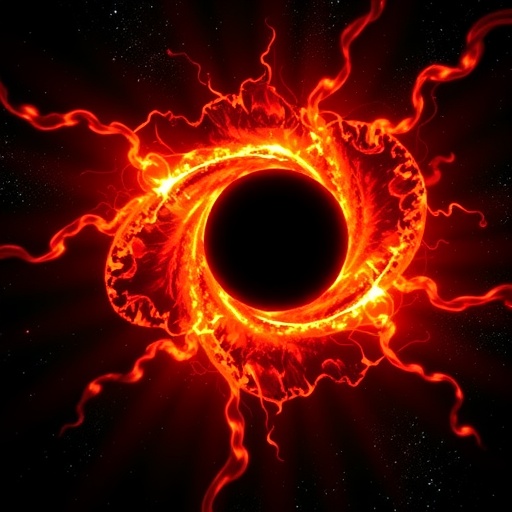
In an extraordinary development in astrophysics, a recent discovery regarding a massive star in the Andromeda galaxy has fundamentally altered our understanding of stellar evolution and black hole formation. This phenomenon, captured through the lens of a NASA telescope in 2014, illustrates a massive star undergoing direct collapse into a black hole without the customary explosive event of a supernova. The research team, led by Kishalay De, an astronomy professor at Columbia University, has meticulously analyzed archival data, unveiling insights that have remained hidden for years. The findings are grounded in a remarkably detailed observational study, which culminated in publication in the prestigious journal Science.
The celestial body in question, identified as M31-2014-DS1, was initially spotted emitting intense infrared light, which gradually increased over a three-year period. Subsequently, the star experienced a dramatic fading before completely disappearing and leaving behind a shimmering shell of dust. Observational data have indicated that this star was a hydrogen-depleted supergiant with an initial mass estimated to be thirteen times that of the sun. However, upon its demise, it had shed a significant portion of its mass and was nearly five solar masses. This substantial mass loss can be attributed to powerful stellar winds that sculpted its life cycle, ultimately leading to an enigmatic end.
The phenomenon of direct collapse has been a topic of speculation for decades among astronomers but until now had not been convincingly observed. Previous theories suggested that massive stars typically die in a spectacular supernova explosion, but the disappearance of M31-2014-DS1 presents a paradigm shift. Kishalay De articulated the surprise that accompanied this discovery, noting that evidence of such an elusive event lay dormant in publicly available archival data, overlooked until this recent analysis. This insight reinforces the notion that many significant astronomical phenomena may go unnoticed if they do not present themselves as traditional explosive events.
The implications of this finding are profound, as it indicates that not all massive stars necessarily meet their end in cataclysmic explosions. The evidence suggests an intricate interplay between gravity, gas pressure, and shock waves within the star that ultimately dictated its fate. Such direct collapse offers a fresh lens through which to view the lifecycle of massive stars, one that could suggest that various pathways to black hole formation may exist, contrary to long-standing beliefs. De emphasized the unusual nature of the star’s fading, asserting that the absence of a supernova implies a direct collapse of the star’s core, resulting in the formation of a black hole rather than a typical supernova event.
The historical context of black hole research is pivotal here. Although black holes have been theorized for over fifty years, and numerous examples have been detected in our Milky Way galaxy and beyond, the exact process of stellar collapse leading to these enigmatic entities remains poorly understood. This discovery offers a rare glimpse into the mechanics of how a massive star can disintegrate quietly, casting light on processes that could be happening far more frequently in the universe than previously imagined.
Adding a layer of depth to this research, a noteworthy correlation has been drawn to a similar event recorded around 2010 in the galaxy NGC 6946. However, that prior instance was characterized by limited observational clarity, making it challenging to draw definitive conclusions about the exact nature of the collapse. By contrast, the recent study of M31-2014-DS1, leveraging high-quality data from NASA’s NEOWISE mission, has allowed for a richer and more robust analysis. This study is now positioned as the largest of its kind, as researchers scrutinize variable infrared sources across the Milky Way and nearby galaxies to pinpoint such rare occurrences.
The methodologies employed in this comprehensive analysis highlight the advances in observational astronomy. Researchers utilized a predictive model established as early as the 1970s, theorizing that a star experiencing direct collapse would leave behind a muted infrared glow as it transitioned to become enveloped in dust. By systematically tracking stars and identifying the variable infrared sources, the team was able to uncover M31-2014-DS1, aligning perfectly with their hypotheses about the late-stage behavior of massive stars.
In closing, the findings surrounding the nature of M31-2014-DS1 pose compelling questions for future research. The revelation that massive stars might quietly disappear without the dynamic display of a supernova opens new avenues for exploration within stellar astrophysics. There is a growing recognition that many other massive stellar deaths may similarly evade detection, suggesting a hidden but significant component of cosmic evolution. As new techniques and technologies in observational astronomy continue to advance, the potential to unveil the mysteries of the universe only deepens, bringing us closer to understanding the complex narrative of stellar life and death.
The seismic shifts in our comprehension of black hole formation herald a new era of astrophysical research where assumptions are continually challenged, and new discoveries wait to emerge from the silence of the cosmos.
Keywords
Stellar evolution, black hole, supernova, direct collapse, Andromeda galaxy, M31-2014-DS1, NASA, NEOWISE, observational astronomy, astrophysics, cosmic phenomena.
Cite Scienmag News
Grant Pearson. (February 12, 2026). Unprecedented Clarity: Scientists Reveal Stunning Images of a Star’s Collapse into a Black Hole. Scienmag. https://scienmag.com/unprecedented-clarity-scientists-reveal-stunning-images-of-a-stars-collapse-into-a-black-hole/
Grant Pearson. "Unprecedented Clarity: Scientists Reveal Stunning Images of a Star’s Collapse into a Black Hole." Scienmag, 12 February 2026, https://scienmag.com/unprecedented-clarity-scientists-reveal-stunning-images-of-a-stars-collapse-into-a-black-hole/. Accessed 4 September 2026.
Grant Pearson. "Unprecedented Clarity: Scientists Reveal Stunning Images of a Star’s Collapse into a Black Hole." Scienmag. February 12, 2026. https://scienmag.com/unprecedented-clarity-scientists-reveal-stunning-images-of-a-stars-collapse-into-a-black-hole/


