


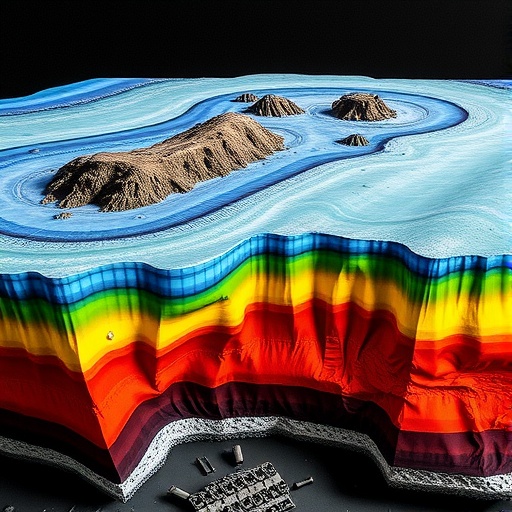
The formation of Earth’s earliest continents during the Archean eon has long posed a captivating enigma within geoscience. Two predominant hypotheses have dominated discourse: the traditional subduction-driven island-arc model and the alternative mantle plume–dominated oceanic plateau paradigm. While subduction-centric theories propose that tectonic plate interactions akin to present-day processes birthed the primordial landmasses, increasing evidence challenges this view’s comprehensiveness. A rising consensus favors the oceanic plateau hypothesis, which better reconciles numerous geochemical and lithological signatures preserved within Archean continental crust. Yet, this model has critically struggled to delineate the provenance of water—an indispensable ingredient for continental crust formation and differentiation. Recent advances, spearheaded by researchers at the University of Science and Technology of China, confront this gap with groundbreaking insights linking mantle dynamics, volatile redistribution, and geomagnetic phenomena.
Fundamental to Earth’s early evolution is the aftermath of the colossal impact thought to have formed the Moon. This cataclysmic collision is theorized to have generated a whole-mantle magma ocean, a vast reservoir of molten silicates enveloping the young planet. Laboratory experiments simulating extreme high-pressure and temperature conditions subsequently revealed that during crystallization, this magma ocean differentiated into two stratified layers: an upper magma ocean and a deeper basal magma ocean (BMO) resting near the core-mantle boundary. Critically, the BMO functioned as a chemical trap, preferentially concentrating incompatible elements and volatiles—including water—over extended geological timescales. This volumetric and compositional stratification laid the groundwork for a profound geodynamic reorganization in the Archean era.
The research team led by Professor Zhongqing Wu proposed a paradigm in which the accumulation of water within the dense basal magma ocean destabilized its gravitational equilibrium. This over-enrichment, coupled with thermal gradients, instigated a phenomenon termed mantle overturn—a large-scale convective reconfiguration whereby segments of the deep mantle surged upward as hot, water-enriched plumes. These ascending mantle masses induced widespread melting and modification of the lithosphere, directly supplying the hydrous magmas essential for the genesis of continental crust. This mantle overturn event reconciles a multitude of geological observations, including global lithological transitions and the pervasive occurrence of large igneous provinces that punctuated the Archean landscape.
Integrating these mantle overturn processes into holistic models of Earth’s thermal evolution offers explanatory power for previously perplexing paleomagnetic data. Archaeomagnetic records from Archean rocks indicate anomalously high paleointensities, far surpassing what classical geodynamo theories would predict under early Earth conditions. Traditional models invoking silicate-based dynamos or core-exsolved light elements struggled to justify the observed field strength. Wu and colleagues demonstrated through sophisticated computational simulations that the buoyant, hot plumes originating from the water-enriched basal magma ocean accelerated the cooling of Earth’s metallic core by enhancing heat flux across the core-mantle boundary. This thermal channelling invigorated the geodynamo, amplifying magnetic field strength during the period of continental maturation.
These insights suggest a temporally and causally linked evolution of Earth’s interior dynamics and surface geology. The mantle overturn not only explains the episodic appearance of continental crust but also corresponds with the intensification of the planet’s geomagnetic field. In essence, the geodynamo’s strength during the Archean was a direct consequence of mantle dynamics that simultaneously shaped Earth’s early continents. This integrated perspective propels understanding beyond isolated models, framing Earth as a tightly coupled system extending from the deep core to the lithospheric surface.
Further implications of this research bear on the longevity and stability of the Archean lithosphere. The introduction of water-rich magmas into the mantle wedge reduces mantle viscosity and modifies melting behavior, potentially enhancing lithospheric differentiation and cratonization. Consequently, the mantle overturn scenario may elucidate the generation of subcontinental lithospheric mantle, a key component underpinning the structural integrity of ancient continental blocks. By tracing the geochemical signatures of volatiles and incompatible elements in these mantle domains, future research can validate the proposed overturn mechanism and its timing.
Moreover, the mantle overturn model recontextualizes Archean large igneous province formation and episodic magmatism. The upwelling plumes driven by destabilized basal magma bodies constitute a robust mechanism for producing the voluminous intraplate magmatic events observed in the geological record. This magmatism not only contributed to crust growth but also influenced surface environments by releasing volatiles critical for atmospheric and hydrospheric evolution. Thus, this integrated geodynamic framework connects Earth’s interior differentiation to surface habitability factors during a pivotal era in planetary history.
Central to these conclusions is the coupling of geophysical and geochemical processes. The numerical simulations employed account for multiphase flow, thermal convection, and chemical partitioning across mantle reservoirs. This computational approach marks a significant advance over earlier static concepts by capturing transient mantle behaviors responsive to compositional gradients and phase changes. Such methodology opens pathways for applying similar models to other terrestrial planets, enriching comparative planetology and the search for habitable worlds.
The coherence between paleomagnetic evidence and mantle overturn-induced core cooling also invites refinements in understanding the timing and stability of Earth’s early magnetic shield. A stronger geomagnetic field during the Archean would have substantial implications for atmospheric retention against solar wind stripping and cosmic radiation exposure, thereby influencing conditions for early life emergence. This demonstrates how deep Earth processes have cascading effects extending to biospheric and climatic evolution.
As models of Archean geodynamics evolve, integrating observed geological features with physical mechanisms becomes paramount. The mantle overturn hypothesis bridges fundamental gaps by linking mantle volatile accumulation, dynamic instability, plume generation, crustal formation, and the geodynamo in a unified theoretical construct. This holistic view redefines the Archean Earth system as an intricately interconnected and evolving entity rather than a static backdrop for continental genesis.
In conclusion, the study by Wu and colleagues ushers in a transformative understanding of early Earth processes. By identifying water-induced mantle overturn as a catalyst for both Archean continental growth and enhanced geomagnetic field generation, they provide a compelling, experimentally and computationally grounded explanation addressing longstanding puzzles. This breakthrough underscores the profound interplay between Earth’s deepest reservoirs and surface environments, reshaping narratives of planetary formation and habitability during the earliest chapters of our planet’s history.
News Publication Date: Not specified.
Web References: http://dx.doi.org/10.1093/nsr/nwaf578
References: Wu, Z., Song, J., Zhao, G., & Pan, Z. (2023). Water-induced mantle overturns leading to the origins of Archean continents and subcontinental lithospheric mantle. Geophysical Research Letters, 50, e2023GL105178.
Cite Scienmag News
Violet Maxwell. (February 12, 2026). Water-Driven Mantle Overturn: A Key to Archean Continental Formation and Robust Geodynamo. Scienmag. https://scienmag.com/water-driven-mantle-overturn-a-key-to-archean-continental-formation-and-robust-geodynamo/
Violet Maxwell. "Water-Driven Mantle Overturn: A Key to Archean Continental Formation and Robust Geodynamo." Scienmag, 12 February 2026, https://scienmag.com/water-driven-mantle-overturn-a-key-to-archean-continental-formation-and-robust-geodynamo/. Accessed 4 September 2026.
Violet Maxwell. "Water-Driven Mantle Overturn: A Key to Archean Continental Formation and Robust Geodynamo." Scienmag. February 12, 2026. https://scienmag.com/water-driven-mantle-overturn-a-key-to-archean-continental-formation-and-robust-geodynamo/


