


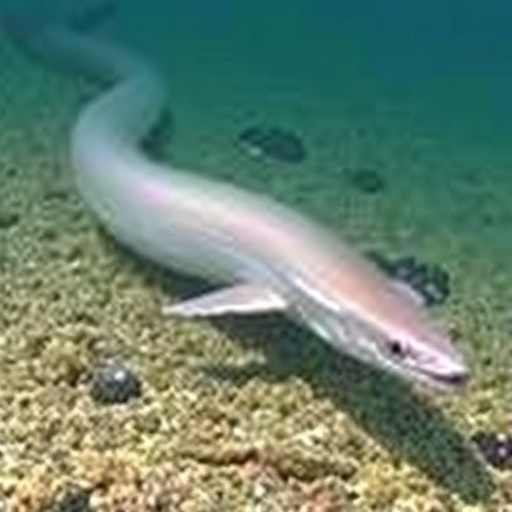
A groundbreaking new study conducted by researchers at Bournemouth University has unveiled a remarkable discovery in the field of freshwater biology: the presence of European eels (Anguilla anguilla) at their silvering stage in the inland waters of Cyprus for the first time. Previously, silver eels had only been documented across various parts of Europe and in some regions of Turkey, but this finding pushes the easternmost boundary of their known range, shedding light on hitherto unexplored aspects of the species’ distribution and life cycle.
This research challenges prior assumptions about the geographic limits of the European eel’s habitat and highlights the species’ ability to adapt and survive in environments previously considered outside their range. The silvering stage, a critical transformation phase preparing the eel for its long spawning migration back to the Atlantic Ocean, is indicative not just of survival but of successful maturation in these inland freshwater systems. This discovery bears significant implications for understanding the resilience and adaptability of this critically endangered species.
The collaborative effort encompassed universities across different regions, including the University of Inverness, Cyprus University of Technology, and the Environment Agency, forming a robust multidisciplinary research alliance. Led by BU Researcher Sotiris Meletiou, the team identified and monitored silver eels in select freshwater habitats in Cyprus, specifically targeting periods and environments conducive to silvering and migration. Their study employed a combination of field surveys, specimen captures, and detailed environmental monitoring to confirm the presence of mature silver eels actively migrating in these eastern Mediterranean waters.
European eels have one of the most complex and enigmatic life cycles known among fish species. Beginning life as tiny glass eels arriving from the Sargasso Sea, they spend many formative years maturing in freshwater before undergoing silvering—physiological and morphological changes enabling their return migration to the ocean for spawning. Despite the species’ once widespread distribution, European eel populations have suffered a catastrophic decline over the last century, attributed to multiple anthropogenic factors such as pollution, habitat fragmentation, parasitic infections, and overexploitation.
The team’s discovery in Cyprus is particularly significant against this backdrop of dramatic population decreases. The International Union for Conservation of Nature (IUCN) has listed the European eel as “Critically Endangered” since 2008, noting that current population levels are approximately 10% of historical numbers. The confirmed presence of silvering eels in Cyprus suggests that despite adverse conditions, some populations endure and complete critical life stages even at the species’ range periphery.
One of the primary research sites for this study was the Polis River, located in northwest Paphos. Mature eels were captured at multiple points along this river, demonstrating that juvenile glass eels successfully migrate and develop upstream. However, the study also revealed that environmental challenges, particularly habitat fragmentation and watercourse disruptions like drying segments, hinder eel migration both upstream and downstream. This blockage not only restricts juvenile distribution but also delays the escapement of maturing silver eels critical for reproduction.
Dr. Demetra Andrea, a Principal Academic in Environmental Science on the UK team, underscored these findings by linking river fragmentation and local environmental conditions directly to eel population dynamics. The barriers in habitats such as the Polis River impede the effective escape of silver eels, thus reducing their migration success rates and subsequent contributions to spawning groups in the Sargasso Sea. This highlights the intricate dependency of eel populations on habitat connectivity and water availability.
In light of these findings, the study advocates for urgent reconsideration of the current frameworks governing eel conservation in Cyprus. European Union legislation requires the development of Eel Management Plans (EMP) for member states to aid in the recovery of this imperiled species. However, Cyprus currently enjoys an exemption from these mandates. Dr. Malen I Vasquez of the Cyprus University of Technology emphasized that the discovery of a thriving population encompassing all life stages offers an unprecedented opportunity for Cyprus to initiate and implement such conservation strategies immediately.
From a broader ecological and climatic perspective, Dr. Ros Wright of the Environment Agency’s National Fisheries Services team highlighted the importance of these findings in understanding the life history and resilience of European eels amid rapidly changing environmental conditions. The resilience demonstrated by eels surviving in fragmented, drought-affected habitats enriches scientific understanding of how this species might withstand the challenges posed by climate change and extreme weather events.
The research team further presents several critical recommendations aimed at improving freshwater ecosystems to facilitate eel migration. These include the removal or modification of barriers in rivers and lakes, restoration of natural flow regimes, and habitat rehabilitation to support both upstream and downstream movements of juvenile and mature eels. Such interventions are vital to reversing population declines and supporting long-term species viability.
By extending knowledge on the easternmost populations of silver European eels, this study catalyzes renewed scientific interest and conservation action in the Mediterranean basin. It underlines the importance of cross-border research collaborations and integrative ecological management to safeguard migratory species whose life cycles transcend geopolitical boundaries.
The discovery reiterates the urgent call for conservation policies sensitive to local environmental conditions and tailored to preserve critical freshwater habitats. The presence of mature silver eels in Cyprus, a previously unrecognized stronghold, holds immense promise for regional biodiversity, ecosystem health, and the future of a species teetering on the brink of extinction.
News Publication Date: 10-Feb-2026
Web References:
DOI: 10.1111/jfb.70357
Cite Scienmag News
Margaret Porter. (February 12, 2026). First-ever Sighting of Silver European Eel Reported in Cyprus. Scienmag. https://scienmag.com/first-ever-sighting-of-silver-european-eel-reported-in-cyprus/
Margaret Porter. "First-ever Sighting of Silver European Eel Reported in Cyprus." Scienmag, 12 February 2026, https://scienmag.com/first-ever-sighting-of-silver-european-eel-reported-in-cyprus/. Accessed 4 September 2026.
Margaret Porter. "First-ever Sighting of Silver European Eel Reported in Cyprus." Scienmag. February 12, 2026. https://scienmag.com/first-ever-sighting-of-silver-european-eel-reported-in-cyprus/


