


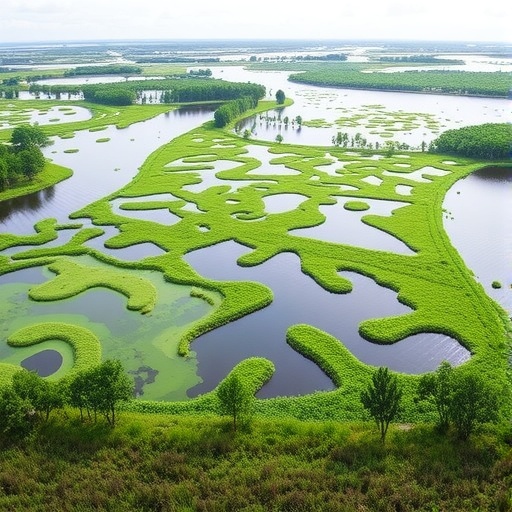
In the face of accelerating climate change and rising sea levels, the resilience of coastal wetlands remains a critical concern for ecologists, geologists, and environmental planners alike. Recent groundbreaking research conducted by Wilson, Quirk, Cahoon, and their multidisciplinary team unveils how ecogeomorphic feedback mechanisms intricately govern elevation change across microtidal wetland environments in coastal Louisiana. This study provides an unprecedented, nuanced understanding of the complex interplay between biological, geomorphic, and hydrological processes that determine the long-term sustainability of these essential ecosystems.
Coastal wetlands act as natural buffers against storm surges, protect biodiversity, and sequester significant amounts of carbon, but they also sit at the frontline of sea-level rise vulnerability. The researchers, employing a combination of detailed field measurements, remote sensing technology, and innovative modeling techniques, scrutinized the subtle yet pivotal feedback loops between vegetation dynamics, sediment deposition, and land subsidence. Their findings reveal that these interactions are critical in moderating elevation trajectories in wetlands where tidal ranges are minimal, often less than two meters.
Central to their investigation was the concept of ecogeomorphic feedbacks—where the biological activity of plants and the physical landscape mutually influence each other in a continuous cycle. In microtidal settings, where tidal energy is limited, these feedbacks take on heightened importance as traditional sedimentary inputs from tides are less dominant. The researchers documented how root biomass, organic matter accumulation, and sediment trapping by vegetation play synergistic roles in vertical land building, counteracting submergence caused by rising sea levels and subsidence.
The intricate patterns observed in the Louisiana coastal wetlands suggest that vegetation is far more than a passive occupant in these systems. Instead, it acts as an active engineer of the landscape. For instance, dense stands of marsh grasses not only slow water flow, encouraging sediment deposition but also contribute to soil volume expansion through root growth and decay. This dual function enhances surface elevation gain, providing a crucial adaptive mechanism amidst increasing flooding pressures.
Moreover, the team uncovered spatial variability in the strength and nature of these ecogeomorphic feedbacks, directly linked to subtle differences in microtopography, soil composition, and hydrologic connectivity. Areas with slightly elevated micro-elevational features experienced different feedback dynamics compared to lower-lying zones prone to prolonged inundation. Such heterogeneity underscores the importance of high-resolution spatial assessments to accurately predict wetland responses to environmental change.
The research also shines a light on the impact of anthropogenic disturbances, including levee construction and land-use modifications, which alter natural sediment and freshwater inputs. These disruptions can weaken ecogeomorphic feedbacks by modifying hydrological regimes and reducing sediment availability, thereby diminishing the natural resilience capacity of wetlands. Understanding these impacts is vital for designing restoration and conservation strategies that harness natural feedbacks rather than undermine them.
One particularly novel aspect of the study is the integration of long-term elevation monitoring data with mechanistic models that simulate the feedback processes over decadal scales. This approach allowed the authors to project future elevation trajectories under different climate and sea-level rise scenarios. The results suggest that while some wetlands possess inherent adaptive capacity via strong ecogeomorphic coupling, others may reach tipping points beyond which elevation loss accelerates unabated, leading to habitat degradation and loss.
Importantly, the team’s findings carry significant implications for coastal management. By identifying the critical thresholds and conditions that sustain positive feedback cycles, managers can prioritize conservation actions that maintain or restore key drivers of sediment accretion and organic matter accumulation. This could involve promoting native vegetation communities known to enhance feedback strength and avoiding hydrological alterations that reduce freshwater and sediment fluxes.
The insights gained from this study also contribute to the broader scientific discourse on landscape evolution and ecosystem engineering. They emphasize that understanding the self-organizing nature of wetlands necessitates a multidisciplinary approach bridging ecology, geomorphology, hydrodynamics, and climate science. Such integrated frameworks are essential for predicting how complex systems will respond to rapidly changing environmental drivers.
Furthermore, the application of these findings extends beyond Louisiana’s microtidal wetlands. Similar ecogeomorphic feedback mechanisms likely operate in various coastal wetland types worldwide, especially in regions where tidal influence is limited. Consequently, the conceptual and methodological advances presented here can inform global efforts to protect vulnerable coastal zones.
Beyond academic circles, the study provides a compelling narrative about the resilience and vulnerability of natural landscapes in the Anthropocene. It highlights nature’s ingenious processes that can mediate some impacts of climate change, yet also the fragility of these systems in the face of human pressures. This message reinforces the urgency of integrating ecosystem-based adaptation measures into climate resilience planning.
The research methodology itself stands out, combining in situ elevation surveys, biogeochemical soil analyses, and hydrodynamic modeling with cutting-edge statistical tools. This robust synthesis enables disentangling the relative contributions of physical and biological drivers—a challenge historically constrained by measurement limitations. Such innovative approaches set new standards for wetland science.
Lastly, the collaborative ethos of the study, involving hydrologists, ecologists, geomorphologists, and statisticians, exemplifies the interdisciplinary spirit required to tackle complex environmental questions. It showcases how bringing diverse expertise to bear on pressing issues yields insights with transformative potential for science and society alike.
As coastal wetlands continue to face mounting threats from sea-level rise, subsidence, and human modification, the elucidation of ecogeomorphic feedbacks offers a beacon of hope. These dynamic processes, if understood and nurtured, could serve as natural allies in sustaining wetland elevation and function in an uncertain future. The work of Wilson and colleagues marks a significant milestone along this path, charting a new course for wetland conservation and coastal resilience in the era of global change.
Cite Scienmag News
Violet Maxwell. (February 11, 2026). Ecogeomorphic Feedbacks Shape Louisiana’s Coastal Wetlands. Scienmag. https://scienmag.com/ecogeomorphic-feedbacks-shape-louisianas-coastal-wetlands/
Violet Maxwell. "Ecogeomorphic Feedbacks Shape Louisiana’s Coastal Wetlands." Scienmag, 11 February 2026, https://scienmag.com/ecogeomorphic-feedbacks-shape-louisianas-coastal-wetlands/. Accessed 3 September 2026.
Violet Maxwell. "Ecogeomorphic Feedbacks Shape Louisiana’s Coastal Wetlands." Scienmag. February 11, 2026. https://scienmag.com/ecogeomorphic-feedbacks-shape-louisianas-coastal-wetlands/


