


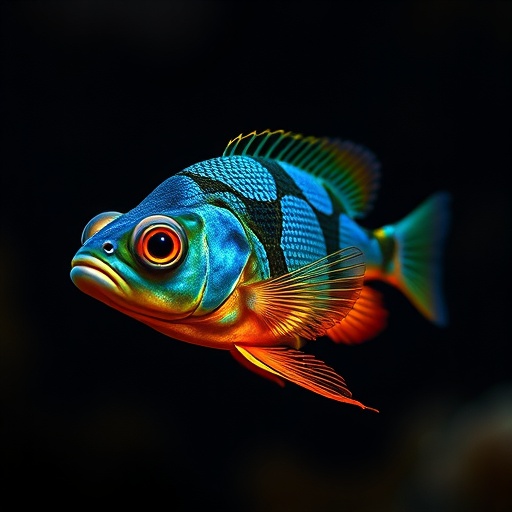
In a groundbreaking discovery that overturns long-standing paradigms about vertebrate vision, researchers have identified a novel type of photoreceptor cell in the larvae of deep-sea fish. This discovery challenges over 150 years of textbook knowledge that classically categorized vertebrate vision as a system composed solely of two photoreceptor types: cones and rods. Cones are known to mediate vision in brightly lit conditions, enabling color perception, whereas rods specialize in low-light or scotopic vision, allowing for sensitivity in the dark. However, through meticulous investigation, scientists have uncovered a hybrid visual cell that combines molecular characteristics of cones with the morphology of rods, creating a highly specialized device optimized for twilight or dim intermediate light environments.
Dr. Fabio Cortesi, from The University of Queensland’s School of the Environment, led a team exploring visual systems in deep-sea fish species. These species, including Maurolicus muelleri and Maurolicus mucronatus, inhabit one of the planet’s most light-limited habitats. Although adult individuals reside at depths near 1000 meters—where light is nearly absent—their larvae inhabit much shallower waters between 20 and 200 meters. Investigating the retinal architecture in these larvae revealed the presence of hybrid photoreceptors that had previously gone unnoticed in vertebrate biology. The hybrid nature of these cells is remarkable: they display the genetic and molecular machinery linked to cones, yet their ultrastructure is reminiscent of rods, indicating an alternative developmental trajectory in vertebrate photoreceptor differentiation.
This discovery emerged from expeditions conducted in the Red Sea, where researchers collected larval specimens during marine exploration voyages. The diminutive size of these larvae, often less than half a centimeter long with eyes smaller than one millimeter, posed significant challenges for microscopic and molecular analysis. Employing advanced histological and genetic techniques, the team was able to dissect and characterize the retinal cells in unprecedented detail. Instruments including high-resolution microscopy and RNA sequencing were utilized to decode the expression profiles of phototransduction proteins, revealing this unexpected cellular hybridization.
The evolutionary and functional implications of this photoreceptor type are profound. From an evolutionary perspective, the existence of such a cell type suggests that vertebrate vision development is more plastic and adaptable to environmental demands than previously hypothesized. Functionally, these hybrid photoreceptors maximize visual performance in dim, twilight-like conditions—a light regime that is neither fully photopic (bright) nor scotopic (dark) but intermediate. By integrating the high sensitivity of rods with certain operational traits of cones, these photoreceptors allow the larvae to exploit ecological niches in the mesopelagic zone, balancing between predator avoidance and efficient feeding.
Upon maturation, these fish descend into the deep ocean, where conventional rod-dominated vision is critical for survival in near-total darkness. However, this research underscores that early developmental stages prioritize an entirely different visual strategy. The hybrid photoreceptors equip larvae to detect subtle light cues in dim surface waters, enabling navigation, prey detection, and predator avoidance during critical growth phases. This reveals a sophisticated ontogenetic switch in visual architecture tailored to the contrasting light environments encountered throughout the lifecycle of deep-sea fishes.
Beyond evolutionary biology, these insights also hold vast potential for technological innovation. Dr. Cortesi suggests that mimicking the hybrid photoreceptor structure could revolutionize imaging sensors for low-light environments. Current camera technologies often face trade-offs between sensitivity and image resolution; the natural design of these cells integrates molecular and structural elements that preserve image sharpness while enhancing sensitivity. This concept might inspire the next generation of cameras, goggles, and sensors tailored for nocturnal, underwater, or industrial low-light scenarios, offering superior visual accuracy without increasing power consumption.
In the realm of medicine, the discovery opens new frontiers for understanding ocular cell biology under extreme environmental conditions. The deep-sea environment subjects organisms to intense hydrostatic pressure and absence of natural light, creating unique stressors on biological tissues. Elucidating how these fish develop and maintain such hybrid photoreceptors could shed light on biological pathways relevant to human eye diseases like glaucoma, which involve pressure-induced optic nerve damage. Insights into cellular resilience and adaptability might unlock novel therapeutic avenues or biomimetic interventions to preserve or restore vision in pathology.
Collaboration was a hallmark of this research, spanning multiple international institutions. Experimental procedures were coordinated through the Queensland Brain Institute, with partners across the University of Basel in Switzerland, King Abdullah University of Science and Technology in Saudi Arabia, Norway’s Institute of Marine Research, and the University of Idaho, USA. This multidisciplinary partnership combined expertise in marine biology, neurobiology, molecular genetics, and biophysics, culminating in a comprehensive characterization of this unprecedented vertebrate visual system.
The findings have been formally published in the respected journal Science Advances, marking a major milestone in sensory biology and deep-sea research. The article details the experimental design, genetic expression profiles, morphological analyses, and the evolutionary context of the hybrid photoreceptors. It invites the scientific community to reconsider canonical models of vertebrate vision and explore the diversity of sensory adaptations that have emerged in Earth’s most challenging habitats.
Researchers emphasize that their work was designed to fully exclude competing interests, lending further credibility to these scientific revelations. The study also makes a broader call to action, advocating for continued exploration of deep-sea biodiversity and sensory systems. As the ocean’s mesopelagic zone remains among the least understood ecosystems globally, discoveries such as these highlight the importance of sustained investment in marine science to unlock hidden biological innovations with wide-ranging applications.
Ultimately, this landmark research not only transforms our fundamental comprehension of how vertebrate vision develops and functions but also serves as a beacon for applied science. By decoding nature’s hybrid solutions to the problem of dim-light vision, humanity may soon witness breakthroughs in imaging technology and innovative treatments for vision impairment, illustrating the inseparable link between environmental adaptation and scientific advancement.
- Science Advances Article
- School of the Environment, UQ
- Queensland Brain Institute
References: - Research article published in Science Advances, DOI: 10.1126/sciadv.adx2596
Image Credits: Dr Wen-Sung Chung
Keywords: hybrid photoreceptors, deep-sea fish, vertebrate vision, dim-light vision, rods and cones, visual system, twilight vision, marine biology, sensory adaptation, imaging technology, glaucoma, molecular genetics
Cite Scienmag News
Violet Maxwell. (February 11, 2026). Study of Twilight Fish Uncovers Unique Hybrid Eye Cells. Scienmag. https://scienmag.com/study-of-twilight-fish-uncovers-unique-hybrid-eye-cells/
Violet Maxwell. "Study of Twilight Fish Uncovers Unique Hybrid Eye Cells." Scienmag, 11 February 2026, https://scienmag.com/study-of-twilight-fish-uncovers-unique-hybrid-eye-cells/. Accessed 3 September 2026.
Violet Maxwell. "Study of Twilight Fish Uncovers Unique Hybrid Eye Cells." Scienmag. February 11, 2026. https://scienmag.com/study-of-twilight-fish-uncovers-unique-hybrid-eye-cells/


