


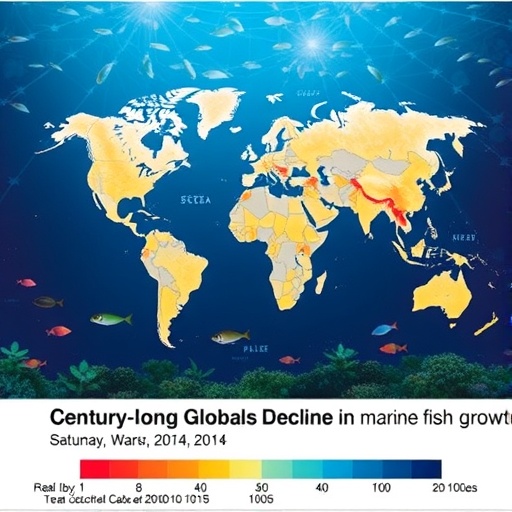
In a revealing new study published in Nature Communications, researchers have documented a profound and far-reaching decline in the growth performance of marine fishes spanning more than a century. This comprehensive analysis utilizes an extensive dataset covering diverse fish species across the globe, uncovering alarming trends that could have significant implications for marine ecosystems, global fisheries, and food security.
The decline in growth performance of marine fishes, as demonstrated by this groundbreaking research, reflects changes in several biological and environmental parameters. Growth performance in fish is a fundamental facet of their life history, influencing reproductive capacity, survival, and population dynamics. It is generally measured by the rate at which fish convert energy into biomass, which relies heavily on environmental conditions such as water temperature, oxygen availability, and nutrient supply.
Historically, fisheries and marine biologists have monitored variations in the size and weight of fish at different life stages, recognizing that these metrics are crucial indicators of ecosystem health. However, the new study pushes beyond regional or species-specific observations by integrating over a century’s worth of data, painting a global picture of this decline. This approach reveals a persistent, widespread pattern rather than isolated incidents.
Environmental stressors are central to understanding this downward trend. Climate change has been recognized as a pivotal driver, with ocean warming altering metabolic rates and physiological processes in fish. Elevated temperatures increase metabolic demands, often reducing the efficiency by which organisms convert energy to growth, particularly when food resources are limited. This mismatch can stunt development and reduce the maximum size fish can achieve, which impacts reproductive potential and resilience.
Additionally, ocean acidification, stemming from increased atmospheric carbon dioxide absorption, affects calcifying organisms and disrupts marine food webs. Fish, being integral components of these webs, indirectly bear the brunt of these shifts as prey species abundance and quality fluctuate. Moreover, hypoxic zones—areas with low oxygen levels—have expanded due to eutrophication and warming waters, further complicating the energy balance and growth potential of marine fish.
The study synthesis points to the role of overfishing as another critical factor. Intensive harvesting often disproportionately removes larger, faster-growing individuals from populations, leading to genetic and phenotypic shifts over time. This evolutionary pressure may select for traits favoring earlier reproduction at smaller sizes, intensifying the decline in growth rates documented across decades.
Furthermore, the research team applied rigorous statistical models to disentangle the relative contributions of environmental changes and fishing pressure. Their findings suggest that while both factors are influential, climate-induced changes in ocean conditions predominantly drive the global trend in reduced growth performance, with fishing pressure exacerbating local declines.
Fish growth performance has implications beyond individual species—alterations cascade through trophic interactions, community composition, and biogeochemical cycles. Smaller or slower-growing fish populations impact predator-prey dynamics and nutrient cycling, potentially disrupting the stability of marine ecosystems. Since fish constitute a major protein source for billions worldwide, such declines may also jeopardize food security and economic livelihoods dependent on sustainable fisheries.
The researchers accentuate the need for integrative management approaches combining climate mitigation, habitat protection, and adaptive fishery policies. Traditional stock assessments must evolve to incorporate physiological and growth metrics sensitive to changing ocean conditions, ensuring more resilient fish populations.
These findings underscore a critical urgency for the scientific community and policymakers alike. They highlight that the ocean’s response to anthropogenic pressures is complex and multi-faceted, requiring coordinated global action. Restoring and preserving marine biodiversity will depend on addressing not only direct exploitation but also mitigating broader environmental changes.
The novel long-term perspective afforded by this study challenges researchers to re-evaluate predictive models for marine fish populations under future climate scenarios. It advocates more robust monitoring frameworks integrating environmental, biological, and fishery data to capture ongoing and prospective shifts in growth dynamics.
In conclusion, the documented long-term decline in growth performance among marine fish serves as a stark indicator of the profound transformations affecting our oceans. This decline is not random but pervasive and has deep roots in anthropogenic influence, reflecting an urgent call to action to safeguard marine life and the resources it sustains.
Cite Scienmag News
Violet Maxwell. (February 11, 2026). Century-Long Global Decline in Marine Fish Growth. Scienmag. https://scienmag.com/century-long-global-decline-in-marine-fish-growth/
Violet Maxwell. "Century-Long Global Decline in Marine Fish Growth." Scienmag, 11 February 2026, https://scienmag.com/century-long-global-decline-in-marine-fish-growth/. Accessed 4 September 2026.
Violet Maxwell. "Century-Long Global Decline in Marine Fish Growth." Scienmag. February 11, 2026. https://scienmag.com/century-long-global-decline-in-marine-fish-growth/


