


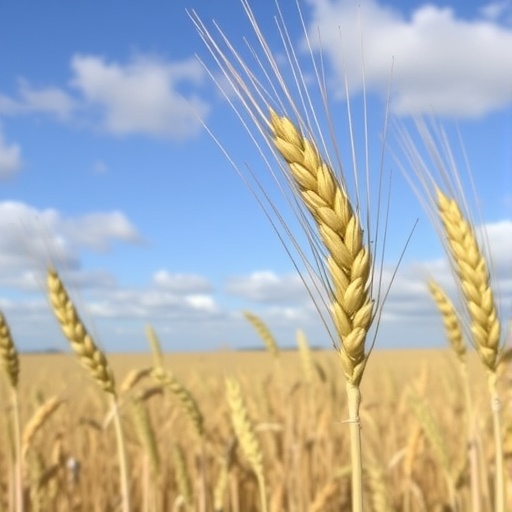
The United Kingdom’s wheat production faces a formidable new challenge with the emergence of a novel strain of the yellow rust pathogen, Puccinia striiformis f. sp. tritici. This airborne fungal agent, notorious for its rapid dissemination during the wheat growing season, has evolved to surpass one of the most critical resistance genes, Yr15, which had until recently safeguarded a significant portion of UK wheat crops. The identification of this strain in 2025 has compelled an immediate and coordinated scientific response, emphasizing the urgent need to unravel new genetic defenses and reinforce the resilience of wheat varieties paramount to both national food security and agricultural sustainability.
Yellow rust, an obligate biotrophic fungus, propagates through wind-dispersed urediniospores that infect wheat leaves, leading to chlorotic lesions and, ultimately, substantial yield losses if left unchecked. The genetic resistance endowed by genes like Yr15 has historically provided an effective barrier, reducing both the incidence and severity of infection. However, the breakdown of Yr15 resistance marks a critical inflection point, rendering more than half of the UK’s wheat acreage susceptible to disease. Alarmingly, this vulnerability extends to the top three commercial wheat varieties, which dominate a third of the UK market, placing economic stability and crop yields under significant threat.
In response to this emerging threat, UK Research and Innovation (UKRI) and the Department for Environment, Food and Rural Affairs (Defra) have issued a Rapid Response grant to a consortium of researchers led by the John Innes Centre. This project aims to delve into the extensive genetic reservoir held within the historic Watkins collection, a compendium of wheat landraces gathered from myriad global locations during the early 20th century. By leveraging advanced genomic technologies, scientists seek to identify novel resistance loci that can be bred into contemporary wheat cultivars to restore and bolster defenses against yellow rust.
The Watkins collection represents a cornucopia of genetic diversity, comprising over 827 landrace lines curated from Europe, Asia, and North Africa. These lines encapsulate a broad spectrum of genetic variation, phenotypic traits, and environmental adaptations, conserved meticulously at the John Innes Centre’s Germplasm Resource Unit. This repository has proven invaluable for mining unexploited alleles conferring disease resistance, particularly as modern breeding practices have narrowed the genetic base of commercial wheat, inadvertently increasing vulnerability to evolving pathogens.
Professor Diane Saunders, a leading figure in plant pathology at the John Innes Centre, highlights that the collapse of Yr15 resistance is unprecedented in scale and urgency. Yet, she emphasizes that the ancient genetic diversity housed within the Watkins collection offers a timely and potent resource to counteract this crisis. By applying state-of-the-art genomic sequencing, gene mapping, and phenotyping methods, the research team intends to pinpoint resistance genes that exhibit efficacy against the newly identified yellow rust strain and introduce them swiftly into breeding pipelines.
This multidisciplinary initiative unites expertise across rust pathology, wheat genetics, and genomics. Collaboration among the John Innes Centre, the National Institute of Agricultural Botany (Niab), and Rothamsted Research ensures integration of disease surveillance, genetic innovation, and stakeholder involvement. Niab contributes its proficiency in monitoring pathogen populations and sourcing resistance genes from wild wheat relatives, while Rothamsted advances the engagement with breeders and growers to facilitate rapid varietal improvement and deployment.
The broader implications of this research extend beyond the UK’s borders. Allied with the International Maize and Wheat Improvement Center (CIMMYT), the project aligns with global breeding efforts to track and counteract yellow rust evolution. Such international cooperation is crucial, as the pathogen’s dissemination does not adhere to geopolitical boundaries, and novel virulent strains can jeopardize food security worldwide. Through these partnerships, novel resistance traits discovered in the Watkins collection can be shared and incorporated into breeding programs globally, amplifying the impact of this initiative.
Central to countering yellow rust is the understanding of pathogen dynamics and host resistance interactions. The fungus’s ability to overcome resistance genes through mutation and recombination requires continuous surveillance of pathogen populations to detect the emergence of virulent races promptly. Niab’s role in early fungicide resistance detection further strengthens the integrated disease management strategy, ensuring chemical control remains effective alongside genetic resistance.
The proposed research underscores the critical balance between conservation and innovation in crop improvement. While modern agricultural practices often prioritize high yield and uniformity, it is the genetic heterogeneity preserved in heritage collections like Watkins that offers a bulwark against emergent diseases. Effectively harnessing this diversity demands sophisticated genetic tools and collaborative networks to translate discovery into field-ready solutions rapidly.
Looking forward, the successful identification and incorporation of new resistance genes into wheat varieties will mitigate reliance on fungicides, lowering production costs, environmental impacts, and risks associated with chemical control measures. This genetic resilience will sustain wheat yields, securing the staple crop’s contribution to the UK’s food system amid evolving biotic challenges driven by climate change and pathogen adaptation.
Ultimately, the rapid mobilization of scientific resources and international cooperation to combat the yellow rust threat exemplifies the agility and dedication required to safeguard global food security. The integration of cutting-edge genomics, historic germplasm repositories, and comprehensive monitoring infrastructures forms a blueprint for tackling agricultural pathogens that threaten the stability of essential crops worldwide.
News Publication Date: 2025
Web References:
- John Innes Centre Watkins Collection: https://zenodo.org/records/18506436
Cite Scienmag News
Alan Morgan. (February 11, 2026). Swift Action Initiated to Combat Emerging Yellow Rust Strains Endangering UK Wheat. Scienmag. https://scienmag.com/swift-action-initiated-to-combat-emerging-yellow-rust-strains-endangering-uk-wheat/
Alan Morgan. "Swift Action Initiated to Combat Emerging Yellow Rust Strains Endangering UK Wheat." Scienmag, 11 February 2026, https://scienmag.com/swift-action-initiated-to-combat-emerging-yellow-rust-strains-endangering-uk-wheat/. Accessed 4 September 2026.
Alan Morgan. "Swift Action Initiated to Combat Emerging Yellow Rust Strains Endangering UK Wheat." Scienmag. February 11, 2026. https://scienmag.com/swift-action-initiated-to-combat-emerging-yellow-rust-strains-endangering-uk-wheat/


