


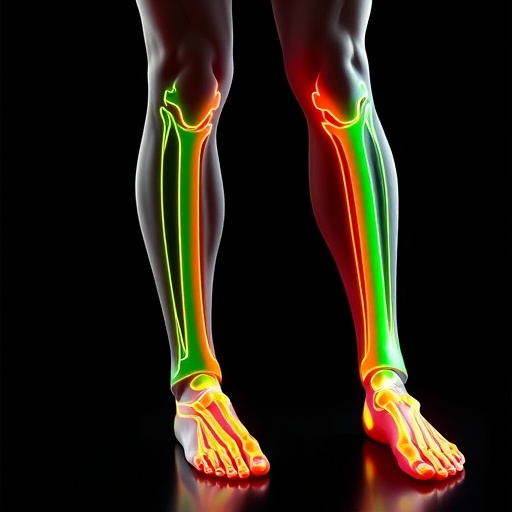
In the ever-evolving realm of biomechanical analysis, understanding the dynamics of the lower limbs plays a pivotal role, particularly when it comes to applications such as the control of assistive robotics, exoskeletons, and smart prosthetic devices. Precise analysis of gait, posture, and load distribution underpins advancements in these technologies. Historically, acquiring detailed insights into lower limb biomechanics has relied on invasive methods, which, despite their accuracy, pose significant drawbacks including high costs, technical complexity, and patient discomfort. These limitations considerably hinder their practical utility outside specialized research environments.
To circumvent such challenges, the scientific community has explored noninvasive alternatives. Among these, musculoskeletal multibody dynamics simulations (MMDS) have emerged as a popular technique. MMDS harnesses data from tools like motion capture systems and force plates to model the internal forces and moments acting within the body. While this approach mitigates some drawbacks of invasive measurement, it still grapples with notable constraints. Chief among these is the reliance on force plates, which complicates setup and reduces mobility of subjects. Additionally, MMDS demands substantial computational resources, limiting its feasibility for real-time feedback — an essential requirement in applications such as robotic control and rehabilitation monitoring.
Addressing these challenges head-on, researchers at the Shenzhen Institutes of Advanced Technology have developed a groundbreaking deep learning model named Marker-GMformer. This innovative approach leverages the power of artificial intelligence to predict lower limb biomechanical parameters, including multi-joint kinematics, joint moments, and three-dimensional ground reaction forces exclusively from marker trajectory data. By eliminating the dependence on force plates and intricate biomechanical models, Marker-GMformer promises to revolutionize the field through its lightweight design and computational efficiency, enabling real-time biomechanical analysis.
At the heart of Marker-GMformer’s architecture lies a meticulous integration of anatomical prior information and advanced spatiotemporal feature extraction techniques. The model is compartmentalized into three primary components: a spatial block, a temporal block, and a temporal embedding layer. The spatial block makes use of a Graph Convolutional Network (GCN) in tandem with a Multi-Layer Perceptron (MLP). The GCN is instrumental in capturing local anatomical relationships by constructing an adjacency matrix that mirrors the skeletal connectivity of the lower limbs. This structural embedding ensures the model respects inherent biomechanical constraints and leverages the connectivity patterns of markers to enhance spatial feature extraction.
The temporal block innovatively applies an enhanced Transformer-based framework, specifically optimized with the ProbSparse self-attention mechanism. This mechanism reduces computational redundancy and significantly improves the model’s ability to process longer sequences of temporal data, which is crucial for nuanced biomechanical analysis. Unlike traditional Transformer models that encode temporal information on a per-time-step basis, Marker-GMformer redefines this approach by treating each marker across the entire time series as an individual token. This facilitates a richer and more granular temporal feature extraction, enabling superior performance in dynamic motion prediction.
A critical advantage of Marker-GMformer is its capacity to facilitate seamless information exchange between spatial and temporal blocks. This synergy enables the model to effectively learn spatial-temporal dependencies that are essential for decoding complex human movement patterns. Experimental validation of Marker-GMformer was conducted across 13 distinct motion patterns, ranging from walking and running to more complex maneuvers like inclined walking. The model delivered predictions that were strikingly consistent with ground truth data obtained via MMDS and force plate measurements. Statistical analyses underscored this consistency, with correlation coefficients surpassing 0.97 for all variables, which is indicative of a robust linear relationship between predicted and actual biomechanical parameters.
Further quantification revealed impressive accuracy levels. The root mean square error (RMSE) was calculated as 1.95° for joint angles, 0.099 N·m/kg for joint moments, and 0.036 body weight for ground reaction forces (GRFs). These metrics highlight the model’s exceptional precision in capturing the subtle dynamics of the lower limbs. Notably, this high fidelity was maintained alongside significantly reduced computational complexity, enabling real-time inference—a critical feature for applications where immediate biomechanical feedback is paramount.
Nevertheless, while the model performed exceptionally well in steady-state locomotion activities such as walking and running, its predictive accuracy showed some decline during highly dynamic and non-periodic movements including squatting, vertical jumping, and hopping. In these scenarios, certain joint moments (especially hip moments) and ground reaction forces (notably the anterior-posterior GRF component) exhibited larger discrepancies from the ground truth. This observation points toward future opportunities to refine the model to handle the complexities of rapid and irregular movements more effectively.
One of the most promising aspects of Marker-GMformer is its minimal input requirement. Unlike MMDS, which demands a full suite of hardware including force plates and intricate biomechanical modeling software, Marker-GMformer relies solely on marker trajectory data. This simplification greatly streamlines data collection procedures and reduces setup time while maintaining rigorous biomechanical insight—an innovation that could democratize access to high-quality biomechanical monitoring.
Beyond performance metrics, the research team emphasized the prospective clinical and engineering implications of this technology. Real-time biomechanical feedback holds transformative potential for robotic rehabilitation devices, enabling adaptive assistance tailored to the patient’s current state. Similarly, sports science applications could benefit from immediate biomechanical metrics to optimize training and prevent injury. By merging anatomical priors with powerful deep learning frameworks, Marker-GMformer sets a new benchmark for biomechanical modeling efficiency and accessibility.
Looking forward, the development team is planning to expand the breadth and diversity of the model’s training dataset. Incorporating more instances of extreme dynamic activities and non-periodic movements could enhance the robustness and generalizability of predictions. Additionally, embedding physical constraints or biomechanically informed priors directly into the model architecture could ensure smoother transitions in torque and GRF outputs, thereby strengthening the physical realism and stability of the system.
The Marker-GMformer project reflects a fruitful collaboration among multiple experts in biomechanics, robotics, and artificial intelligence, including Hao Zhou, Yinghu Peng, Xiaohui Li, Xueyan Lyu, Hongfei Zou, Xu Yong, Dahua Shou, Guanglin Li, and Lin Wang. Their work was made possible through generous funding from several prominent Chinese research initiatives, signaling the strategic importance of this technology for future scientific and technological advancement.
In summary, Marker-GMformer represents a cutting-edge leap forward in continuous lower limb biomechanics prediction. It combines deep domain knowledge with state-of-the-art artificial intelligence to overcome the limitations of existing methods. Its success heralds a new era in efficient, precise, and real-time biomechanical monitoring, with far-reaching implications for healthcare, robotics, and human performance optimization.
News Publication Date: January 15, 2026.
Web References: DOI: 10.34133/cbsystems.0476.
Cite Scienmag News
Ophelia Keating. (February 10, 2026). Lightweight Marker-GMformer Enables Continuous Prediction of Lower Limb Biomechanics Using Prior Knowledge. Scienmag. https://scienmag.com/lightweight-marker-gmformer-enables-continuous-prediction-of-lower-limb-biomechanics-using-prior-knowledge/
Ophelia Keating. "Lightweight Marker-GMformer Enables Continuous Prediction of Lower Limb Biomechanics Using Prior Knowledge." Scienmag, 10 February 2026, https://scienmag.com/lightweight-marker-gmformer-enables-continuous-prediction-of-lower-limb-biomechanics-using-prior-knowledge/. Accessed 4 September 2026.
Ophelia Keating. "Lightweight Marker-GMformer Enables Continuous Prediction of Lower Limb Biomechanics Using Prior Knowledge." Scienmag. February 10, 2026. https://scienmag.com/lightweight-marker-gmformer-enables-continuous-prediction-of-lower-limb-biomechanics-using-prior-knowledge/


