


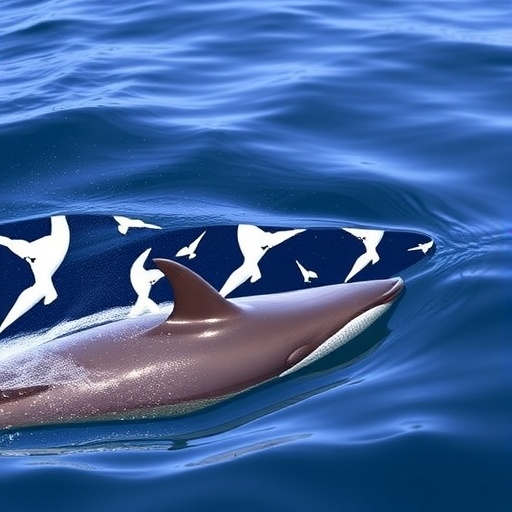
In the narrow straits of the Little Belt in Denmark, a groundbreaking study has unveiled how harbour porpoises (Phocoena phocoena) modulate their behavior in response to the increasing presence of maritime traffic. These small cetaceans, notable for their rapid metabolic rates and almost constant foraging behavior, have shown a worrying decrease in their characteristic “buzzes”—short acoustic signals associated with feeding and social interactions—when boats and ships traverse their habitat. This phenomenon highlights a significant disruptive influence, with profound implications for the conservation and management of this sensitive marine species.
Utilizing sophisticated underwater acoustic monitoring technology, researchers deployed an array of hydrophones strategically within the Little Belt to capture the intricate soundscape produced by harbour porpoises. By correlating these acoustic data with precise vessel traffic records over multiple diurnal and seasonal cycles, the study delineates a clear inverse relationship between boat presence and porpoise acoustic activity. During peak vessel transit periods, the incidence of porpoise buzzes declined by as much as 45%, signaling a substantial reduction in natural foraging and social behaviors critical to their ecological fitness.
This research is particularly salient given the unique ecological niche that harbour porpoises occupy in shallow coastal waters. Their high metabolic demands necessitate near-continuous feeding to maintain energy homeostasis. Consequently, any disruption to their ability to engage effectively in feeding jeopardizes their health, growth, and reproductive success. The observed decrease in buzzing behavior thus suggests a tangible stressor imposed by anthropogenic noise and physical disturbance, potentially compromising the population’s long-term viability.
The team’s analysis revealed that the most pronounced behavioral suppression occurred during daylight hours in summer — precisely when vessel traffic intensifies due to both commercial shipping and recreational boating. Conversely, in moments devoid of vessel presence, porpoise acoustic activity markedly increased, highlighting their behavioral plasticity but also underscoring the persistent impact of human activity on their natural rhythms.
Importantly, the study emphasizes that harbour porpoises cannot simply relocate to quieter waters. The Little Belt offers a unique prey density and habitat configuration essential for their survival. Alternate habitats may lack the necessary abundance and diversity of prey species, suggesting that displacement is not a viable mitigation strategy. This ecological constraint accentuates the urgency for targeted conservation measures within this critical habitat.
The study’s co-lead author, Rachel Lennon, whose work was conducted as part of a master’s program in Marine Vertebrate Ecology and Conservation at the University of Exeter, stresses that chronic exposure to maritime traffic represents a sustained challenge to harbour porpoise populations. This persistent disturbance potentially undermines the animals’ ability to fulfill crucial life history functions, including foraging efficiency and social bonding, which collectively underpin population resilience.
Shannon Merkle, a co-lead on the project, contextualizes these findings within a broader ecological framework, drawing on a growing body of evidence linking foraging disruption to declines in cetacean health, body condition, reproductive output, and survival rates. The research argues that the observed behavioral alterations may exacerbate the vulnerability of harbour porpoises to other environmental pressures, including pollution, climate change, and prey variability.
From a conservation perspective, these findings have immediate implications for the management of vessel traffic in highly frequented coastal zones. The study advocates for the implementation of mitigation strategies such as reducing boat speeds, restricting vessel numbers during critical periods, and designating protected marine areas with regulated access. Such tactics aim to minimize noise pollution and physical disturbances, thereby fostering an environment where harbour porpoises can feed and socialize without impairment.
The Little Belt region, forming one of the three narrow straits connecting the Baltic Sea and the North Sea, experiences thousands of large commercial ship passages annually, in addition to countless recreational boats. This intense marine traffic not only introduces noise pollution but also alters the acoustic structure of the habitat, complicating the porpoises’ echolocation and communication abilities that are vital for prey detection and social interaction.
Adding a layer of urgency, the harbour porpoise population in the Belt Sea is currently classified as “Endangered” by the Helsinki Commission (HELCOM), a regional marine environmental protection body. This status underscores the critical need for immediate conservation action, since any additional stressors such as vessel disturbance could further accelerate population decline.
Jonas Teilmann, professor at Aarhus University and co-author of the study, emphasizes how this research enhances our understanding of underwater noise ecology and its biological ramifications. He proposes that integrating these insights into maritime spatial planning could lead to optimized vessel scheduling and speed regulations, greatly benefiting noise-sensitive species like the harbour porpoise while allowing sustainable maritime economic activities.
Carried out in collaboration between Aarhus University and the industry partner Seiche, this comprehensive study bridges academic research and practical conservation efforts. Published in the prestigious journal Marine Mammal Science, the paper titled “Seasonal and diurnal patterns of harbor porpoise (Phocoena phocoena) behavior and the disruptive effects of vessel presence in a high-traffic coastal habitat” represents a pivotal addition to marine ecology literature, catalyzing further research and policy interventions aimed at protecting one of the Baltic’s most vulnerable marine mammals.
News Publication Date: 9-Feb-2026
Web References: http://dx.doi.org/10.1111/mms.70123
Cite Scienmag News
Gavin Prescott. (February 10, 2026). Porpoises Reduce ‘Buzzing’ Sounds in the Presence of Boats, Study Finds. Scienmag. https://scienmag.com/porpoises-reduce-buzzing-sounds-in-the-presence-of-boats-study-finds/
Gavin Prescott. "Porpoises Reduce ‘Buzzing’ Sounds in the Presence of Boats, Study Finds." Scienmag, 10 February 2026, https://scienmag.com/porpoises-reduce-buzzing-sounds-in-the-presence-of-boats-study-finds/. Accessed 3 September 2026.
Gavin Prescott. "Porpoises Reduce ‘Buzzing’ Sounds in the Presence of Boats, Study Finds." Scienmag. February 10, 2026. https://scienmag.com/porpoises-reduce-buzzing-sounds-in-the-presence-of-boats-study-finds/


