


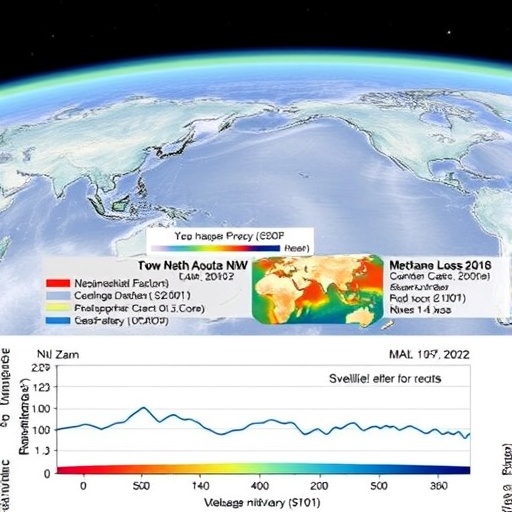
Methane stands out as a significantly potent greenhouse gas, known for its remarkable heat-trapping abilities which surpass those of the more prevalent carbon dioxide in the atmosphere. Although methane is present at lower levels compared to carbon dioxide, scientific assessments link approximately 30% of recent global warming trends directly to its increasing atmospheric concentrations. Understanding what drives the fluctuations and growth in methane levels is vital, yet the complexity of its sources and sinks continues to obscure the full picture of its environmental behavior.
One of the notable challenges in methane research lies in accurately determining its atmospheric lifetime and removal rates. Methane undergoes natural degradation over roughly a decade through various atmospheric and soil processes, with the stratosphere—the second layer of Earth’s atmosphere—playing a crucial role in its breakdown. However, quantifying this removal has been elusive, primarily because such processes are difficult to observe and measure directly. Historically, climate scientists have relied heavily on chemistry-climate models, which simulate methane destruction, but the reliability of these predictive methods has often been disputed due to their inherent assumptions and uncertainties.
A groundbreaking study conducted by researchers at the University of Washington has changed the landscape of methane removal research by employing satellite data, providing the first observationally based estimate of methane loss in the stratosphere. This innovative approach revealed that methane removal rates in this atmospheric layer are actually higher than what previous model-based studies suggested. The implications are profound, indicating that the natural cleansing of methane could be more efficient than anticipated, which in turn affects how we interpret atmospheric methane trends.
Qiang Fu, a leading atmospheric and climate scientist at the University of Washington and principal investigator of the study, highlights the importance of precision in methane budgeting. He explains that the large values representing methane sources and sinks are closely balanced, and the small net difference dictates whether atmospheric methane accumulates or declines over time. This fine balance hinges on an accurate understanding of methane removal rates, particularly in the under-explored stratosphere.
Human activities remain the dominant contributors to methane emissions globally. Sources such as agriculture, including livestock and rice paddies, waste management systems, and fossil fuel extraction and use, have dramatically increased methane releases. Natural emissions, primarily from wetlands and geological seepage, continue to feed methane into the atmosphere as well. Meanwhile, methane sinks, including oxidative processes in the soil and chemical reactions within both the troposphere and stratosphere, work continually to remove methane, but these sinks have been overwhelmed by growing emissions.
Methane degradation occurs primarily in the atmospheric regions closest to Earth’s surface, known as the troposphere, and the overlying stratosphere. The dynamic interplay between methane sources and sinks represents a delicate equilibrium. Anthropogenic influences have tipped this scale towards greater sources, leading to an accumulation of methane and subsequent intensification of its greenhouse effect. Since methane remains in the atmosphere for a relatively short period, roughly ten years, it presents a unique mitigation opportunity compared to more persistent greenhouse gases such as carbon dioxide.
One of the key reasons methane has become a favored target for climate change mitigation efforts is this comparatively short atmospheric lifetime. Unlike carbon dioxide, which can linger for centuries, the effects of reducing methane emissions can manifest more rapidly in atmospheric concentration declines and, consequently, near-term temperature stabilization. Governments and policymakers increasingly emphasize methane reduction strategies as a means to achieve swift climate benefits.
Determining methane’s atmospheric budget and understanding its trajectory relies on two contrasting methodologies. The top-down approach assesses methane directly from atmospheric measurements, capturing the real-time accumulation and loss rates. Conversely, the bottom-up approach aggregates estimates from all known emission sources and sinks based on ground-based and localized data. Historically, these two approaches have produced conflicting results, with bottom-up calculations suggesting source emissions exceed removal sinks by a wider margin than the top-down observational data indicates.
In the recent University of Washington study, Fu and his graduate student Cong Dong harnessed satellite observations from the period 2007 to 2010 to derive a more precise and observationally founded estimate of methane loss in the stratosphere. By replacing the previously uncertain model-derived removal rates with this empirical data in methane budget calculations, they achieved unprecedented alignment between the bottom-up and top-down approaches. This convergence marks a seminal advancement in atmospheric methane science, significantly boosting confidence in global methane cycle assessments.
This research does not just refine the methane budget; it unlocks insights into atmospheric chemistry processes interconnected with methane dynamics. For example, the breakdown of methane in the stratosphere generates water vapor, a further contributor to the greenhouse effect, and influences ozone chemistry that affects the integrity of the protective ozone layer. Through improved quantification of methane loss, scientists can better estimate these secondary effects, which have broad implications for climate modeling and understanding Earth’s atmospheric systems.
The enhanced accuracy in defining methane removal helps unify disparate measurement techniques and provides a crucial checkpoint for climate models. This advancement is especially critical because methane’s role in climate forcing can either accelerate or decelerate near-term warming trends depending on the balance of sources and sinks. The satellite-based approach enhances observational capabilities, offering a replicable methodology for future studies to monitor methane’s atmospheric fate in the face of evolving anthropogenic pressures.
As the climate change discourse evolves, mitigating methane emissions offers a vital lever for policymakers seeking immediate and effective strategies. By advancing understanding of where and how methane is removed from the atmosphere, this research informs more precise emission reduction targets and improves projections of future climate conditions. A deeper grasp of methane’s atmospheric journey also supports international efforts, such as the Global Methane Pledge, aimed at collectively reducing methane emissions worldwide.
In summary, the University of Washington’s landmark study, grounded in satellite data analysis, marks a pivotal step forward in resolving long-standing ambiguities in methane atmospheric science. The findings underscore the heightened role of the stratosphere in methane removal and bridge critical gaps between observational and modeled data. This synergy propels the atmospheric science community toward a more coherent and actionable understanding of methane’s influence on global climate, helping chart a course for impactful environmental policy decisions.
Cite Scienmag News
Russell Cooper. (February 9, 2026). UW Scientists Quantify Stratospheric Methane Loss Using Satellite Data. Scienmag. https://scienmag.com/uw-scientists-quantify-stratospheric-methane-loss-using-satellite-data/
Russell Cooper. "UW Scientists Quantify Stratospheric Methane Loss Using Satellite Data." Scienmag, 9 February 2026, https://scienmag.com/uw-scientists-quantify-stratospheric-methane-loss-using-satellite-data/. Accessed 5 September 2026.
Russell Cooper. "UW Scientists Quantify Stratospheric Methane Loss Using Satellite Data." Scienmag. February 9, 2026. https://scienmag.com/uw-scientists-quantify-stratospheric-methane-loss-using-satellite-data/


